The Best Woman for the Job

Now that I’m not in the classroom every day, I occasionally have breakfast with a group of retired band directors who live in Northern Michigan and meet monthly to reminisce about the good old days in public school music education. Here we are, in September. Notice anything?

cadillac breakfast.jpg

I’m guessing the gender ratio would be similar in any state, if you got retired school band teachers together.  Kind of looks like Congress did, in the 1970s, when I started teaching. Or graduation day at any law, engineering or medical school, back then. A man’s, man’s, etc. world.

I have a large collection of stories around being the only alto in a room full of tenors and basses, year after year. Some of them are funny (like my very first regional band directors’ association meeting, where I was offered the position of Secretary five minutes after introducing myself—and I took it). Some are terrible, heart-rending memories of being belittled, underestimated and ignored. Or worse.

The funny thing is, I didn’t set out to be a pioneer.

I wanted to teach instrumental music, for two simple reasons. One, playing music was my greatest joy in life. Nothing moved me and fulfilled me more than the challenge and the glory that came from making beautiful music.  That may sound like rhetorical overkill, but it’s true. I got hooked on gorgeous music early in life and wanted to turn it into my life’s work. I wanted to share that joy with kids—make their lives richer and more rewarding.

The second reason I became a band director is because I thought I’d be good at it.  I’d observed many instrumental conductors at all levels, played in lots of groups other than my school band—and knew something about what motivated me as a student musician. I had already worked hard to successfully master an instrument and was confident that I could learn the skills and knowledge necessary to become a school band teacher.

Of course, I knew that most band teachers were men. In fact, I’d never worked with or even met a woman director. My high school band instructor told me that he ‘didn’t believe in lady band directors’ and suggested I pursue elementary music education as a college major. The university I chose (like other universities at the time) did not permit women in the marching bandit took lawsuits to make that happen, around the country. Nobody was encouraging me or mentoring me.

Nevertheless, I persisted. It really wasn’t a dramatic personal quest to break a glass ceiling with my piccolo.  I just wanted to teach band.  It seemed like a fun and rewarding job. For anyone.

I went on job interviews where my fitness and stamina in directing a band were questioned. One principal I interviewed with told me he had no intention of hiring me—he just wanted to meet the girl who thought she could handle his HS band.  When I finally got a job, teaching middle school band, the principal who hired me had been on the job one day.  Maybe he didn’t know the rules about band directors? In any event, once I got a job, I was a band director for 30 years.

I’ve been thinking about this a great deal, as mid-term election outcomes have become clear. You’ve probably seen the photographic comparison of Republican vs. Democratic freshmen in the House of Representatives.  ‘Diversity on Stark Display’ says the headline—and it would be difficult to argue, in a representative democracy, that diversity isn’t the crucial ingredient in a fair and equitable decision-making body—or teaching staff, for that matter.

Senator Debbie Stabenow wrote a piece about how the top four offices on the ballot in Michigan were won by women. Not because they were women. But because they were the best person running for the job. The entire mid-term election was a festival of firsts, on the diversity front—and the outcomes were good.

Numbers, in all jobs and experiences once thought to be (usually white) men’s work, are leveling out. The visible trends are positive. And that—in politics, education and the world of work—is good. I’m grateful to every woman who carved or smoothed the pathway for those who came after her.

That doesn’t mean that subtle, deeply embedded sexism has gone away, though. It hasn’t.

It’s often understated and frequently not recognized by its perpetrators. Men relate differently to other men than they do women, in the workplace (and on line). Sometimes, our buried assumptions drive actions in ways we can’t predict. It’s complicated. I learned to work around bias toward women as band directors, but it never went away.

I’m not just making this up, by the way. There’s research.

Whenever I’ve written a blog about the lopsided gender relationships in education, I get a lot of negative feedback. There is lots of room for growth in the way we value who’s teaching second grade, and who’s writing the laws that govern education, however.

You have to be careful before leveling a charge of sexism. But the fact remains, sometimes the best woman for the job is passed over for someone whose qualifications are being louder and ‘bolder.

Yearbooks

I was editor of my high school yearbook. It was way more work than I anticipated when I took on the job–and because our yearbook wasn’t distributed until August, long after graduation and right before school started, the page proofs weren’t due until after school was out. Which meant I spent the first few weeks of summer slapping final edits on pages, in between shifts at a waterfront breakfast joint favored by 5:00 a.m. fishing enthusiasts and old men who wanted 14 ‘bottomless’ coffee refills and left quarter tips.

If I flirted with them, that is. And I needed every quarter, because I was going off to college–the first in my family–in three months.

As a doctoral student in Education Policy, many decades later, one of my ProSeminar assignments was choosing an educational artifact, analyzing and contrasting three diverse examples of that item, over time. Most of my colleagues chose prestigious, chart-laden reports from non-profits or the federal government on a single topic–mathematics education changes over time, say, or uses of standardized testing data.

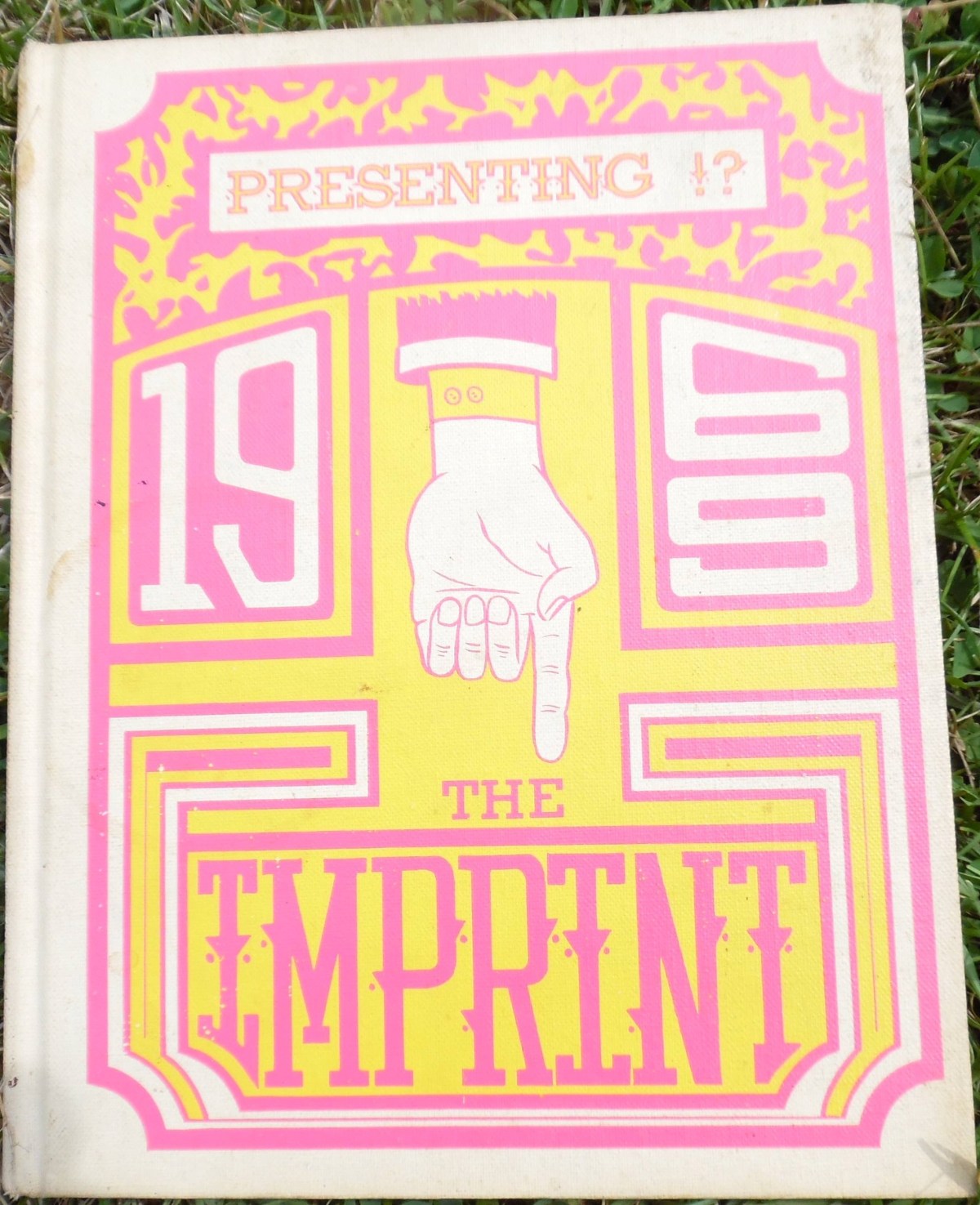
I chose yearbooks. I was in possession of my mother’s HS yearbook (Class of ’45), my own yearbook (Class of ’69) and my son’s yearbook (Class of 2006). And I knew something about how yearbooks were put together, whose voices and photos would predominate, and about how easy it was to sneak in juicy little personalized bits that seem uproarious at the time, but may have been overlooked by the faculty sponsor.

Besides the obvious surface features–color photos, fashion and 200 self-indulgent pages– there some distinct differences, over the 60+ years between the oldest and most recent yearbooks. You can tell a great deal about school climate and the socio-economic prospects of the students from a school yearbook, in addition to observing a revealing sketch of critical cultural issues in America at the time.

The ’45 yearbook was sparse, including headshots, nicknames and future plans of students, plus tiny pictures of faculty. There were a few group photos of clubs and events, but no sports teams, no Homecoming queen, no prom. Instead, there was a sober, black-bordered page of boys (and these were indeed boys) who had already lost their lives in WWII, and another page featuring service photos of classmates who had dropped out of HS to join the military. Girls outnumbered boys perhaps three to one in the class that was actually graduating in May.

All students were identified by their course of study–general, business, vocational, college prep.  Most boys in the graduating class were college prep, and my mother had written which branch of the service they entered, post-graduation. Next to one, she even wrote ‘4F.’ Even though both V-E and V-J Days were celebrated immediately after the graduation of this Class of ’45, my mother tracked, with her handy-dandy fountain pen, the classmates who enlisted anyway and went off, presumably to mop up, and those who returned to faithful girlfriends and G.E.D. diplomas.

Life seemed to be about growing up quickly and doing your duty. Kind of the original no-excuses curriculum and climate.

A mere 24 years later, the 1969 volume was infused with Essence of Baby Boomer, from the hippy-dippy cover to the e.e. cummings-like lack of capital letters in page titles and names. Classes had been de-tracked, and nobody was labeled by their scholastic prowess or future educational plans. There was an eight-page photo essay based on a Beatles tune, and lots and lots of sports pages. Other than cheerleading and synchronized swimming, these pages were boys-only features.

The original ESEA was passed in 1965, and four years later, because of the law, my previously all-white, blue collar high school had been integrated. Why? Because we had a newly built school with extra classrooms (unlike overcrowded, older school districts in the mid-1960s). We could house something new: a program for students who needed a ‘special education’ setting. A majority of the newly identified special ed students were black, and were bused from the city to the unzoned outer edge of town, where I lived, to a different school.

I remember asking a teacher about the new kids–who were mostly in self-contained classrooms in 1967-69, mingling with us only at lunch and in physical education–and she said our equalized tax base was low, and we got money for taking these students, money that was needed because we had a smaller revenue stream than other local districts.

It was my introduction to the general inadequacy and inequity of school finance, but I didn’t realize it at the time. I was operating on the ‘Be True to Your School’ model of pride and loyalty, rah rah, sis boom bah. It never occurred to me that, because I lived on the working-class side of town, my school got less money, and the budget had to stretch further. Or that the first kids in my county to be labeled ‘special ed’ were collected out of their home schools and went across town to a school that was underfunded.

My son’s yearbook is twice as thick as mine, and filled with color shots of graduates, plus a paragraph of personal in-jokes and reminiscing for each. There’s a lot more focus on events–casual shots from dances, parties, contests and games. The big difference in 2006 is girls. More girls in leadership roles, the exit of the Future Homemakers club, and an abundance of girls in sports. They’re everywhere.

There are forty pages in the back of the book–in the place where older yearbooks have ads from local businesses–filled with space purchased by parents to celebrate their graduates. These tributes often include a shot of the graduate as a toddler or kindergartener, plus some humble bragging about all the student’s achievements and college plans.

Buying more space in the yearbook to advertise (is that the right word?) your kid is pricey, but lots of parents seemed to see this as one of the embedded costs of having a high school graduate–nearly half the class participated, in quarter / half / full-page increments of parental praise. I’m not criticizing parents for feeling proud of their kids. I’m wondering about parents who absolutely can’t spare the money, feeling bad about their kid not getting a half-page accolade when they’ve worked hard and done well. Kind of puts a different spin on yearbooks, when they’re funded by the folks whose kids are the stars.

Brett Kavanaugh’s yearbook seems to come from a vastly different socio-economic context than any that I studied–but there are some of the same classic yearbook elements that tell us lots about who he is.

Primarily– the now well-known graduation photo with his smart-ass, ‘let’s see what I can get past the faculty advisor,’ guy-joke paragraph of memories. The ones about the Devil’s Triangle, the 100 Keg Club, the truly despicable shaming of a girl (Renate) from a nearby school and the rest of his little witticisms.

In 1982, I had been teaching for 10 years. I can tell you that a faculty advisor who let that stuff be printed was either asleep on the job or (more likely) simply reflecting the prevailing norms at Georgetown Prep, unworried about the boys being jerks because that kind of behavior was common.  Kavanaugh’s personal yearbook memories were similar to what other boys wrote–there were eight of them tormenting poor Renate. The yearbook caught the flavor of the culture around there in 1982. Preppies on the loose.

When Kavanaugh was asked, by Senator Patrick Leahy, about text from his yearbook, he sneered. Oh, he said–we’re gonna talk about my yearbook now?

It’s surprising what you can learn from a high school yearbook.