
You know how sometimes a headline will catch your eye and you’ll engage in a brief wrestling match with your intelligence and judgment: Is this clickbait? Is this AI? Could this, in any sense of the word, be real?
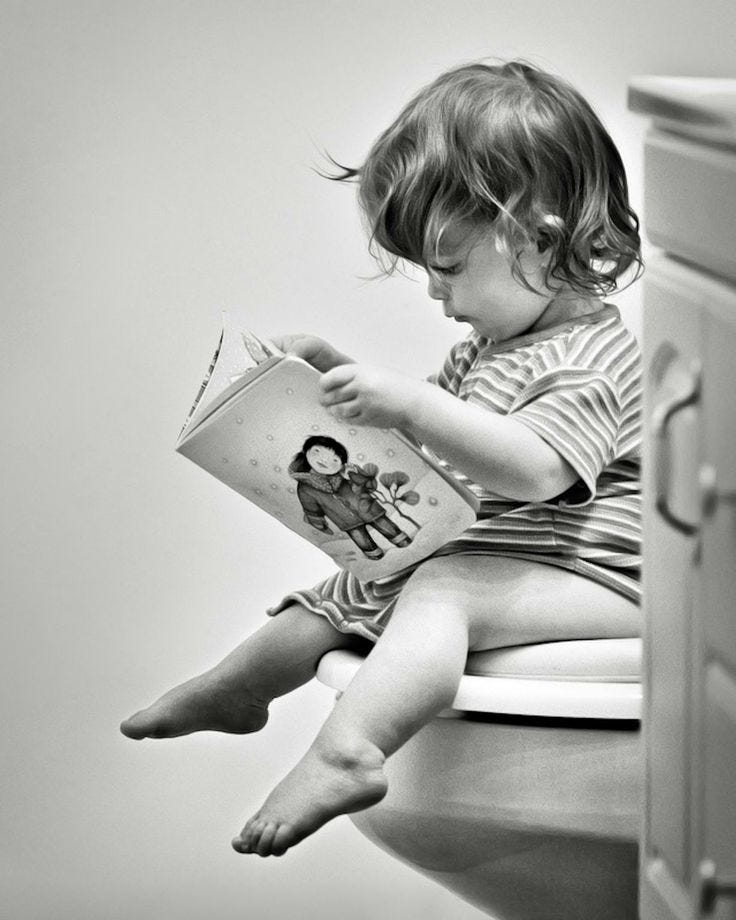
Here’s the headline that triggered that response in me: Who’s Responsible for Toilet Training? Schools or Families?
Here’s the gist, from an Education Week survey: Most [teacher] respondents agreed that, compared with two years ago, students are struggling more with basic skills and tasks—from following instructions to tying their own shoes and, in some instances, personal care, including toileting.
Mind you—we’re not talking about children with significant disabilities or the occasional kindergarten accident. We’re talking about the expectation that children will handle their own bathroom needs when they’re five years old vs. the prospect of teachers dealing with toilet assistance for 30 children, some of whom are still wearing pull-ups.
In addition, of course, to literacy, numeracy and putting on their snowsuits.
I have lots of teacher friends. Those in early childhood classrooms have been concerned about those basic skills and tasks for more than a few years now. They’re not calling it a learning recession—which is a stupid label—but they are noticing downward trends in the markers of independence that students bring to school. They’ve got stories.
Anne Lutz Fernandez, commenting on the “learning recession” designation in a new report gets this exactly right: Teachers and professors nationwide have been sounding the alarm for some time about the declines in student skills, knowledge, and behavior they’ve been seeing firsthand, much of which can’t be measured by standardized tests. But test scores are all that many political and educational leaders heed when it comes to school success.
I’m old enough to remember the rollout of No Child Left Behind—the dismay, once we realized that third grade would become the first year when children would be defined annually by their test scores. We were accustomed to standardized assessments—Michigan was giving the statewide MEAP test in 1970, in 4th, 7th and 10th grades—but it was easy to see that the general public would soon rely on test scores as the only reliable indicator of student progress.
It was also easy to see that those annual tests would begin to drive instruction, re-focus curriculum and put pressure on schools to raise scores. What we didn’t foresee, initially, was the long tail: statistical voodoo that calculated an individual teacher’s ‘value added,’ for example. Or closing down schools, often community centers in poor neighborhoods, with low test numbers. Or the pre-test pep assemblies, the frantic search for curricula that would boost scores, the third grade flunk rules. Not to mention the cheating.
What I find interesting in the “learning recession” talk is the approximate date that the test scores began going down: around 2013. Which would be the time when all K-12 students had experienced the Brave New World of NCLB and its subsequent federal incarnations.
Seniors graduating in 2013 would have taken all the standardized tests and experienced all the efforts to <cough> raise the data bar. From that point on, it should have been a steady upward climb. But no.
It was also, of course, just about the time 7th graders began asking for their own phones and one-to-one Chromebooks were district selling points. There is resistance to blaming sagging test scores on technology—when you spend a huge percentage of a district budget on tech hardware, software and training, it’s hard to admit you’ve been bamboozled.
Anne Lutz Fernandez, again: The problem with this phraseology [learning recession] is that it frames the crisis as one not of culture or human systems but one of business and economics. A key legacy of the accountability regime and its heavy reliance on standardized testing is the inability of politicians and pundits to see or discuss the work of schools in other terms.
Bingo. We might begin by admitting that test scores aren’t truth. And if test scores peaked and then diminished, it might have something to do with that fact. Nobody—including 3rd graders—wants to be defined by a number. When you’re old enough to understand that your test scores are more important to your school (and, perhaps, your teacher) than you, motivation for trying hard might diminish as well.
But that’s a cultural issue—like five year-olds who have not mastered toileting yet. If there is a recession, it touches many ordinary skills that are part of growing up and self-management, and it reflects on the world our youngest schoolchildren inhabit.
A culture fraught with disrespect, parental indifference to schools and learning, a lack of healthy play and human relationships. A country where AI memes serve as news, and political leaders lie and lie and lie. Where teaching is no longer defined as a profession.
If there is a learning recession, fixing it won’t happen by ratcheting up the stakes, once again. It calls for a new vision of which learning is important, and a new commitment to the children of this nation, as well as public education, which is—or used to be—America’s best idea.


So, why aren’t kids toilet trained?… I was able to be home to train my kids and being trained was part of going to nursery school at three (or at least mostly trained). Now, more and more parents are working full time and putting babies in daycare after too short parental leaves. What are we blaming for all these preschool types of skills?
LikeLiked by 1 person
Your questions were my questions. The EdWeek piece (which tried to take a ‘fair and balanced’ approach, on a topic that seemed pretty one-sided to me) noted that most children in the 1950s were toilet trained shortly after age 2, but 50 years later, it was closer to age 3.
Again– these are garden-variety kids, not special needs toddlers, where delayed toilet training makes sense. The fact remains: the age at which kids are independent in handling toilet needs is rising, and the first encounter with schooling now happens when kids are younger. I was fascinated by superintendents saying that of course, teachers would handle late bloomers. NO! Not the teacher’s job.
My own children (born in the 80s) would not have been allowed into our school district’s pre-K when they were not trained. I have known families where kids were (politely, kindly) advised to keep 3-year olds home until toilet skills were secure. Let it be an incentive– you can go to school when you can go potty like a big boy. Whatever.
Mothers who work and don’t have time for the at-home process of training might be a factor. Universal child care, readily available and affordable in other countries, is expensive and unreliable here. And I have empathy for working moms who prefer to read books to kids in pull-ups, rather than hauling out the cheerios and charts and rewards and whatever it takes to successfully train their kiddos. I get it, I do.
What I don’t get is assuming that schools (including pre-schools) should have to take that chore on as well. Many of my friends keep extra pants in all sizes at school, for their students who have an accident. You can be compassionate and practical about this issue– but it’s not a job for a teacher.
LikeLike
I can’t help but wonder about the preschool pressure placed on children, early learning, and, I’m guessing, potty training. As a parent, I found that some parents can get pretty obsessed with early potty training.
I remember with my own child that when I quit worrying about it, they walked out of their room one evening after going to bed, dropped the nighttime Huggies on the floor, and said, “DONE!” And that was that.
LikeLiked by 1 person
I had an identical thought (and a similar experience with one of my kids). Kids perceive so many things that they can’t articulate– You want me to use the potty? What will happen if I decide not to? Parents who are dying to get their kids off to preschool but can’t because a child refuses to be potty trained– I can see why that might happen.
What I don’t understand is the idea that teachers should add toileting assistance to the important cognitive and social work they’re already expected to do.
Thanks for the comment.
LikeLike
[…] Most people, including ed policy experts, university educators and teachers who have not experienced certification do not fully understand the National Board process (although many think they do). It’s difficult to explain, especially to educators and researchers whose entire careers have been shadowed by our national love affair with standardized testing. […]
LikeLike