I am a volunteer in a homegrown program to support middle and high school students in my (small, rural) county. Entitled LIFT—Leelanau Investing for Teens—it’s a program designed to give middle school and HS kids something valuable: a safe (free) place to hang out, stuff to do and friends to talk to, in the long and sometimes empty hours after school.
I was attracted to this idea because my own band room was frequently a place for secondary band students to hang out after school, jamming on the drum set and spreading snack detritus all over the floor. I quickly recognized the idea that elementary children need childcare after school, but 6th graders are fine on their own was baloney. Maybe even dangerous baloney. A safe, supervised place to go could, in the long run, be a life saver for young teens.
I generally volunteer on Wednesdays, which is Homework Day. Kids with missing assignments can drop by for help in getting them completed. I’m one of the few volunteers who isn’t intimidated by MS math, having taught it for two years. HS students can also get community service hours (20 required, in my district) by volunteering to help the MS kids with their homework—and MS students definitely prefer working with HS kids. You’re role models, we tell the HS students. And they like that.
All good. A program that started in one school has expanded to all four public schools in the county. Entirely funded by grants and donations, there are paid coordinators in every school, and a host of adult volunteers like me who show up as evidence that we care about teenagers in our community.
I was thinking about LIFT when I read Peter Greene’s piece, How You Made Them Feel. He makes a salient point: it’s not a teacher’s job to make kids feel good—it’s our job to make them learn something. If they feel good about that genuine accomplishment, great—and if a teacher keeps pushing and handholding and (jargon alert!) scaffolding to get them there, also great. But we’re not responsible for their self-esteem, beyond what new skills and being part of a learning community yield.
If we’re encouraging anything at LIFT, it’s being part of a community—the LIFT program at my school lets kids check their phones after school (which restricts phone use during the academic day), for a half hour. Then—programming begins and phones are stowed until pickup time. What I have been noticing is that, more and more, kids prefer to chat—IRL, person to person—during that first half hour. Snacks are also free and readily available, often donated by community members. Kids loaf on the donated couches and beanbags, to decompress and make jokes. It’s pretty much perfect, when you’re 13.
I’ve been volunteering in this program for two school years (and one summer). We have not had disciplinary issues, beyond horseplay and the occasional rude remark, which are par for the course with middle schoolers (and addressed by volunteers, who are trained). According to EdWeek, student misbehavior tops the list of things—a long list—that are currently stressing teachers out.
Misbehavior tops educators’ stressors:
‘For novice and veteran teachers alike, student misbehavior is the most common cause of stress, according to new RAND Corp. data. More teachers consider behavior management among their top three stressors than any other aspect of the workplace.’
Maybe it’s just this particular school but speaking as a person with decades of experience in disruptive student misconduct, the two and a half hours of LIFT go by swiftly and smoothly, whether there is a craft to make, a game of Uno, a movie to watch, a bike ride or catching up on homework.
I know, in my gut, that it’s good work, a lifeline for kids who need activities and peers. When one of our LIFT kids tells us they won’t be coming for a while, because they got a part in the play or decided to go out for softball, it feels like a victory.
As a retired teacher, it’s also a good way to use my own skills. I think, all the time, about retired teachers and how they can support public schools in substantive ways.
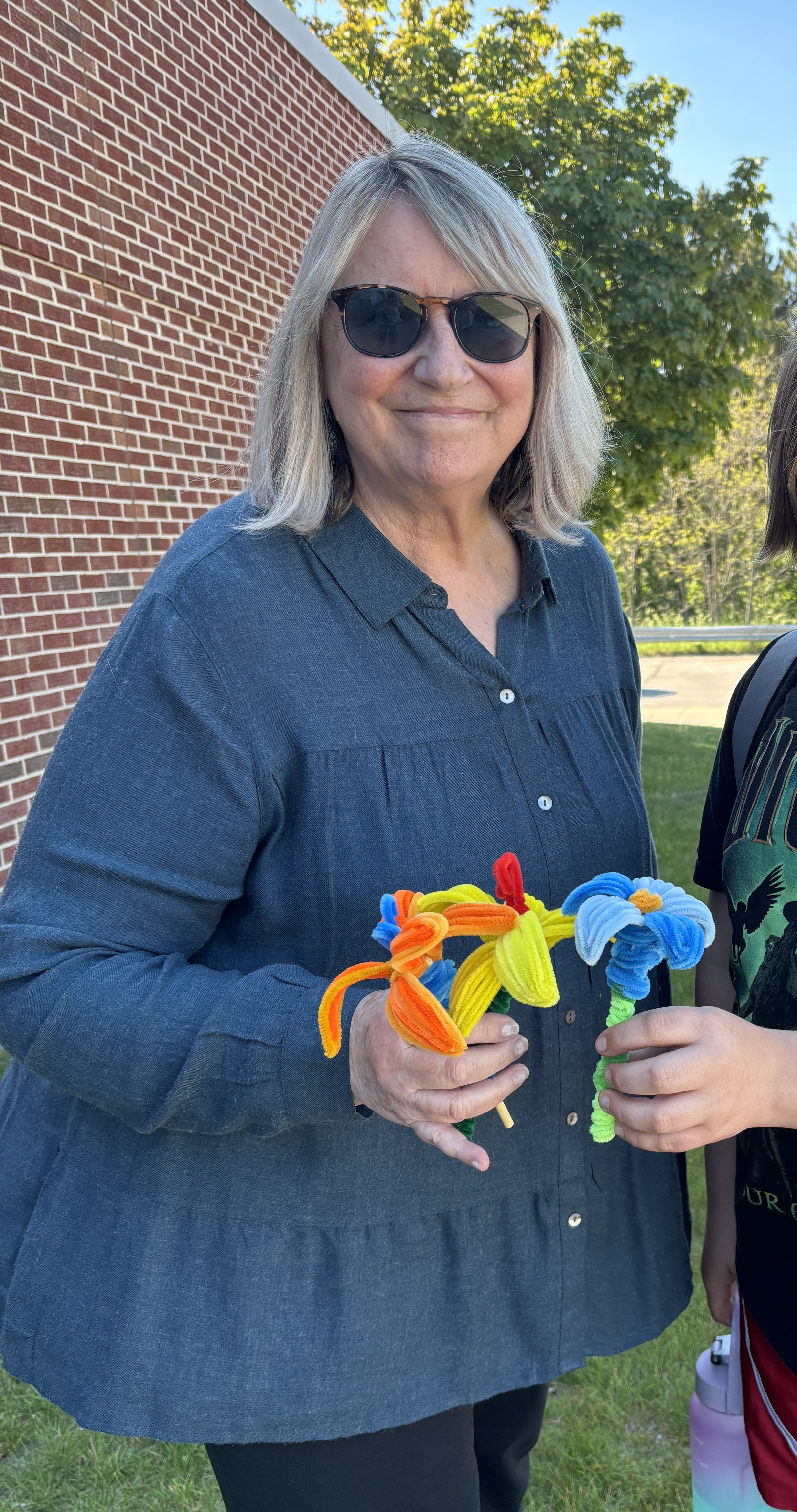
On my last day of volunteering this year, the craft for the day was making pipe-cleaner flowers. You might think this activity would not appeal to jaded middle schoolers, especially boys. You would be wrong. Turns out that making stuff is fun, and an avenue for wacky creativity.
We spent 90 minutes bending pipe cleaners, directed by three super-cute HS girls who exemplified role modeling and laughed with their pupils when things fell apart. I had to clip a LIFT kid out of the photo below, per privacy rules, but trust me—they were having a blast.
Such a simple idea. Such good work.