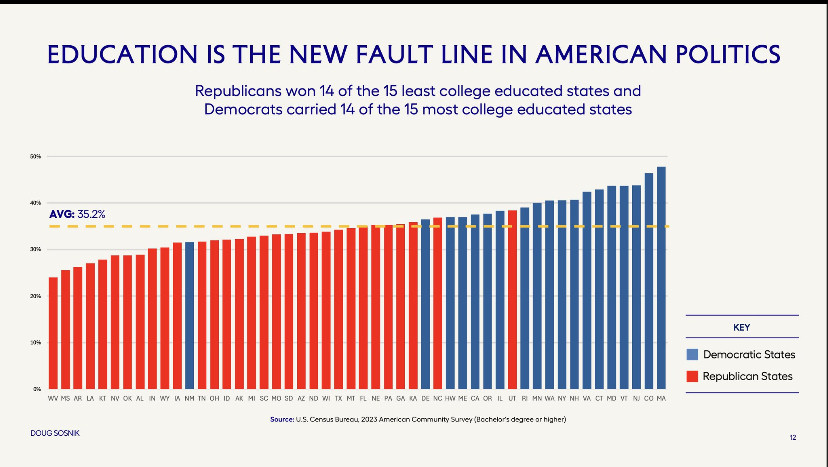
I’ve spent a lot of time considering this graphic.
IS education the fault line in American politics?
First shock: There are 33 states with more-educated people than (purple) Michigan, where there are world-class colleges and universities. What makes us an under-achiever?
2nd: Consider Trump’s mouth-blabber remark: “I love the poorly educated.” As well he should. They’re his base.
Digging deeper– what makes someone with a college degree more likely to vote Democratic? Does a college education make someone more broad-minded, more aware of the social and political factors influencing their well-being? Or is this all just about economics– being able to afford a college degree?
And personally–something I have been wrestling with since 2016–is there something I could have done, as a teacher, to model that broad-mindedness to my students?
It feels weird to be opining about professional development when teachers in Minnesota are dealing with the effects of mayhem in the street, poisoning the normal ebb and flow of public schooling.
Coincidentally, it was a group of dynamic teachers in the Twin Cities area who first showed me what it really could look like to be in charge of their own professional learning. More on that later.
First, let me say the obvious. Teachers actually are, and always will be, in charge of whatever they decide they need to improve their teaching. For some, it will be a career-long quest to learn and try new things, building a practice with what works best. Others might be less enthused about the latest mandated program. You can lead a teacher to PD, but you can’t make them believe it’s useful.
This is an evergreen issue, of course. My district dabbled in a ‘choose your own PD’ model for a few years, giving teachers the choice to work in their own rooms or attend planned presentations. The lure of hours of uninterrupted time to plan lessons, run copies, review new materials, catch up on grading or chat with a partner teacher was irresistible.
Going home without a tote bag full of work? Priceless. But when only a handful of people showed up for the paid presenter? Embarrassing for the administrator who did the hiring. I say this having been one of those presenters once, setting up for 35 attendees and then having only four show up for a half-day workshop on National Board Certification.
In fact, it was a group of National Board Certified Teachers from a public high school in Minneapolis who proved to me that teacher-led professional development could be incredibly exciting and precisely targeted to the work of teaching specific students.
The name of the HS is not important—but it was a school with a high percentage of immigrant students, so there were ESL issues and poverty issues and old-building facility issues. Sometimes the assigned curricula just did not work for the students they had.
A progressive principal bought into the idea of genuine teacher leadership and re-arranged the classic HS schedule so that he was teaching classes daily, opening up time for teachers to take on traditional administrative tasks. Like professional development.
Teachers surveyed their colleagues—What do you need to know to teach your students well? What issues do you want to talk about?—and set up weekly brown-bag lunch chats and after-school gatherings at a local restaurant, with snacks paid by the school budget. There was intensive mentoring for new teachers and regular time set aside for teachers to tweak curriculum, as they were teaching it. Peer observations and conversations were built into daily practice.
A lot of what they were doing was around the use of time, shaving it off here and adding it there—only an experienced teacher can understand the difference adding 20 minutes to lunch makes, where some of the best professional development happens spontaneously.
The most impressive thing was not that teachers were ‘in charge of their own PD’—but that teachers were collaborating to build professional learning and conversations that made sense to them, on the fly.
The first question from the audience (of teachers): Did everyone in your building buy into this new, ongoing PD model? Answer: No. A couple left the building for what they saw as greener pastures. But several skeptics stayed and eventually became converts. And now, they said, when we hire, we let new teachers know they will be surrounded by support in that first year. It’s who we are—a team.
We didn’t start this fire. But teachers—beaten down and dissed by our own government—will have a role to play in rebuilding the idea of representative democracy. Right now, that’s our best hope.
Their music and media tell them individualism will pull them out of squalor. The people behind those messages shove the economic ladders from underneath them. (Jose Vilson)
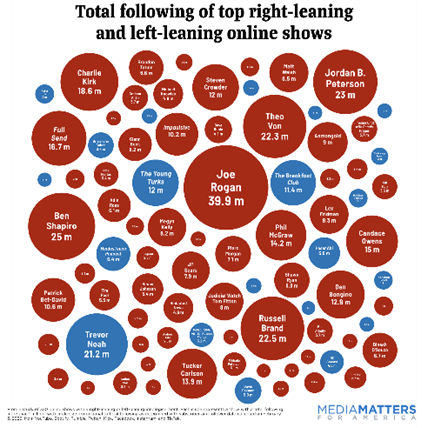
One of the most stunning bits of clarifying data I’ve seen in the past few weeks is this chart from Media Matters, with data from February 2025:
It’s a graphic of most listened-to online news and commentary shows, color-coded and sized to represent the magnitude and political leanings of the American audience. It’s year-old data, remember—but it goes some way toward answering the question I’ve spent the past year obsessing over: Who ARE these people and how could they have re-elected the corrupt man who led the insurrection against their pretty-good government?
I’m old enough to remember 2008, when Barack Obama’s online media savvy and fund-raising prowess was attracting voters and the envy of the other party, stuck in Walter-Cronkite land. Kids who were primary consumers of social media then, are in their 30s now, and apparently have shifted to eating up Joe Rogan, Ben Shapiro and Nick Fuentes.
But what are kids listening to in 2026? I think the JLV, in two sentences, above, sums up what I’m thinking: They’re young. They’re being bamboozled by glitzy media and music, convinced that their own swagger will save them. And then it doesn’t. In fact, they’re a generation that almost certainly will experience less prosperity and fewer prospects than their parents’ generation.
I volunteer in an after-school program for middle-schoolers, usually on afternoons dedicated to homework (or missing assignments). It’s no secret to any teacher that a lot of incomplete and missing work happens because the students don’t know how to do it. They will finally tell you—I don’t get this—after making excuses and going to their locker or the bathroom three times. This happens a lot with math, but also with conventional Q & A, end-of-chapter reviews and short writing assignments.
Our kids have their own Chromebooks and most of the teachers provide several vetted information sources beyond the textbook, which is great. But only if students go there, and wade around. Unfortunately, chatbots have now given them a get-out-of-jail quick option.
These students are—I emphasize—not dumb (or any similar but less insulting word). After homework is completed, we often play board games or cards. They understand and can negotiate things that the games require—similes and other wordplay, strategy and logic, memory. Some are also readers (passing around personally owned books that I never ask to see). There are conversations full of humor and current music and YouTube video references.
But at age twelve or so—where are they getting their information about the world at large? On the day after the 2024 election, our coordinator stopped by to remind volunteers NOT to speak about the election. Not that any of the kids mentioned it. It was as if it hadn’t happened.
If we can’t count on legacy media, who’s going to sort through those red and blue bubbles of independent media? It’s going to take more than hope and good will to teach kids to be critical consumers of media and music, to discern the difference between glittering generalities and sometimes unpleasant truth.
Of course, teachers are proscribed from sharing their opinions on the best sources of accurate and unbiased information, lest they be labeled DEI or woke. Makes you wonder how the public opinion on DEI and woke, two ideas that were once debatable if not accepted, solidified into broadly understood negative concepts. Where did that “information” come from?
Because I hang out with middle schoolers on the regular, I don’t think it’s too late to take a stand for discretion around the truthfulness of media sources. But simply letting the red bubbles win is a mistake.
“A generation raised under the [moral tone set by FDR] went on to build the modern middle class, defeat fascism, and help construct a postwar world that valued democracy, human rights, and shared prosperity.
Contrast that with the bigoted, hateful, revenge-filled claptrap children have heard for the past decade from the emotionally stunted psychopath currently occupying the White House.” Thom Hartmann
My goal in blogging—something I’ve been doing for almost 25 years—has always been to write about what it’s like to be a teacher in the United States. I wanted to focus on teacher leadership, to write about the ‘inconsistencies and inspirations, the incomprehensible, immoral and imaginative, in American education.’
Because—back in 2001, when I got my first paid gig writing on the internet (there were unpaid local newspaper columns before that), there were many inspiring things to write about, from my own experience as a classroom teacher. There were also important questions about instruction, thorny policy issues and curricular problems to solve, but it really felt as if public school educators were on the same page—valuing democracy, human rights, shared prosperity, as Thom Hartmann says.
You could see a turning point coming. Topics from my December 28, 2016 “best blogs” review when I was writing for Education Week:Charters aren’t the answer. Women are disrespected even in a field where they’re a huge majority. We still don’t know what “teacher leadership” looks like—or might accomplish. Standards may shape practice, but they don’t automatically raise achievement. Competition and marketing aren’t the answer, either. And the future of public education is in serious jeopardy.
Going through the blogs I wrote this year was an exercise in dismay. Although I had many rewarding experiences volunteering in schools, in 2025, pulling the camera back to see where we’re going in pubic education is – no other word—monumentally depressing.
Here are 10 blogs from 2025 that I think represent our current trajectory, such as it is. Wish I could offer readers better news:
Speaking as a person who has spent decades working in public schools and with public school teachers across the country, schools are generally among the most conventional and cautious institutions on the planet, subject to pressures and opinions from a wide range of (often clueless) critics. And likely headed by someone who adamantly does not want to get phone calls from honked-off parents.
If we were to sit down together over a cup of coffee, I could tell you dozens of stories from my teaching career that illustrate both moral clarity in my classroom, as well as times when I absolutely failed at establishing a trusting, collaborative ecology. It’s probably enough to say that I got way better at it, over 30+ years.
Why would we abandon public schools’ infrastructure and experienced personnel? Crushing public education is not policy—it’s vandalism. It makes no sense.
Maybe the question is not: Is Public Education Over? Maybe the question is: What’s worth saving in public education?
Times do change. People do change. And I would assert that changing people for the better happens in good schools, every day. Not all classrooms, not all playgrounds, not all teachers—but public schooling is an overall force for good, for a better, healthier nation.
Actually, if you’re taking away (via federally approved punishments and reduced funding) inclusion, equity and diversity, what you’ve got left is exclusion of non-preferred students, discriminatory distribution of resources, and separation of student groups based on physical characteristics. In other words, Arkansas in 1957. What happens when a latter-day Orval Faubus emerges?
While it’s important for boys to have personal agency in their learning, and be trusted by their teachers, boys need to have role models, as well. Who are we offering up as heroes, men whose lives and actions are worthy and admirable? Men worth emulating, who care for their spouses and children, men whose values serve as guardrails, men who are civically engaged?
When I first heard about Elon Musk’s email blast to over two million federal employees directing them to submit approximately five bullet points of what they accomplished in the previous week, I was reminded of a couple of school administrators from my past.
Eugene Robinson called Musk’s scheme “an exercise in contempt”—also a great description of some of the so-called professional development teachers routinely endure. When a principal doesn’t trust their professional staff to know what they’d like to do with time available for their own learning or planning, you end up with meaningless exercises like “five things I did last week.”
Ultimately, it’s about control.
Who’s in Favor of Authoritarianism? For the current administration, bent on “saving” federal dollars for their own preferences, breaking up this monolith will be a giant display of power that impacts some 50 million students and their families. Think you’re in charge of your local school, your classroom? Think again. Easy peasy.
No, the federal government–and supporting Republicans and conservative courts–say. No, we don’t want your media literacy classes. No, we don’t want kids nosing around in issues like fairness and equity in our recent history. No speaking Spanish. No arts classes or events to help students make sense of the world they live in. No vaccines to protect them, or accurate health information.
The world of education research is replete with studies that feel… unnecessary to folks who have spent their careers in front of K-12 classrooms. Primarily because so much good research is ignored in practice, and so much bad research becomes conventional wisdom.
There are lots of reasons why education research is suspect—or products are published to great fanfare, then sink like an oversized silver bullet: An analysis of 30 years of educational research by scholars at Johns Hopkins University found that when a maker of an educational intervention conducted its own research or paid someone to do the research, the results commonly showed greater benefits for students than when the research was independent. On average, the developer research showed benefits — usually improvements in test scores — that were 70 percent greater than what independent studies found.
Hmmm. I’d put my money on teacher perspectives about instructional strategies and materials, especially if teachers were in charge of their own professional work and offered ongoing opportunities to assess worthy curricula and teaching techniques.
(Dangerous but brave) subheading: The findings stand in contrast to conservative rhetoric about ‘indoctrination’ in the social studies. And surprise! The polls themselves were conducted by EdChoice, a nonprofit advocacy organization supporting school choice, and the Morning Consult Public Opinion Tracker.
‘More than 80% of K-12 teachers thought it was “very” or “extremely” important to teach students about the Constitution’s core values, and 62% found it similarly crucial to teach that America is a fundamentally good country. In both cases, teachers were more likely than parents or the public at large to favor teaching these concepts.’
Least surprising education research result, ever. Kind of shoots holes in the ‘teachers practice leftist brainwashing’ theory that the privatizers and public school vandals keep advancing. The study showed that 57 percent of parents thought schools should overtly teach patriotism and loyalty to the United State—the exact same percentage as teachers.
There’s more: ‘Both Democratic and Republican teachers were less likely than similarly affiliated members of the public to think it important to teach students to question government actions and policies.’
Again—totally predictable. Schools are inherently moderate and cautious, politically. Your teenager is far more likely to become radicalized—in either direction—via their online presence. Online—where there isn’t a caring and educated adult moderating the decontextualized content they are reading.
It represented a sentiment I hear all the time: I can’t believe there are people who think Trump is the second coming. Who in their right mind could see him as a transformative leader? Who does not perceive the grifting, the rank incompetence, the prejudice, the lies—and the danger to a functioning democracy?
Yeah—I know. You read this stuff, too—eye-popping, outrageous stories—and ask the same questions.
Maybe you’re wondering if teachers—underpaid and overworked—could have done more to establish the habit of questioning authority, discerning which evidence and rhetoric are reliable. Examining biases, looking at turning points in history, and so on.
‘Some large portion of voters do not appear to understand elementary, objective aspects of reality.We have jobs and lives, too. If we can understand reality, then they should be able to as well.
It does seem as though the last Democratic administration focused like a laser on economic issues. It managed the economy well, avoiding a recession and achieving a soft landing. It passed major, bipartisan legislation around Kitchen Table Issues like infrastructure spending. It kept the economy strong, with historically low unemployment and real-wage growth. It did not try to ban assault weapons but instead passed a gun-reform bill so sensible that it received bipartisan support. It successfully negotiated the most hawkish immigration reform bill in American history, only to have it sabotaged at the last minute by Donald Trump. These are actual things that happened in the real world over the course of 48 months.
Yet somehow all of this activity was invisible to voters? While these same people were highly attuned to the number of times LGBTQ appeared in the Democratic platform?
Which is it? Are the voters oblivious? Or are they discerning? Or does it depend on the situation: Willfully blind to some facts, but hyper-attuned to others?
Another theory is that voters are largely incapable of discerning reality, so expressed policy preferences matter much less than atmospherics and vibes. This theory holds that voters will respond more to entertainment or projections of strength than to a policy-based focus on the Real Issues.’
So. Here’s the real nub. If a third of American voters can’t tell fact from ugly fiction, or actually prefer to be governed by racists,quacks and the mentally diminished, if they are Republicans, what are we to do? Is this a permanent shift in American politics? Or are there ways to rebuild trust in our neighbors, our institutions, our national pride?
‘The writer had already lost his home, his livelihood, and most of his family. Rumors were spreading that deportations east meant death, and he wrote “We hear that being deported East means they are going to kill us, but there’s just no way the Germans would do that.”’
Lately, I have tried to focus on ways to reconnect with those who might regret their vote, or whose habitual partisan roots might finally seem like a bad habit. People who are becoming increasingly alarmed at seeing Bad Things happen, even though they remain safe and unharmed. Two thoughts:
‘This is the Ditch Principle: Your ditch neighbor may disagree with you about everything except keeping the water running — so you start there. The neighbor who might pull you out of a snowbank doesn’t stop being your neighbor when you disagree about politics. Rural communities practice interdependence because isolation kills.’
‘How has Mamdani, an unapologetic socialist—and progressive Muslim and advocate for Palestinian rights—pulled off the feat of likely winning against the odds, against the tide, and against all early predictions? In part, I think, by calling forth the best from voters, rather than kowtowing to existing polling data.’
As a veteran educator, I hate saying this—but I don’t think this is something learned in required coursework, no matter how great your Civics curriculum is. Schools are a kind of stage, where society plays out its biases and beliefs, bad and good. Incorporating content standards into becoming a more responsible and caring human is something that can be modeled—but not tested and ranked.
There is no class syllabus that prescribes pulling your neighbor out of a snowbank—but if your dad pulls over on a snowy day to get a speeding classmate out of the ditch, you’ve learned an important lesson in interdependence. Likewise, there are teachers who call forth the best from students, by integrating facts and skills with compassion and curiosity.
I wish I had answers for these questions. What do YOU think?
My introduction to Diane Ravitch: I can’t remember precisely which education conference it was, but I was in graduate school, so it was between 2005 and 2010. Ravitch had just begun writing her Bridging Differences blog with Deborah Meier at Education Week, a sort of point-counterpoint exercise. I had also just read her book The Language Policefor a grad class, and—although she’d always been perceived as a right-wing critic of public education—found myself agreeing with some of her arguments.
She was on a panel at a conference session. I can’t remember the assigned topic, but after the presentation was opened up to questions, they were all directed to her. And she kept saying smart things about NCLB and testing and even unions. Finally, a gentleman got up to the microphone and said: Who ARE you—and what have you done with Diane Ravitch? The room exploded in laughter. Ravitch included.
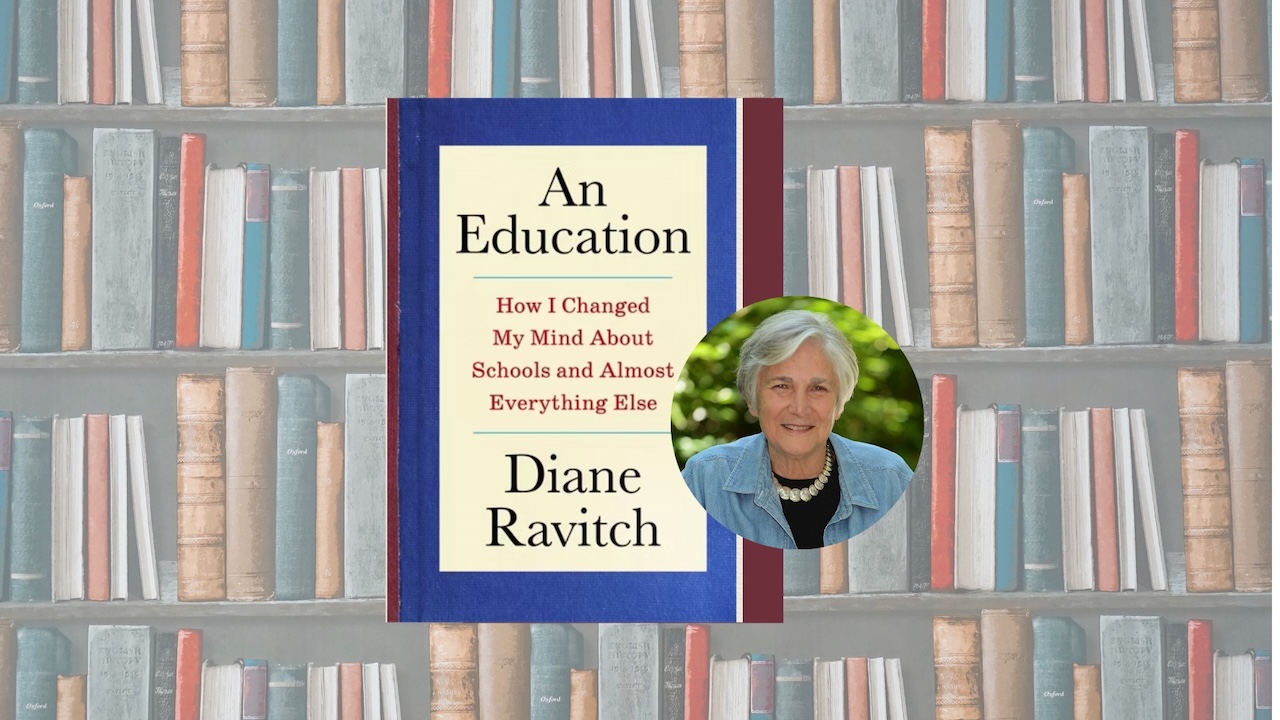
And now, at age 87, she’s written a kind of expanded autobiography, An Education: How I Changed my Mind about Schools and Almost Everything Else. She tells us how her vast experience with education policy, across partisan and ideological lines, has left her with a well-honed set of ideas about how to build good schools and serve students well. How, in fact, to save public education, if we have the will to do so.
You get the sense, as Diane Ravitch wraps up “An Education,” that she is indeed wrapping up– she sees this as her last opportunity to get it all out there: Her early life. How she found happiness. Mistakes and regrets, and triumphs. It’s a very satisfying read, putting her life’s work in context.
For her followers and admirers (count me in), the book explains everything about her beliefs. Her working-to-middle-class roots and her family’s loyalty to FDR and what the Democrats stood for, during post-World War II America, go a long way to explaining how she eventually (with some major diversions) became an articulate proponent of public education.
I’m glad she included a nostalgic portrait of growing up in TX with a hard-working mother and feckless (and worse) father. The glimpses we get into public education in TX in the post-war years resonated with me–and it’s easy to see how going far away to an Ivy League college shaped her entire adulthood. Her classmates at Wellesley, like Ravitch, were ambitious and curious; I’m old enough to remember a time when female ambition was suspect.
The most fascinating part of the book, for me, was the middle third, where she wrote about researching the history of public education and being asked to sit on prestigious boards and serve as Assistant Secretary in the George H. W. Bush Department of Education. There’s a whole chapter on Famous Education Opinion Leaders (many of whom are still working to suppress full public education) taking Diane to lunch, tapping into her work ethic and offering her opportunities to be part of the power structure, to write and speak (and—big point—learn what they’re really up to).
N.B.: Award-winning teachers are also often asked to become part of the education establishment by sitting on boards, writing op-eds, and serving on task forces– and it can be easy to feel as if you’re contributing, at a higher level, when what you are actually doing is giving credence to people who have a very different, but hidden, agenda.
The final third of the book is the Diane Ravitch most educators know and respect. Her observations come from swimming in the ocean of education policy for decades– and they’re accurate. I expect Ravitch to continue to blog and write and speak, as long as she is able. She is the rare voice in education that has examined education ideas across the spectrum and found many popular notions weak or dangerous.
The book is a fine testament to a life spent searching for the truth about public education.
We need to make sure our coverage is rooted in enduring principles and values. We need to make sure we don’t “both sides” the issues when it comes to objective truths. We need to speak and deliver news with moral clarity. (Ben Meiselas)
I would imagine that most sentient people—red- or blue-leaning—would agree with Meiselas, an activist attorney and founder of Meidas Touch news network. To be more specific—most teachers would acknowledge that there are objective truths, common values upon which we have built our most enduring institutions, including public schools.
Anyone who’s spent considerable time in front of a classroom knows that dispensing assigned content is only a small fraction of the job. The easiest part, in fact. It’s much harder to get students to care about that content and agree to practice useful skills that will serve them well as adults.
In addition, classrooms serve as involuntary communities, places where kids will spend somewhere between 180 and 1000 hours together over the course of a school year. And functional communities have common values.
Any teacher who’s ever posted her list of classroom rules (or, God forbid, the Ten Commandments) and then been surprised when her students blithely ignore them, understands this principle. It takes time to establish what you might call moral clarity in a classroom.
How do you build a classroom community with common values? Some teachers initially rely on threats, fear and punishments to get what they want: compliance. Sound familiar?
Threats and fear will work on some kids, especially younger ones, for a time. But they don’t establish trust or a genuine sense of belonging, two enduring values in a classroom where everyone feels safe enough to learn (or disagree—or even act out).
‘In the fantasy of civility, if we are polite about our disagreements, we are practicing politics the right way. If we are polite when we express bigotry, we are performing respectability for people whom we do not actually respect and who, in return, do not respect us. The performance is the only thing that matters.’
I like Gay’s word choice: respect. Classroom interactions built on respect will, over time, build communal trust, but only if the respect goes three ways: teacher to students, students to teacher, and students to students. Which means that every day, every lesson, is fraught with opportunities to build a functioning community that can actually absorb content, discuss Big Ideas and build skills.
Or tear it all down with a false remark, impulsive action or empty threat. Roxana Gay is right—if you don’t respect your students and what they bring to the table, don’t expect them to respect you or follow your rules, let alone learn what they’re supposed to be learning in your classroom.
What are the hallmarks of moral clarity in a public school classroom?
Mutual respect
Truth telling—kids are excellent lie detectors.
Purpose—Every teacher should be prepared to answer questions about why we’re doing this, and how it will be useful in the future. And that answer should never be “because it’s on the standardized test.”
Modeling behaviors that reflect intellectual curiosity, humility and forgiveness.
That last one? Admitting you don’t know everything and apologizing when you have wronged a student? Very humbling—and very important. I remember standing on the podium in front of 60 middle schoolers and apologizing for losing my temper the previous day and verbally castigating a couple of boys in the back row. I’m sorry, I said. This performance means a lot to me, but that’s no reason to jump all over somebody. I apologize.
There were several beats of shocked silence. I picked up my baton. And we proceeded to have an excellent, focused rehearsal. And after class, the two boys apologized to me.
Modeling.
In fact, if we were to sit down together over a cup of coffee, I could tell you dozens of stories from my teaching career that illustrate both moral clarity in my classroom, as well as times when I absolutely failed at establishing a trusting, collaborative ecology. It’s probably enough to say that I got way better at it, over 30+ years.
Moral clarity has been on my mind lately, as the country’s 250th birthday approaches, and the Department of Education launches its America 250 Civics Coalition with about 40 national and state organizations, including many conservative and religious groups, that will create curriculum for K-12 and university students in civics education.
If there ever were a subject that requires moral clarity, truth-telling and purpose, it would be the study of our nation’s history, government and values.
The mainstream media has been full of the bad news: new study shows that reading for pleasure has declined! Fewer people are reading for fun: From 2003 to 2023, the share of Americans who read for pleasure fell 40 percent, a sharp decline that is part of a continuing downward trend.
It’s easy to feel depressed about declining—what? literacy? —in the American citizenry. Just one more piece of evidence that schools are failing, blah, blah—nobody reads anymore!
But Anne Helen Peterson, in her substack, Culture Study, has a great piece dissecting the study that these scary headlines are based on. Maybe we’re not reading less; in fact, we may be taking in much more information and storytelling via means other than books.
Peterson posits six interesting theories about the way the study’s questions were framed and interpreted, and why we may need to re-evaluate what it means to be fully literate. She’s also a big-time book-reading enthusiast—not someone who sees the death of book-reading as inevitable in a digital world. Reading for pleasure is worth preserving, for all citizens. It broadens perspectives, makes us more interesting.
I immediately felt better after reading the piece. People aren’t reading less, necessarily; they’re reading differently. But I keep thinking about this story, told to me by a veteran teacher:
She started her career teaching in an elementary school, with reading blocks every day. She went back, as teachers sometimes do, to get a master’s degree in media and library science, then moved to a position in a middle school. A big part of her job there was managing young teenagers’ quests for information about whatever, using the internet as well as print resources.
After several years of staffing her school district’s seven libraries, the money ran out, libraries closed, and she was transferred back to a fourth grade. She said the most shocking thing about returning to a self-contained classroom was how much the kids hated reading.
It had been nearly two decades since she taught reading in an elementary classroom, and there was a palpable difference. Not just in the official reading program and instructional practice, but in the way students–both solid readers and those who struggled–responded to reading, in general. She was directed to follow daily scripts and a pacing chart, whether the students were ready to move on, or not.
She told me that—having already been involuntarily transferred away from a literacy-based job she loved and did well—she was no longer fearful of reprimands, and taught reading in ways that made sense to her fourth graders, including lengthy daily read-alouds that connected them to interesting stories. Their scores (and there are scores, in every story about reading) improved.
‘The results of the 2025 Michigan Student Test of Educational Progress, known as M-STEP, showed only 38.9% of third-graders and 42.4% of fourth-graders statewide scored proficient on the state’s English language arts (ELA) test, down from last year’s scores of 39.6% and 43.3%, respectively.
Eighth graders performed best in reading, with 65.3% proficient compared with 64.5% last year. Students in eighth grade take the PSAT, a precursor to the SAT, for math and English. Their social studies and science results come from the M-STEP.’
So there’s that. But did you notice that the worrisome ‘slide’ is .7% for third graders and .9% for fourth graders? Less than one percent? And that—miracle of miracles—Michigan 8th graders’ scores are a whopping 26.4% more proficient than Michigan 3rd graders?
There’s a lot to unpack here, but the Detroit News merrily goes on, blaming the fact that Michigan is coming late to legally mandated ‘Science of Reading,’ which kind of makes you wonder about what was wrong with the reading programs that produced success in two-thirds of the state’s 8th graders.
MI 8th graders took the PSAT, a national test, and the rest of Michigan’s kids took the statewide assessment, the M-STEP. Which is the most trustworthy? And why are scores so wildly different? These are questions the Detroit News does not address.
Last year’s third and fourth graders were in pre-K and kindergarten during the worst years of the pandemic. The things they were coping with—fear and loss– as very young children, have left traces of damage, from school absenteeism to the very thing my friend mentioned: her fourth graders hated to read.
Why? Because learning to read had been a disrupted and difficult process, focused on improving scores, rather than developing an appreciation for an essential skill that would provide an enriched life, in multiple aspects? Including enjoyment—reading for pleasure?
‘The fact is that students’ days will be spent quite differently depending on whether the primary objective is to make them memorize what someone decided children of their age should know, on the one hand, or to help them “make fuller, deeper, and more accurate sense of their experiences,”on the other.’
I would call reading for pleasure a fuller, deeper and more accurate sense of our experiences—what it means to be a fully literate human being.
It’s August. I admit that I am a sucker for the cute back-to-school photos—students holding little chalkboards, shiny floors and carefully stapled bulletin boards. Special props to veteran teachers, posing for their 26th year of sixth grade or new job as Dean of Students. Online, there are cheery little edu-pieces about team-building exercises and how to set work-life boundaries.
To which I say: Hahhahhahahhaa (deep breath) hahhahahhahahah.
I can see you veteran teachers in the back of the room–surreptitiously writing lesson plans during the mandated PD–muttering about plenty of other terrible First Days, like the year they were on strike or the year the building had black mold–or the August when the district was short nine certified teachers and just who was going to teach those kids?
And that, actually, is my point. No matter what’s going on in the world, and how it impacts children (who actually are, as the songwriter said, our future), public schools open their doors every fall and teach children. All the children. Including those that the private school refused to enroll, and the charter school declared ‘not a good fit’ last year.
And teachers? Robert Reich:94% of teachers have had to dip into their own pockets to buy school supplies. An estimated 1 in 6 have second jobs during the school year to make ends meet. The average Wall Street employee got a record $244,700 bonus last year. Something has gone terribly wrong.
With all due respect to Robert Reich, one of my personal top five political-thinker heroes, something went terribly wrong over a quarter-century ago. But—again, this is my point—nobody believes that the bus won’t come, the teacher won’t be meeting kids at the door, and school won’t start when they say it will. There may be too many kids, and too few resources, but our public schools will step up, one more time, and do their best.
In short, the news about public education is both terrible—and steadily getting worse—while simultaneously heartening. No matter how punitive the policy, how insulting the rhetoric, public education is still reliably America’s best idea.
It’s a great piece, all about how kids learn to obey (or not) in our classrooms, and what that means in a city–or society–facing police and military suppression. Are public schools doing students a favor by insisting on authoritarian classrooms? There’s a great topic for educators: How we manage our classrooms has an impact on the world that we want to live in. Discuss.
We could use a little bit of magic – a dash of deus ex machina – to lift our chances of surviving this. But we can make what looks like magic happen by applying steady pressure. Magic is when your opponents defeat themselves.Pressure creates the conditions for self-defeat.
Fighting on multiple fronts exhausts our opponents (don’t believe we’re the only ones who are exhausted). Showing resolve makes your opposition doubt their invincibility. A sense of humor infuriates them. Creating beautiful things and showing love and compassion utterly confuses them. Remaining focused and strategic exposes their weak spots. Showing you’ll go to the wall increases their fear. Showing up with successive waves of troops confounds them.
And that’s my wish for teachers everywhere, headed back to school:
Make your classroom a conduit for the country you wish to live in. Create beautiful things for and with your students. Show them love and compassion and dedication. Ignore threats. Break rules. Show resolve and especially, a sense of humor. Generate steady pressure against the forces that would destroy your important world-building work.





 Teacher in a strange land