Hate Definitely Has a Home Here

If there’s one question on the minds of my friend group these days—old friends, fellow teachers, new acquaintances, anyone paying attention—it’s this: How can anyone, let alone a third of the population, look at current events in the United States in the past year, and believe that we are on the right track, doing OK, making our people and nation stronger?

I don’t really have to spell it out, although I am mindful of Rachel Bitecofer’s principle: repeated negative messaging works in electionsbecause voters will  only be mad about what we tell them to be mad about.

So here’s the bottom line: we are in real trouble, as a nation, on dozens of fronts, beginning with the fact that we are being lied tovicious lies, filthy lies, heedless lies—on the regular. Even teaching the truth about history and science in ordinary classrooms, museums and national parks has been explicitly forbidden, plaques removed, educators silenced.

Teaching has never been easy, but it’s really a miracle that so many fine teachers are still in the classroom and finding some satisfaction in their work there. According to an EdWeek Research Center survey on teacher morale, teachers described their feelings about teaching as a very lukewarm positive—a +13 on a 200-point scale, ranging from -100 to +100.

Last year, teachers were slightly more positive, at +18, but that’s hardly a ringing endorsement of the world’s most important and rewarding profession. Interesting nugget: teachers in Arkansas reported the highest morale (+24); Pennsylvania, the lowest (+1). Make of that what you will.

Which is why I loved reading Paper Girl: A Memoir of Home and Family in a Fractured America by Beth Macy.  Macy, who also wrote Dopesick, a book that helped me understand opioid addiction, travels to her hometown of Urbana, Ohio, once a thriving town with good schools and a solid middle class. She was looking for reasons that people there voted—three-quarters of them—for Trump.

Among her heroes, the people who are still seeking to preserve what’s good and healthy in a failing Midwestern town, are teachers. The teachers she interviews, and whose work with and dedication to Urbana’s public school students is fierce and clear-eyed, are one of the last walls between kids making headway in life, and disaster. 

Macy also remembers the teachers who helped her get away from a working-class background with the help of Pell grants, talent and a lot of luck. Her siblings were not so lucky—one of the most painful parts of her narrative are conversations with her brother and sisters, and her niece who suffered from a stepparent’s abuse.

It is through these conversations and seeing how despair and the empty promises of preachers and politicians impact the down and out, that I began to understand who votes for powerful liars, and why.

It also helps explain why Americans hate each other:
The Pew Research Center finds that 53% of American adults describe the morality and ethics of our fellow citizens as “bad” (ranging from “somewhat bad” to “very bad”). In the 24 other countries polled by Pew, most people called their fellow citizens somewhat good or very good. At the opposite end of the spectrum from the United States is Canada, where 92% say their fellow Canadians are good, while just 7% say they’re bad.

Macy does a superb job of weaving anecdotes and memoir about growing up in a town that feels very familiar to me, also a Midwestern girl. She analyzes just what went wrong, much of it having to do with international trade, the dangerous equity gap, decades of negative political messaging about welfare queens. The demise of empathy, and the rise of right-wing pole-barn churches with fundamentalist men at the pulpit. Greed. Racism. Sexism.

Although the book won a number of awards (and was one of Barack Obama’s favorite books in 2025), I found the comments from readers enlightening. Either people loved it, finding that it deepened their understanding of just what is happening in the forgotten little towns across the country—or they hated it, believing Macy is encouraging people to talk to the enemy.

Which is a strategy that has not worked, commenters say. Unless we fight back—the “pound the negative message” model—we keep losing ground. Forget people in your past, your family. They’re the ones who voted him in. The enemy.

Who’s right?

I looked for a photo of Beth Macy and discovered she’s running for Congress in a ruby-red district in Virginia. It’s apparent to me (if not to her readers) that she’s willing to fight hard against the damage to our democracy.

She’s also right about teachers—especially those with the courage to stand up for truth, for the kids they serve, no matter their prospects. Donation sent.

Here in northern Michigan, an elderly gentleman who’s spent his life working for progressive causes was so upset about seeing Barack and Michelle Obama portrayed as apes that he called his neighbor, offering to fund signs to place around our small county, saying HATE HAS NO HOME HERE. She honored his request, designing and ordering signs.

During this process, the gentleman died. The signs will be ready next week, and planting one at the end of my driveway will be both advocacy and memorial. What I’d really like to see is a couple of those signs posted around our local school. Because that’s one of the few places where hate speech and hate actions are actively discouraged and prohibited.

Read Paper Girl.  If you’re like me, you’ll love it.

Gifted and Talented Redux

I got my master’s degree in gifted education—actually, a master’s in curriculum and instruction with an emphasis on identifying and serving gifted students, but whatever. At the time—the 1980s—I was focused on the ‘talented’ part, as a music teacher.

What could I do, I wondered, to better understand and challenge the exceptionally proficient students who showed up in my band room? There had only been a handful, at that time, students who leapt over my pedestrian instruction, right into credible Mozart concertos in the 6th grade, relying on recordings and (this sounds so quaint) library books about the great composers and their style characteristics.

I had many thoughtful conversations with people in my master’s classes, in my building, and fellow band directors (whose advice was generally directed toward private lessons and summer camps–the ‘better teacher/better cohort’ theory). But overall, takeaways on who was gifted and what to do about it were murky.

One person’s budding genius was another teacher’s ho-hum. A lot of it had to do with perceived student effort, and very little was about digging gifts and talents or even preferences and goals out of kids who were content to skate by.

Also, lots of kids who had exceptional natural talent in playing instruments were not so gifted in other areas, and therefore not interesting to the guy teaching Algebra II to 7th graders. Just because you can flawlessly pick up salsa rhythms with all four of your limbs or produce a crystalline high C on the trumpet doesn’t mean you’re… gifted. Or so it seemed.

I’ve written many pieces—here, here, here, here and here, for example—about giftedness. Invariably, they draw nasty comments. It’s very much a tender spot for parents of bright children who worry that their children are not being adequately challenged. Or are ignored by their teachers because so many other kids are struggling or misbehaving. I get it.

But I also know that talents and gifts are randomly distributed across school populations and have to be developed over time, with the cooperation of the identified GT student. I was struck by this quote from a spokesperson for Mayor Zohran Mamdani, reflecting on the mayoral decision not to test kindergarteners to determine who’s gifted:

This administration does not believe in G. & T. evaluation for kindergartners. But that’s not the same as eliminating advanced opportunities across all grades. 

My thoughts, precisely.

I recognize that NY City is unique—such a diverse population, so many school options, such hot politicking and parent-pleasing—but I fully agree with the mayor (or his advisor, more likely): Testing five-year olds for giftedness is ridiculous and bound to siphon off disadvantaged kids before they’ve really had a chance to, you know, go to school and learn stuff.

It’s the ultimate, rigged-end game: the outcomes of inequality, right out of the chute. Dividing the herd, yet again. Why? How does that help us?

If I had faith in any test to identify extraordinary, socially useful intelligence, skills, or creativity, I might feel differently. But I don’t. What I do believe is that all children deserve a rich and challenging education, whether a test identifies them as potentially brainy or sub-par. You just never know what role they might play, eventually, in making the world better.

Since more than half of American teens now admit to using chatbots to do “research” that they may not be able to evaluate for veracity, to write and calculate for them, it’s going to get harder and harder to distinguish students who produce genuinely brilliant work from those who are merely good at disguising where that work product originated.

We still need brilliant original work—not to feed the AI maw, but to enlighten ourselves, cure diseases, prevent wars, create peace, to explore, entertain and inspire. We need the indisputably brilliant kid who plays salsa rhythms but forgets to turn in his social studies worksheets for some reason. Because he has gifts to share.

We need a new definition of ‘gifted’—and maybe one for ‘talented’ as well. We need to stop accepting the assertion that machines are helping students learn better than human interaction and judgment. And most of all—we need to stop cutting kids off at the pass, sorting and labeling them when they’re in kindergarten.

Photo:sanbeiji (Creative Commons)

Sex Education, v. 2026.0

The Michigan State Board of Education approved a new set of guidelines for sex education in Michigan public schools late last year. They heard copious commentary from the public, worked with experts, teachers and parents, and settled on a revision that included informing students—just the facts—about varying ways that humans express their sexuality and gender.

As a parent and veteran teacher, I’ve been through many iterations of sex ed curricula, local and state, decades’ worth of changes and hot issues, explosive board meetings and muttered accusations. I’ve heard many parents express worry that their precious children—no snark—might be learning something that they don’t talk about at home.

They don’t express it like that, of course, but that’s what it usually comes down to—fear. Fear of other peoples’ values, fear of change, fear that their own child will not follow a single, approved track into adulthood. As if avoiding exposure to things we don’t approve of will mean our children won’t be tempted by them. (Snorting.)

Speaking personally, I was always grateful that my kids had a no-nonsense health and sex education teacher. I was glad that they discussed embarrassing things, boys and girls together, in a factual way. And that their teacher had a sense of humor in addition to good information.

IMHO, sex ed is one of those “takes a village” things, especially when kids are utterly surrounded by—even drowning in—graphic sexual images, language and concepts, many of them inappropriate, to use a teacher word. What is appropriate is bringing these ideas up in a classroom full of other 7th graders and dispassionately telling kids the truth.

I read through the revised version—skimmed it, noting the places where the language I was familiar with from back when my kids were in 7th grade had changed (this was the first revision in over 20 years). It all seemed pretty normal, developmentally appropriate, and so on. What hadn’t changed was the parental right to opt students out of all sex education lessons—guaranteed. In addition, every school district needs a parent advisory committee to tailor the curriculum or address questions.

What’s different in 2026? Sex education has become partisan. It’s always been politicized, with opinions across the spectrum on the value of reproductive health and sexual hygiene as school subjects vs. family prerogatives. But now, there’s a Republican POV and a Democratic perspective:

At an Oversight Committee meeting, House Republicans questioned Interim State Superintendent Sue Carnell about how many genders there are and the reasoning behind the department’s proposal [to update sex education guidelines]. 

This time-wasting challenge to a standard policy revision all seems to be rolled into a right-wing pushback on what they call ‘woke’– the US Department of Education’s proscription on ending anything to do with diversity via “Dear Colleague”  letter, for example, or FL Governor Ron Desantis vacating the Board at New College. The new MI sex ed guidelines passed 6-2, on party lines, as MI State Board members are elected rather than appointed—an option that Republicans (perhaps too optimistically) have endorsed in the past.

 But wait! you might be saying—didn’t that letter threatening schools (and, natch, school administrators) with funding cuts if DEI programs (to be defined by ED) were discovered on campus get struck down? Here’s one take on that:

Trump’s Department of Education conceded defeat on its unconstitutional directive to cut federal funding from any school with DEI programs. After the National Education Association and the ACLU sued, a federal court permanently invalidated the order—it can’t be enforced against anyone, anywhere, ever again.

As a lifelong educator, however, I agree with Peter Greene—this is a minor setback for the anti-woke Russ Vought types, perhaps, but there are many more ways for the feds (and compliant states) to stick their lily white fingers into the running of our nation’s schools. So many things to mess with, flooding zone after zone, dividing the resistance, blurring lines.

You could require Bible readings in public schools, for instance.

You could gut decades of work from actual K-12 history teachers by creating a junky, misleading History Rocks curriculum. From the NYT’s Jessica Grose:

I spent the last week talking to public school parents who were not excited to hear that the Secretary [Linda McMahon] was coming to Alabama, Illinois, New Jersey and Connecticut because of the extremely conservative, anti-L.G.B.T.Q. and Christian makeup of the America 250 Civics Education Coalition. They were concerned that this tour was part of a larger Trumpian effort to whitewash American history.

Bingo. But it’s just one large drop in the anti-woke bucket.

This week, they came after Michigan’s new sex-ed guidelines:

The U.S. Department of Justice has opened an investigation into three Michigan public school districts — Detroit Public Schools, Lansing Public Schools and Godfrey-Lee Public Schools, a small district in Kent County — for inclusion of “sexual orientation and gender ideology” content in the districts’ K-12 curricula. 

Here’s the letter they sent to these districts. It’s filled with lofty language about parental rights, vague but intimidating threats—we’re launching a federal investigation into your school!—and pages of demands for a truckload of specific documents and verifications, all due in six weeks.

I can’t figure out how ED (what remains of it) chose these districts to torment. Detroit and Lansing are large, urban districts where a diligent attempt to meet the federal investigation requirements would be incredibly onerous, to say the least. Godfrey-Lee is a small district (1700 students) in a suburb southwest of Grand Rapids. Ninety percent of its students are minorities; most of its students are living in poverty.

The superintendent told the press that there have been no charges, and they’ll cooperate fully—but what the hell? Was there a complaint? Is it just random harassment? Or perhaps their state legislators were the real target, since the feds couldn’t get to the State Board of Education and punish them for doing what they were elected to do: revise policy.

Bottom line: this is none of the US Dept of Education’s business.

Sex education—the reality of teaching it, not what pages of policy prescribe—is always going to happen in classrooms, shaped by teacher discretion and students’ questions. The best we can hope for is a no-nonsense, caring teacher with a sense of humor and good information.   

Does Love Really Make the World (or Classroom) Go ‘Round?

Some years ago, when talk radio ruled the discourse, I was listening to a national teacher union leader talk with a right-leaning—and nationally recognized—radio host. The topic was teachers as catalysts for improving public education.

The union leader mentioned National Board Certification as a model for identifying teacher leaders, the kinds of folks whose classroom expertise was validated, whose ideas about advancing public school achievement could be valuable.

Radio host: So what do these so-called nationally certified teachers have to do to prove they’re good?

Union leader: Well, they are assessed on five core principles of pedagogical excellence. The first one is knowledge of their students, and what they need to succeed. Teachers need to be committed to their students and their learning.

Radio host (full of snark): So good teachers just have to love the kids? Hug ‘em until they drop out?

That conversation—which could have featured any of the podcasters grabbing the public ear in 2026—is familiar. Lots of media figures seem to feel that the cure for “fixing” public schools is coming down hard on kids, raising the bar, forcing them to pull up their (nonexistent) bootstraps and get to work, damn it.

I thought about that conversation when I read this headline:

Valentine’s Day events around Minneapolis take on the ‘horrors of the world’in the Minneapolis Star.

Tag line: After a heavy start to the year, some Minneapolis residents are using Valentine’s Day to love thy neighbor.

Bingo. ‘Love thy neighbor’ is currently working in besieged communities like the Twin Cities. It works in the classroom. In fact, getting along is Job #1 in classrooms.

Kindness. Patience. Respect, a two-way street.

And then—and only then—engagement. Communication and collaboration. Joy, even. Deep learning.

Why is that so hard to believe—or understand? Human beings seldom respond to fear, threats, isolation or humiliation. They shut down—or fight back. People who relish the idea that the modern-day equivalent of smacking kids’ hands with a ruler is a productive idea are wrong.

From the National Education Policy Center newsletter:

…70% [of surveyed U.S. principals] said that “[s]tudents from immigrant families have expressed concerns about their well-being or the well-being of their families due to policies
or political rhetoric related to immigrants.” These impacts on schools across the nation are shockingly pervasive, and those impacts can be devastating, even for those students not directly targeted. “Fear undermines the ability of public schools to foster a civic community,” [survey author John] Rogers told Education Week last month.

This is unsurprising—and none of this is new. The ecology of school success has always centered on relationships. When everyone—and this includes teachers—feels comfortable and part of the community, stuff gets done.

In fact, Herbert J. Taylor created a set of ethical guidelines for the Rotary Club in 1932 that might be useful for anyone concerned with kids’ well-being in 2026. It consists of four questions to guide all our decisions:

  1. Is it the TRUTH? 2. Is it FAIR to all concerned? 3. Will it build GOODWILL and BETTER FRIENDSHIPS? 4. Will it be BENEFICIAL to all concerned?

Is our government using any of these old-fashioned, even corny, principles to guide their actions around immigration? Or election security? Or ethical business practice?

Do we have to love our students? No. That’s not reality—or practical.

But caring for each other may be the only thing that will save us, in these dark times.
Happy Valentine’s Day.

Dispatch from New Mexico

We are in Carlsbad, New Mexico at 5:30 on a Saturday night, hoping to grab a quick dinner at a Chili’s that seems to be THE happening place for families. There are kids running around outdoors—it’s a balmy 70 degrees—while their parents wait for a table. We grab the only two seats at the bar.

It’s clear that this is also the place where the working men of Carlsbad relax. All of the stools and tables in the bar area are filled with big, tattooed dudes. If we were in Michigan, they’d be in Carhartt, but here, it’s baseball caps and faded black T-shirts. The friendly, attractive bartender—who’s also wearing a black T-shirt with “Just Dump Him” surrounded by a heart–is taking drink orders in English and Spanish. She seems to know everyone in the place.

The guy sitting next to me is on his phone—speaking Spanish—in intense conversation, for maybe 10 minutes, punctuated by laughter.  A teenager carrying a bucket of ice appears to refill the bar supply and the guy hails him. Cruz! the kid says—and they hug over the bar and chatter some more. It feels like we’re guests in this place, with the regulars just carrying on around us.

Then the guy next to me says—Do you mind if I ask something? Sure, I say (wiping my mouth—Chili’s does have great ribs). How long have you been married? he asks. Forty-seven years, we tell him. I knew it, he says. I’m jealous. I’ve been watching you interact. You have what I wanted, but I am divorced.

We chat for about 15 minutes, occasionally looping in another guy, sitting next to my husband, who has an artificial leg. They’re mine workers. We tell them we’re going to Carlsbad Caverns, a bucket list thing, and they offer (good) advice. We hear about their kids and see adorable photos. I show them photos of the dog we adopted, Atticus, a stray who was reclaimed and trained by inmates in a Michigan prison.

My husband asks for the check and the bartender says it’s already been paid—by Cruz. I turn to protest and he says he does this all the time (the bartender nods, yup, he does). I’m not rich, he says—but I have plenty. More than enough. My pastor showed me how giving comes back to you. I thank you for showing me that love can last for 47 years.

The next morning, we go to Carlsbad Caverns and they’re spectacular indeed. That evening, in another New Mexico hotel, we watch a fabulous half-time show, full of color and love. It’s also in Spanish.

And the next day, we read all the wonderful (and alas, despicable) comments on Bad Bunny’s loving tribute to Puerto Rico, its history of oppression, his celebration of a unique culture, the importance of joy and love.

Fact: There are over 50 million Spanish speakers in the United States, and half a billion world-wide. We’re one of the few countries where speaking a second language is not considered essential, and where many states and school districts do not emphasize the value of learning to address the world through more than one language lens.

My own pastor, Reverend Lynne Fry, wrote this, which summarizes the point beautifully:

I’m hearing many people saying, “I just wish there were translated subtitles or some English lyrics”….

This is the point.

Where else in the everyday white American experience are we asked to be in a situation where we don’t know the cultural code, don’t speak the language, we feel like we are missing something?

This is frequently what it feels like to be an immigrant, a foreigner, an outsider, a minority. This is what many of our grandparents or great grandparents dealt with. This is what millions of Americans still experience every day.

Those who are white, English-only speakers were invited to experience it for 15 minutes. For many, the discomfort was intolerable. Many didn’t even try.

When invited to walk a mile in someone else’s shoes, even if the fit is uncomfortable, will we?

What can—should—educators do to teach our children the beauty of other cultures, other languages, other faces? How can we reach over and share with the stranger?

Carlsbad Caverns, the Big Room. My photo.

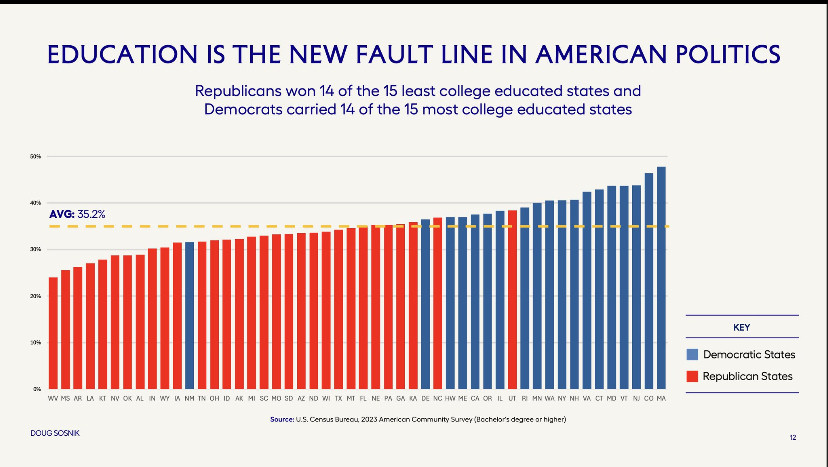
The Fault Line in American politics?

I’ve spent a lot of time considering this graphic.

IS education the fault line in American politics?

First shock: There are 33 states with more-educated people than (purple) Michigan, where there are world-class colleges and universities. What makes us an under-achiever?

2nd: Consider Trump’s mouth-blabber remark: “I love the poorly educated.” As well he should. They’re his base.

Digging deeper– what makes someone with a college degree more likely to vote Democratic? Does a college education make someone more broad-minded, more aware of the social and political factors influencing their well-being? Or is this all just about economics– being able to afford a college degree?

And personally–something I have been wrestling with since 2016–is there something I could have done, as a teacher, to model that broad-mindedness to my students?

ICE: Not your friendly neighborhood cops

I was talking with an acquaintance, and made a comment about ICE being reported in Leelanau County. Don’t you want to see illegal immigrants gone? she asked. Besides, they’re only picking up the ones with a criminal record.

I was dumbfounded. I knew she was likely a Republican; our points of contact have nothing to do with politics. But still– it came as a shock to know that she felt ICE was doing good, justifiable work– keeping her safe, here in nearly all-white Leelanau County.

This didn’t feel political. It felt personal. How could anyone who’s paying attention to the news support an out-of-control federal agency, ripping families apart and harming American citizens, with our tax dollars? Could you be a good person while accepting government-sponsored violence against innocent people?

There were lots of questions I could have asked, researched and validated arguments to be made, beginning with data about the non-criminals and citizens who have been detained. But–shamefully, I admit–I said nothing, just changed the subject to the reason we were meeting.

Thinking it over, I resolved not to just ‘let it go’ anymore. It’s true that many of these folks have made up their mind and are impervious to facts. And, at this moment, nobody is out in the streets when the wind chill is 25 below.

But–thinking people, actual good citizens, care about the people who live in and serve their communities. We are not seeing public safety being played out. We are seeing the base of a presidential posse–men with vicious grudges and biases empowered to destroy public services and schools. We all need to speak up.

Even when it’s socially awkward or unlikely to change minds.

Why? Well– read the article below. It’s a gift article, so you can read the whole thing.

Put Teachers in Charge of Their Own PD?

It feels weird to be opining about professional development when teachers in Minnesota are dealing with the effects of mayhem in the street, poisoning the normal ebb and flow of public schooling.

Is it exam week in the Minneapolis Public Schools, I find myself wondering—how will they handle that on-line, with a significant chunk of kids missing? Friends who teach in Minnesota share heartbreaking stories or ask me to donate $10 toward a project their students put together: getting food to families too frightened to shop. Incredible stressors for educators and also retired educators—thank you for all you are doing to keep schooling as safe as possible.

Coincidentally, it was a group of dynamic teachers in the Twin Cities area who first showed me what it really could look like to be in charge of their own professional learning. More on that later.

First, let me say the obvious. Teachers actually are, and always will be, in charge of whatever they decide they need to improve their teaching. For some, it will be a career-long quest to learn and try new things, building a practice with what works best. Others might be less enthused about the latest mandated program. You can lead a teacher to PD, but you can’t make them believe it’s useful.

The question is not what teachers need and want, to grow. It’s what administrators think they need, in the time set aside for professional development.

When principals and central office leaders are making the decisions (and hiring outside consultants)? EdWeek Research Center found that almost half of the respondents said the PD they are required to take is irrelevant. By contrast, 41% of the more than 650 school leaders surveyed at the same time said the PD they provided was “very relevant.”

This is an evergreen issue, of course. My district dabbled in a ‘choose your own PD’ model for a few years, giving teachers the choice to work in their own rooms or attend planned presentations. The lure of hours of uninterrupted time to plan lessons, run copies, review new materials, catch up on grading or chat with a partner teacher was irresistible.

Going home without a tote bag full of work? Priceless. But when only a handful of people showed up for the paid presenter? Embarrassing for the administrator who did the hiring. I say this having been one of those presenters once, setting up for 35 attendees and then having only four show up for a half-day workshop on National Board Certification.

In fact, it was a group of National Board Certified Teachers from a public high school in Minneapolis who proved to me that teacher-led professional development could be incredibly exciting and precisely targeted to the work of teaching specific students.

The name of the HS is not important—but it was a school with a high percentage of immigrant students, so there were ESL issues and poverty issues and old-building facility issues. Sometimes the assigned curricula just did not work for the students they had.

A progressive principal bought into the idea of genuine teacher leadership and re-arranged the classic HS schedule so that he was teaching classes daily, opening up time for teachers to take on traditional administrative tasks. Like professional development.

Teachers surveyed their colleagues—What do you need to know to teach your students well? What issues do you want to talk about?—and set up weekly brown-bag lunch chats and after-school gatherings at a local restaurant, with snacks paid by the school budget. There was intensive mentoring for new teachers and regular time set aside for teachers to tweak curriculum, as they were teaching it. Peer observations and conversations were built into daily practice.

A lot of what they were doing was around the use of time, shaving it off here and adding it there—only an experienced teacher can understand the difference adding 20 minutes to lunch makes, where some of the best professional development happens spontaneously.

The most impressive thing was not that teachers were ‘in charge of their own PD’—but that teachers were collaborating to build professional learning and conversations that made sense to them, on the fly.

The first question from the audience (of teachers): Did everyone in your building buy into this new, ongoing PD model? Answer: No. A couple left the building for what they saw as greener pastures. But several skeptics stayed and eventually became converts. And now, they said, when we hire, we let new teachers know they will be surrounded by support in that first year. It’s who we are—a team.

I’ve been thinking about that school, a lot, as we watch Trump’s quasi-militia wreak havoc on blue cities. Is there such a thing as professional preparation for having your teachers and students harassed? Are there materials that might help explain the chaos to kids? Will there someday be ed-conference sessions on the intersection of civic education and government coercion?

We didn’t start this fire. But teachers—beaten down and dissed by our own government—will have a role to play in rebuilding the idea of representative democracy. Right now, that’s our best hope.

Where Do Kids Get Their Information?

Their music and media tell them individualism will pull them out of squalor. The people behind those messages shove the economic ladders from underneath them.   (Jose Vilson)

One of the most stunning bits of clarifying data I’ve seen in the past few weeks is this chart from Media Matters, with data from February 2025:

It’s a graphic of most listened-to online news and commentary shows, color-coded and sized to represent the magnitude and political leanings of the American audience. It’s year-old data, remember—but it goes some way toward answering the question I’ve spent the past year obsessing over: Who ARE these people and how could they have re-elected the corrupt man who led the insurrection against their pretty-good government?

I’m old enough to remember 2008, when Barack Obama’s online media savvy and fund-raising prowess was attracting voters and the envy of the other party, stuck in Walter-Cronkite land. Kids who were primary consumers of social media then, are in their 30s now, and apparently have shifted to eating up Joe Rogan, Ben Shapiro and Nick Fuentes.

But what are kids listening to in 2026?  I think the JLV, in two sentences, above, sums up what I’m thinking: They’re young. They’re being bamboozled by glitzy media and music, convinced that their own swagger will save them. And then it doesn’t. In fact, they’re a generation that almost certainly will experience less prosperity and fewer prospects than their parents’ generation.

I volunteer in an after-school program for middle-schoolers, usually on afternoons dedicated to homework (or missing assignments). It’s no secret to any teacher that a lot of incomplete and missing work happens because the students don’t know how to do it. They will finally tell you—I don’t get this—after making excuses and going to their locker or the bathroom three times. This happens a lot with math, but also with conventional Q & A, end-of-chapter reviews and short writing assignments.

Our kids have their own Chromebooks and most of the teachers provide several vetted information sources beyond the textbook, which is great. But only if students go there, and wade around. Unfortunately, chatbots have now given them a get-out-of-jail quick option.

These students are—I emphasize—not dumb (or any similar but less insulting word). After homework is completed, we often play board games or cards. They understand and can negotiate things that the games require—similes and other wordplay, strategy and logic, memory. Some are also readers (passing around personally owned books that I never ask to see). There are conversations full of humor and current music and YouTube video references.

But at age twelve or so—where are they getting their information about the world at large? On the day after the 2024 election, our coordinator stopped by to remind volunteers NOT to speak about the election. Not that any of the kids mentioned it. It was as if it hadn’t happened.

A couple of days ago, there was a local protest in town about the Venezuelan invasion, and Indivisible posted photos on their Facebook page. This drew a flood of bot comments and an irritated response from protest organizers. Bots have taken over the normal give-and-take on many social media advocacy platforms. We are no longer getting honest news from legacy sites, and right-wing frat-boy videographers get millions of eyeballs on their dishonest grift.

If we can’t count on legacy media, who’s going to sort through those red and blue bubbles of independent media? It’s going to take more than hope and good will to teach kids to be critical consumers of media and music, to discern the difference between glittering generalities and sometimes unpleasant truth.

Somebody needs to clue them in to the fact that not all elected and appointed leaders can be trusted, and actors and musicians run the gamut from good guys to sleaze . There are malignant forces in the world,  people who are capable of extreme evil, which, as Hannah Arendt pointed out, is typically characterized by mediocrity. 

Of course, teachers are proscribed from sharing their opinions on the best sources of accurate and unbiased information, lest they be labeled DEI or woke. Makes you wonder how the public opinion on DEI and woke, two ideas that were once debatable if not accepted, solidified into broadly understood negative concepts. Where did that “information” come from?

Because I hang out with middle schoolers on the regular, I don’t think it’s too late to take a stand for discretion around the truthfulness of media sources. But simply letting the red bubbles win is a mistake.

Most  Depressing Blogs of 2025

“A generation raised under the [moral tone set by FDR] went on to build the modern middle class, defeat fascism, and help construct a postwar world that valued democracy, human rights, and shared prosperity.

Contrast that with the bigoted, hateful, revenge-filled claptrap children have heard for the past decade from the emotionally stunted psychopath currently occupying the White House.”                                                                                                          Thom Hartmann

My goal in blogging—something I’ve been doing for almost 25 years—has always been to write about what it’s like to be a teacher in the United States. I wanted to focus on teacher leadership, to write about the ‘inconsistencies and inspirations, the incomprehensible, immoral and imaginative, in American education.’

Because—back in 2001, when I got my first paid gig writing on the internet (there were unpaid local newspaper columns before that), there were many inspiring things to write about, from my own experience as a classroom teacher. There were also important questions about instruction, thorny policy issues and curricular problems to solve, but it really felt as if public school educators were on the same page—valuing democracy, human rights, shared prosperity, as Thom Hartmann says.

You could see a turning point coming. Topics from my December 28, 2016 “best blogs” review when I was writing for Education Week: Charters aren’t the answer. Women are disrespected even in a field where they’re a huge majority. We still don’t know what “teacher leadership” looks like—or might accomplish. Standards may shape practice, but they don’t automatically raise achievement. Competition and marketing aren’t the answer, either. And the future of public education is in serious jeopardy.

Going through the blogs I wrote this year was an exercise in dismay. Although I had many rewarding experiences volunteering in schools, in 2025, pulling the camera back to see where we’re going in pubic education is – no other word—monumentally depressing.

Here are 10 blogs from 2025 that I think represent our current trajectory, such as it is. Wish I could offer readers better news:

Teachers are Patriots! Who Knew?

You might say that teachers’ observations and informal experiments—Teach it this way? Or that?—are the most valuable action research data to build a successful practice. But don’t say it too loud, because research is tied tightly to the source of the money that funds it—and the commercial products and politics that drive educational change.

Progressive” Schools

Speaking as a person who has spent decades working in public schools and with public school teachers across the country, schools are generally among the most conventional and cautious institutions on the planet, subject to pressures and opinions from a wide range of (often clueless) critics. And likely headed by someone who adamantly does not want to get phone calls from honked-off parents.

Moral Clarity in the Classroom

If we were to sit down together over a cup of coffee, I could tell you dozens of stories from my teaching career that illustrate both moral clarity in my classroom, as well as times when I absolutely failed at establishing a trusting, collaborative ecology. It’s probably enough to say that I got way better at it, over 30+ years.

What I Still Believe about Public Education

Why would we abandon public schools’ infrastructure and experienced personnel? Crushing public education is not policy—it’s vandalism. It makes no sense.

Maybe the question is not: Is Public Education Over? Maybe the question is: What’s worth saving in public education?

Political Violence in the Classroom

Times do change. People do change. And I would assert that changing people for the better happens in good schools, every day. Not all classrooms, not all playgrounds, not all teachers—but public schooling is an overall force for good, for a better, healthier nation.

The Good News in August and Why It’s Baloney

 This is not just another start of school. This is (among other things) the first school year since 1979 when there hasn’t been a functional Department of Education. It’s a year when there’s now concrete evidence that addressing equity and appreciating diversity can get you fired. It’s a year when federal funding —especially for the neediest schools—can disappear overnight. Maybe never to return.

What’s Better than DEI?

Actually, if you’re taking away (via federally approved punishments and reduced funding) inclusion, equity and diversity, what you’ve got left is exclusion of non-preferred students, discriminatory distribution of resources, and separation of student groups based on physical characteristics. In other words, Arkansas in 1957. What happens when a latter-day Orval Faubus emerges?

Boys

While it’s important for boys to have personal agency in their learning, and be trusted by their teachers, boys need to have role models, as well. Who are we offering up as heroes, men whose lives and actions are worthy and admirable? Men worth emulating, who care for their spouses and children, men whose values serve as guardrails, men who are civically engaged?

Boys are growing up in schools where their neighbors on the school board worry about “weaponizing empathy.”  Where men at the highest levels of government power are uninformed bulliescareless in their actions but never held accountable.  

Five Things Your Child’s Teacher Accomplished Last Week

When I first heard about Elon Musk’s email blast to over two million federal employees directing them to submit approximately five bullet points of what they accomplished in the previous week, I was reminded of a couple of school administrators from my past.

Eugene Robinson called Musk’s scheme “an exercise in contempt”—also a great description of some of the so-called professional development teachers routinely endure. When a principal doesn’t trust their professional staff to know what they’d like to do with time available for their own learning or planning, you end up with meaningless exercises like “five things I did last week.”

Ultimately, it’s about control.

Who’s in Favor of Authoritarianism?
For the current administration, bent on “saving” federal dollars for their own preferences, breaking up this monolith will be a giant display of power that impacts some 50 million students and their families. Think you’re in charge of your local school, your classroom? Think again. Easy peasy.

No, the federal government–and supporting Republicans and conservative courts–say. No, we don’t want your media literacy classes. No, we don’t want kids nosing around in issues like fairness and equity in our recent history. No speaking Spanish. No arts classes or events to help students make sense of the world they live in. No vaccines to protect them, or accurate health information.