
I remember the first time I encountered unisex bathrooms.
I was traveling, with a backpack and not much money, in Europe, staying in youth hostels and tourist rooms, often in the homes of women I would meet at train stations holding up signs saying Zimmer zu vermieten.
Near the end of the trip, an eight-week journey which I funded with just under $1000, I was in Munich, trying to find a cheap (really, really cheap) place to stay. Someone told me about a hostel camp, maybe an hour’s hike from the train station—a field outside the city where you could stay in a huge tent. If you got there early enough, there was also food.
I schlepped out there and stayed the last two nights of the trip, also visiting Dachau on my final day. It was bare bones—BYO sleeping bag and ground pad. There were unisex flush toilets in wooden cubicles, in a single concrete building of the type you’d find in any state park campground today. There were also warm-water showers, in a large room with no dividers for males and females. BYO towels and soap, as well.
The hardest part of adjusting to this was trying to act casual, as if I were used to waiting in line to use the toilet between Hans and Karl, or nonchalantly showering with a couple dozen mixed-gender strangers. Everyone else seemed pretty blasé about it. The vibe at the camp was international, friendly and very safe.
The year was 1976, the 200th anniversary of the home of the brave, land of the free.
Now, nearly a half-century later, some people have their knickers in a twist over newly remodeled unisex bathrooms in Michigan State University’s Campbell Hall, a beautiful dormitory on the oldest part of campus, which houses the Honors College.
The retrofitting took traditional community baths and turned them into lockable, fully enclosed private stalls, each with a shower, toilet and sink. For a quick hand-wash or teeth brushing, there are also community sinks.
Apparently, the MSU Board got a letter of outrage from a parent, although students (who had to apply to live there) seem to be fine with the plan. There were some comments at the Board meeting about walking around after showering in a towel, but I chalk those up to people with too much time on their hands, wallowing in trad-nostalgia or perhaps sexual fantasies.
Back in the1970s, I lived in a co-ed dorm with community bathrooms. There were four floors—two community baths for women, two for men—although the dorm rooms alternated between men and women. I can’t tell you how many times I went to the women’s bathroom and found some dude walking out of a stall, because he didn’t feel like going upstairs. Lockable stalls with all you need sound vastly preferable to stumbling upon your roommate and her boyfriend showering together in the community bathroom.
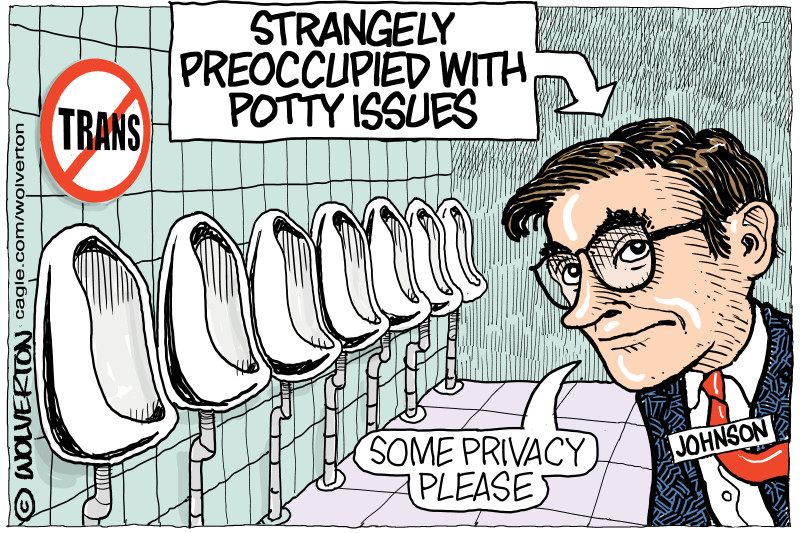
Makes me wonder why Republican legislators always bring up bathrooms when they want to gin up fear around gender expression. There really isn’t anything moral or magic about using the bathroom, with either gender.
There’s this: ‘Opposition to transgender inclusion has become a rallying cry for many conservatives. The debate is at the heart of a bill advancing in Michigan’s Republican-led House that aims to restrict bathroom use at schools and colleges on the basis of biological sex.
Sponsoring Rep. Joseph Fox, R-Fremont, suggested Wednesday that allowing transgender students to use bathrooms of the gender they identify with is “traumatizing little girls.” He called it a “safety issue.”’
Then there’s this: “Michigan must stop making references to gender identity in sex educational materials provided to schools or risk losing millions of dollars in federal funding, according to President Donald Trump’s administration.”
“A recommendation that schools include instruction about gender identity or expression and sexual orientation by eighth grade has prompted criticism from several parental rights groups and Republican politicians.
“These proposed standards cross into deeply personal and spiritual territory, normalizing behaviors that many families find harmful and contrary to their faith.’”
Traumatizing little girls? Normalizing behaviors that contradict families’ religious beliefs? And not being allowed to talk about it, in eighth grade sex ed classes, even if your parents say it’s OK?
It’s all about what’s happening in American bathrooms, evidently.
Gender-neutral bathrooms are commonplace in Europe. Why is that? What do they understand that we don’t?







 Teacher in a strange land