Diane Ravitch Sums It All Up

My introduction to Diane Ravitch: I can’t remember precisely which education conference it was, but I was in graduate school, so it was between 2005 and 2010. Ravitch had just begun writing her Bridging Differences blog with Deborah Meier at Education Week, a sort of point-counterpoint exercise. I had also just read her book The Language Police for a grad class, and—although she’d always been perceived as a right-wing critic of public education—found myself agreeing with some of her arguments.

She was on a panel at a conference session. I can’t remember the assigned topic, but after the presentation was opened up to questions, they were all directed to her. And she kept saying smart things about NCLB and testing and even unions. Finally, a gentleman got up to the microphone and said:

Who ARE you—and what have you done with Diane Ravitch?
The room exploded in laughter. Ravitch included.

Ravitch has published two dozen books and countless articles. She is a historian—making her the Heather Cox Richardson of education history, someone who can remind you that when it comes to education policy, what goes around comes around. Her previous three books were, IMHO, masterpieces of analysis and logic, describing the well-funded and relentless campaign to destroy public education here in the U.S.

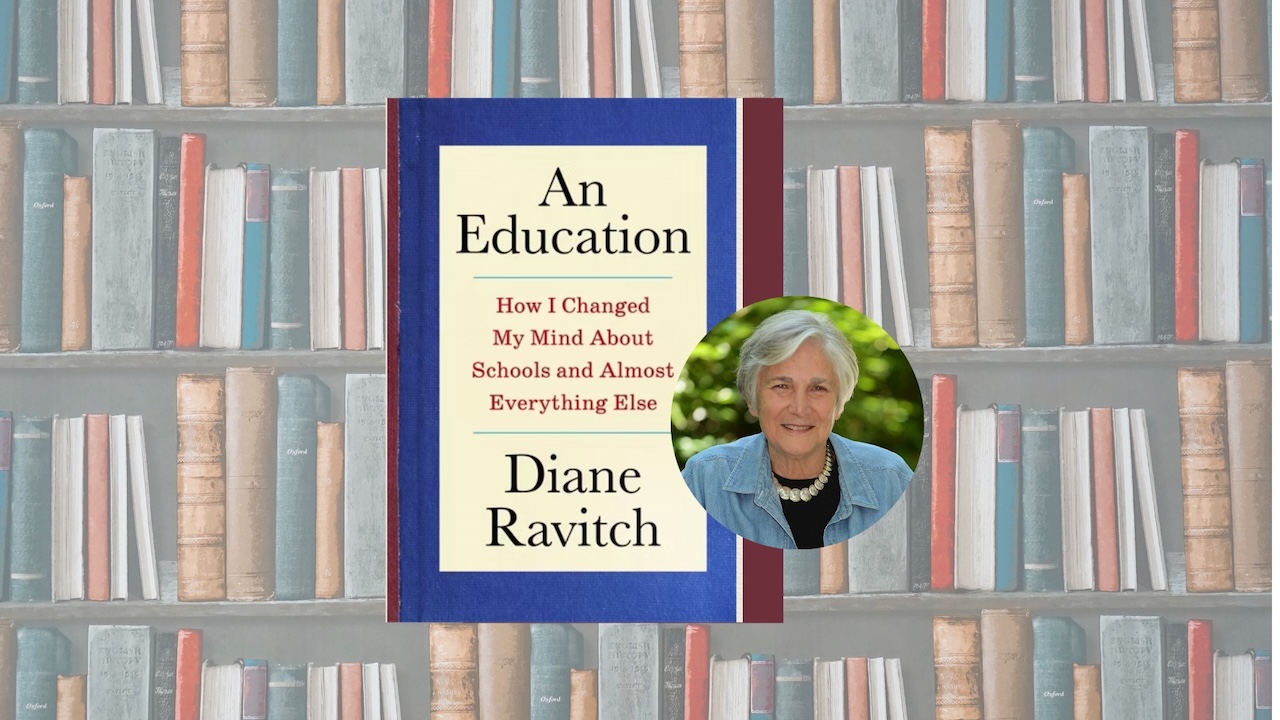
And now, at age 87, she’s written a kind of expanded autobiography, An Education: How I Changed my Mind about Schools and Almost Everything Else. She tells us how her vast experience with education policy, across partisan and ideological lines, has left her with a well-honed set of ideas about how to build good schools and serve students well. How, in fact, to save public education, if we have the will to do so.

You get the sense, as Diane Ravitch wraps up “An Education,” that she is indeed wrapping up– she sees this as her last opportunity to get it all out there: Her early life. How she found happiness. Mistakes and regrets, and triumphs. It’s a very satisfying read, putting her life’s work in context.

For her followers and admirers (count me in), the book explains everything about her beliefs. Her working-to-middle-class roots and her family’s loyalty to FDR and what the Democrats stood for, during post-World War II America, go a long way to explaining how she eventually (with some major diversions) became an articulate proponent of public education.

I’m glad she included a nostalgic portrait of growing up in TX with a hard-working mother and feckless (and worse) father. The glimpses we get into public education in TX in the post-war years resonated with me–and it’s easy to see how going far away to an Ivy League college shaped her entire adulthood. Her classmates at Wellesley, like Ravitch, were ambitious and curious; I’m old enough to remember a time when female ambition was suspect.

The most fascinating part of the book, for me, was the middle third, where she wrote about researching the history of public education and being asked to sit on prestigious boards and serve as Assistant Secretary in the George H. W. Bush Department of Education. There’s a whole chapter on Famous Education Opinion Leaders (many of whom are still working to suppress full public education) taking Diane to lunch, tapping into her work ethic and offering her opportunities to be part of the power structure, to write and speak (and—big point—learn what they’re really up to).

N.B.: Award-winning teachers are also often asked to become part of the education establishment by sitting on boards, writing op-eds, and serving on task forces– and it can be easy to feel as if you’re contributing, at a higher level, when what you are actually doing is giving credence to people who have a very different, but hidden, agenda.

The final third of the book is the Diane Ravitch most educators know and respect. Her observations come from swimming in the ocean of education policy for decades– and they’re accurate. I expect Ravitch to continue to blog and write and speak, as long as she is able. She is the rare voice in education that has examined education ideas across the spectrum and found many popular notions weak or dangerous.

The book is a fine testament to a life spent searching for the truth about public education.

Five stars.

Is There Really a Decline in Pleasure Reading?

The mainstream media has been full of the bad news: new study shows that reading for pleasure has declined! Fewer people are reading for fun: From 2003 to 2023, the share of Americans who read for pleasure fell 40 percent, a sharp decline that is part of a continuing downward trend.

It’s easy to feel depressed about declining—what? literacy? —in the American citizenry. Just one more piece of evidence that schools are failing, blah, blah—nobody reads anymore!

But Anne Helen Peterson, in her substack, Culture Study, has a great piece dissecting the study that these scary headlines are based on. Maybe we’re not reading less; in fact, we may be taking in much more information and storytelling via means other than books.

Peterson posits six interesting theories about the way the study’s questions were framed and interpreted, and why we may need to re-evaluate what it means to be fully literate. She’s also a big-time book-reading enthusiast—not someone who sees the death of book-reading as inevitable in a digital world. Reading for pleasure is worth preserving, for all citizens. It broadens perspectives, makes us more interesting.

I immediately felt better after reading the piece. People aren’t reading less, necessarily; they’re reading differently. But I keep thinking about this story, told to me by a veteran teacher:

She started her career teaching in an elementary school, with reading blocks every day. She went back, as teachers sometimes do, to get a master’s degree in media and library science, then moved to a position in a middle school. A big part of her job there was managing young teenagers’ quests for information about whatever, using the internet as well as print resources.

After several years of staffing her school district’s seven libraries, the money ran out, libraries closed, and she was transferred back to a fourth grade. She said the most shocking thing about returning to a self-contained classroom was how much the kids hated reading.

It had been nearly two decades since she taught reading in an elementary classroom, and there was a palpable difference. Not just in the official reading program and instructional practice, but in the way students–both solid readers and those who struggled–responded to reading, in general. She was directed to follow daily scripts and a pacing chart, whether the students were ready to move on, or not.

She told me that—having already been involuntarily transferred away from a literacy-based job she loved and did well—she was no longer fearful of reprimands, and taught reading in ways that made sense to her fourth graders, including lengthy daily read-alouds that connected them to interesting stories. Their scores (and there are scores, in every story about reading) improved.

Headline today, from the right-leaning Detroit News: Michigan’s Reading Scores Continue to Slide for Youngest Students:

‘The results of the 2025 Michigan Student Test of Educational Progress, known as M-STEP, showed only 38.9% of third-graders and 42.4% of fourth-graders statewide scored proficient on the state’s English language arts (ELA) test, down from last year’s scores of 39.6% and 43.3%, respectively.

Eighth graders performed best in reading, with 65.3% proficient compared with 64.5% last year. Students in eighth grade take the PSAT, a precursor to the SAT, for math and English. Their social studies and science results come from the M-STEP.’

Read the data again. What do you notice? For starters—in every damned story about the so-called ‘reading crisis’—the undefined word ‘proficient’ appears. What does it mean? Everyone thinks they know. But ‘proficient’ (according to the Nation’s Report Card) does not mean ‘on grade level.’  It’s an indicator of advanced skills.

So there’s that. But did you notice that the worrisome ‘slide’ is .7% for third graders and .9% for fourth graders? Less than one percent? And that—miracle of miracles—Michigan 8th graders’ scores are a whopping 26.4% more proficient than Michigan 3rd graders?

There’s a lot to unpack here, but the Detroit News merrily goes on, blaming the fact that Michigan is coming late to legally mandated ‘Science of Reading,’ which kind of makes you wonder about what was wrong with the reading programs that produced success in two-thirds of the state’s 8th graders.

MI 8th graders took the PSAT, a national test, and the rest of Michigan’s kids took the statewide assessment, the M-STEP. Which is the most trustworthy? And why are scores so wildly different? These are questions the Detroit News does not address.

Nor does their reporting on reading scores factor in where the COVID pandemic impacted student instruction. In fact, I have seen op-ed commentary (NOT going to link) exclaim that because the pandemic is ‘over,’  reading scores should have ‘bounced back’—which reveals nothing more than a profound misunderstanding of education and public health data, mixed with contempt for public education.

Last year’s third and fourth graders were in pre-K and kindergarten during the worst years of the pandemic. The things they were coping with—fear and loss– as very young children, have left traces of damage, from school absenteeism to the very thing my friend mentioned: her fourth graders hated to read.

Why? Because learning to read had been a disrupted and difficult process, focused on improving scores, rather than developing an appreciation for an essential skill that would provide an enriched life, in multiple aspects? Including enjoyment—reading for pleasure?

Alfie Kohn:

‘The fact is that students’ days will be spent quite differently depending on whether the primary objective is to make them memorize what someone decided children of their age should know, on the one hand, or to help them “make fuller, deeper, and more accurate sense of their experiences,”on the other.’

I would call reading for pleasure a fuller, deeper and more accurate sense of our experiences—what it means to be a fully literate human being.

Men Who Like Books Start Out as Boys Who Read

Maureen Dowd, in a NYT article entitled Attention, Men: Books are Sexy!:

Men are reading less. Women make up 80 percent of fiction sales. “Young men have regressed educationally, emotionally and culturally,” David J. Morris wrote in a Times essay titled “The Disappearance of Literary Men Should Worry Everyone.”

The fiction gap makes me sad. A man staring into a phone is not sexy. But a man with a book has become so rare, such an object of fantasy, that there’s a popular Instagram account called “Hot Dudes Reading.”

It’s enough to make me re-up my abandoned Instagram account.

I also sincerely hope that Maureen and I are not a dying breed, older women (we are the exact same age) who find Men Who Read attractive. I once experienced a tiny swoon when I read that Stephen King carries a paperback with him, wherever he goes. You know, in case he has to wait 10 minutes in line at the post office.

This is more than just my elderly romantic fantasy, however. I think Men Who Read are—or should be—a national education goal. Not men who can decode, nor men who can type fast with their thumbs or pass tests about content. Men who actually enjoy reading.

Reading to use their imagination, rather than seeing prepackaged ideas on video. Reading and—important–evaluating information. Using the language they absorb, via reading, in their daily interactions with others. Reading for pleasure.

Personal story: When I met my husband, he told me about working third shift at the Stroh’s factory in Detroit, while he was in law school. His job involved dealing with a machine that flattened cardboard beer cases and needed tending only at certain times. The rest of the time he filled with reading, hours every night. He would take two books to work, in case he finished the first one. He read hundreds of library books, mostly popular fiction.

He is still that person, 46 years later. Swoon-worthy.

When I read (endlessly) and think about how we’re teaching reading these days, it strikes me that the discussion is almost entirely technical: Do we really have a “reading crisis?”  Why? Is it the fault of a program that was once popular and taught millions of kids to read, but is now being replaced, sometimes via legislation crafted by people who haven’t met first graders or stepped foot into their classrooms?

I recently had a conversation with a middle school teacher in Massachusetts who is a fan of phonics-intensive science of reading curricula, largely because she gets a high percentage of non-readers into her Language Arts classes, kids who have big brains but no reading skills. She’s had some success in getting them to read, using sound-it-out instructional materials they should have experienced in early grades.

Good for her. And good for all teachers who are searching (sometimes in secret) for the right strategies to get their particular kids to read. But I’d like to point out that if the technical skills of reading aren’t matched by reasons for reading, it’s like any other thing we learn to do, then abandon. I’m guessing my friend’s students want to learn to read, because they like her, and they find what she’s teaching them interesting.

From an Atlantic piece: ‘The science of reading started as a neutral description of a set of principles, but it has now become a brand name, another off-the-shelf solution to America’s educational problems. The answer to those problems might not be to swap out one commercial curriculum package for another—but that’s what the system is set up to enable.

A teacher must command a class that includes students with dyslexia as well as those who find reading a breeze, and kids whose parents read to them every night alongside children who don’t speak English at home.

There you have it. We’re looking, once again, for a one-size-fits-all solution to a technical, easily measured “problem”—reading scores—when what we really need is honest reasons for people to pick up a book. Or a newspaper. To enjoy a story, or a deep dive into current issues.

My dad, who didn’t graduate from HS and had a physical job all his life, came home from work every afternoon and read the newspaper. He was more literate than many college grads I know.

He had reasons for reading. He was not carrying a smartphone and had only three TV channels, undistinguished by political points of view. He read TIME and LIFE magazines. I disagreed with my father on almost every issue, back in the day, but he could marshal a political argument. Because he was a reader.

So why are reading scores dropping? Curriculum and poor teaching are lazy, one-note answers. If we want a truly literate population, we need to make reading and writing essential, something that kids can’t wait to do. Because it’s a passageway to becoming an adult, to succeeding in life, no matter what their goals are, or how they evolve.

We currently have a president who doesn’t read his daily briefings, and bases his critical viewpoints on hunger in Gaza on what he sees on TV. But we used to have a president who published an annual list of his ten favorite books.

Which one of them is a (sexy) role model?

Book-banning, Book-burning, Book reading—and Truth

Cue (the 1970s): Nervous young candidate for a job teaching music steps out of her dad’s car—she doesn’t own a car, yet–in a small Michigan town on the rural outer ring surrounding Detroit, where little villages are interspersed with working farmland. The town is charming, full of old houses and 19th century buildings. The principal she’s meeting proposes they take a walk around the town while interviewing.

He gives her a thumbnail history of the Hartland Music Hall, the cemetery and the “1921 Building”—the first high school in the county. They end their walk at the Cromaine Library, the crown jewel of this little village. It’s exquisite—built in 1927, before the Wall Street Crash that sent the country spiraling into Depression—with beautiful Georgian windows, and a working fireplace. Every child in the Hartland Schools comes to the Cromaine Library and gets a library card, the principal tells her—it’s part of the school district.

Of course, I got that job (and bought a car)—and raised my family in that little town, taking my personal children to that library hundreds of times. My husband served on the library board, for a time. It was (beautifully) expanded in 1980 and has remained, for nearly 100 years, the heart of the community, a hub for both kids and adults—and for learning.

I was sickened to read that the Cromaine Library Board (like, unfortunately, the Hartland School Board) has now been co-opted by right-wing morality scolds. Serving on library boards—like school boards and other civic oversight jobs for volunteers—is a thankless job, but also a power-grabbing opportunity for those who’d really prefer to live in an anti-DEI town. In an anti-DEI world, in fact.

“For the Hartland Cromaine District Library in Livingston County, the conversation on labeling books started in 2022. Over time and with the election of new library Board of Trustees members, the conversation became much more pointed.

Much of that had to do with the election of Bill Bolin, the pastor of the FloodGate Church in Brighton, and his elevation to the president of the Cromaine District Library board in January. Bolin and his church have been written about by various publications, including Tim Alberta detailing Bolin’s mixture of right-wing conspiratorial politics and Christianity. Bolin also features throughout Alberta’s 2023 book, “The Kingdom, the Power, and the Glory: American Evangelicals in an Age of Extremism.”

Bolin:
“I desire to protect children from the harm that can befall them over coercive behavior. The approach I am suggesting, along with certain colleagues, is a commonsense approach to changing the sexual tone and nature of some library policies and practices.”

Bolin said the Board [under his leadership] would discuss controversial items on the agenda, including the removal of June LGBTQ+ Pride displays, labeling certain books that may be deemed controversial, moving books to an age restricted area, providing supervision in the teen area to monitor “behavior” and returning the Pledge of Allegiance to monthly meetings.

Bolin then recited a potential warning label he had created warning adults of the dangers of providing such material to children. But Bolin wasn’t talking about dirty magazines in a seedy retail store: he was talking about books within the community’s public library. Bolin added that a list of books that could be recommended for labeling was being compiled with at least 80 titles, minimum.

The article goes on to say that the Board was advised by the ACLU and their own law firm that they’re setting themselves up for legal pushback. A meeting gets heated and the Sheriff is called to escort those endorsing leaving the books on the shelves out of the room. It’s shocking—and nauseating. I loved this library.

Several attendees note that Bolin hopes this case will be the showcase legal action in front of the Supreme Court. Bolin muses on his belief that: “legal discourse was changing in America, indicating that courts in the era of Trump might be turning the tide to support measures much like the one being discussed by the Cromaine District Library board.”

And maybe that’s the saving grace—this is not just happening here, in small towns in the Midwest. When Georgia high schools can no longer present classic theatre like “The Crucible”which is how I learned about the McCarthy hearings, as a HS student—then we all need to rise up. Show up at board meetings. And speak.  

Free choice of reading. It’s right there in the Bill of Rights. Remember?

In a previous column, I wrote about the moving experience of standing in the Square where—on May 10, 1933—students (students!) supporting the emergent Nazi party burned books. Thousands and thousands of books that the party said were too Jewish (including classic works of literature and philosophy) or not German enough: In 1933, Nazi German authorities aimed to synchronize professional and cultural organizations with Nazi ideology and policy (Gleichschaltung).

That’s precisely what’s happening in what I used to think of as my little town: synchronizing professional and cultural organizations with Trumpian ideology and policy.

Only engaged citizens can stop this.

Are Women the Cause of Reluctance to Read?

I remember learning–perhaps in a grad class or professional development session, years ago–that boys didn’t like to read about girl things. You know—relationships, communication, emotions, the finer points of making a home or enriching family life. Boys wanted to read stories about adventures, we were told. Starring, naturally, other boys.

Ergo, if we wanted to turn boys into enthusiastic readers, we needed books where boys did boy stuff—creeks, animals, cars, fights, danger, you name it. Write it and they will come.

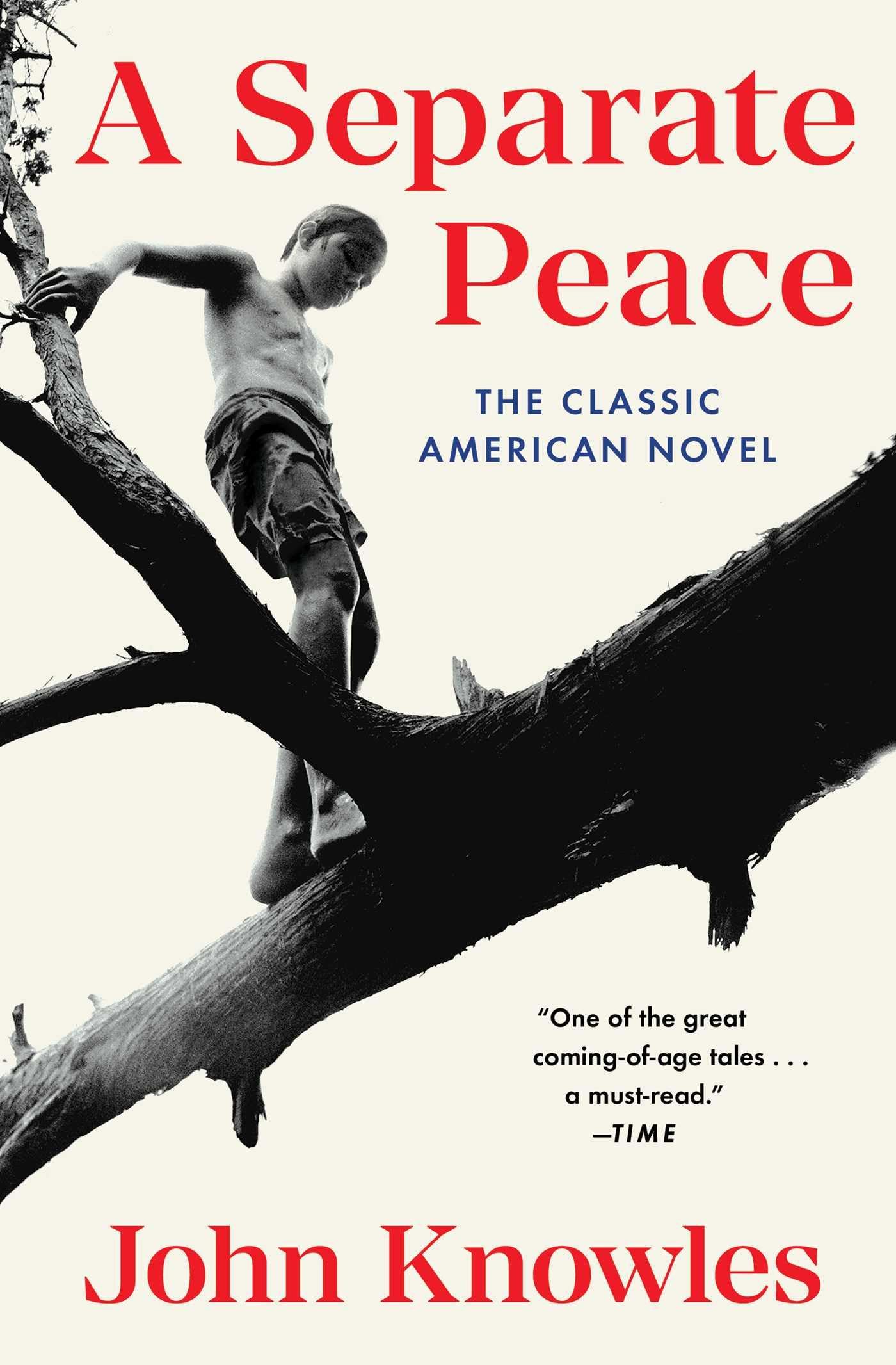
I thought about this when re-reading A Separate Peace this month. My book club is doing a “Books You’ve Already Read—or should have read” month, and I thought it was time to re-read a book that I put on my Top Ten list for decades.

(Seriously—I kept continuously updated top ten lists of books, movies and LPs until I had both children and a full-time job. There are still some gems on those lists—but also some really embarrassing stuff.)

I wouldn’t, however, call Separate Peace an embarrassing pick. I read it in high school, although not as a class novel. In the late 60s, my public high school adopted a choice-based language arts curriculum. Instead of English 9/10/etc, there was an array of semester-long courses. I took journalism, speed reading and Great Books, a totally wonderful class where students did nothing but read books, then journal their impressions.

There was a list of great books (SP was on it), but you could also deviate, with the teacher’s permission. It was that teacher—Mrs. Palmer—who introduced me to Daphne du Maurier, Virginia Woolf, and Madeleine L’Engel.

It’s hard for me to put my finger now on why I loved Separate Peace so much. Partly, it was the boarding school setting—what it would be like to live in dorms, with other students whose parents weren’t scraping to pay the mortgage, for whom college was a certainty, not a stretch.

Mostly, though, I think it was because—spoiler—there’s a death in the book, under unusual circumstances, leading the reader (this teenaged reader, anyway) to muse on Big Meaningful Issues. In case you’re wondering whether I noticed the homoerotic flavor of the relationship between the narrator and his best friend, the answer (1969) is no and (2025) yes.

But here’s what really jumped out at me, some 50+ years later: there are no women in this book. Aside from a couple of sentences mentioning a screechy school nurse, and a sentence describing a classmate’s mother as kindly, there is zero female presence in this book. There’s plenty of adventure, danger, scrapes and disobedience. Even a student-led tribunal, and a World War. But not a single woman, or girl.

From a recent article in The Guardian, about a newly formed publishing house that intends to publish only books by men: 

Cook said the publishing landscape has changed “dramatically” over the past 15 years as a reaction to the “prevailing toxic male-dominated literary scene of the 80s, 90s and noughties”. Now, “excitement and energy around new and adventurous fiction is around female authors – and this is only right as a timely corrective”.

“This new breed of young female authors, spearheaded by Sally Rooney et al, ushered in a renaissance for literary fiction by women, giving rise to a situation where stories by new male authors are often overlooked, with a perception that the male voice is problematic,” he said.

Hunh. I wasn’t really paying attention to any toxic literary scene in the 1980s and 90s, due to the aforementioned family and job. But I was still reading a lot—and was deeply involved in whether and what my students were reading. Or not reading.

It was a time when getting any kind of reading material—from comic books to Captain Underpants— into kids’ hands was the prescription for reluctant readers. There was a rolling bookshelf in my band room, filled with books about music and musicians. Some had some vaguely naughty photos. I purchased all of them, and they were well used.

My take on any reduction in male readers in the 21st century is that omnipresent screens, not problematic masculine voices, are responsible.

Still. What I notice about this (well-meant, I assume) announcement is that it only took a couple of decades for men to perceive that women were “ushering in a renaissance,” then set up their own literary clubhouse, no girls allowed.

There’s also this:
Less than half of parents find it fun to read aloud to their children, new research shows. Only 40% of parents with children aged 0 to 13 agreed that “reading books to my child is fun for me”, according to a survey conducted by Nielsen and publisher HarperCollins. The survey shows a steep decline in the number of parents reading aloud to young children, with 41% of 0- to four-year-olds now being read to frequently, down from 64% in 2012.

A significant gender disparity was identified, with 29% of 0- to two-year-old boys being read to every day or nearly every day compared with 44% of girls of the same age.

Plus this, ominously: Many parents focus on the literacy element of reading, seeing it as a skill, rather than encouraging a love for reading in their children.

So—who’s not reading, and why?

If you talk to the Science of Reading crowd, boys’ reading difficulties and reluctance to read can be laid at the feet of teachers who were never taught the only correct protocols for reading instruction, or—worse—fail to use them with fidelity, a word I have come to loathe when applied to pedagogy.

And since the overwhelming majority of early-grades teachers are women, this can be construed as another way in which women are not paying attention to the needs of boys. But it’s so much more complex than phonemic awareness, yada yada.

The Great Books class at my high school only lasted a few years, then fell when the “cafeteria curriculum” became outmoded, in favor of … what? I forget. Back to Basics? One of our cyclical returns to The Canon—in which white male-authored books have literally always been deemed more worthy of study?

All children deserve to be read to, daily, even when they’re able to read themselves. Stories about both boys and girls. Because that’s how they learn to be curious about the real world.

Version 1.0.0

The Folly of Settled Science

It was on Morning Edition, seven years ago—a cheery little piece on how we now know just how to teach students with dyslexia how to read. Interesting, I thought then, expecting to hear about some new breakthrough technique in reading pedagogy. Instead, what I heard was this:

Dyslexia is the most common learning disability, affecting tens of millions of people in the United States. But getting help for children who have it in public school can be a nightmare. “They wouldn’t acknowledge that he had a problem. They wouldn’t say the word ‘dyslexia.’’’

Wow. Not true in my school. We talked about dyslexia and reading instruction endlessly, being very careful not to throw around the label (which impacts 3% to 7% of students, depending on how the condition is defined) indiscriminately. I found it hard to believe that parents who sought help for a genuinely dyslexic child would find the process ‘nightmarish.’

I spent most of my career in one school district, but teachers there expended a great deal of effort and analysis in teaching kids to read and reinforcing ‘reading across the curriculum’ in upper grades. Over three decades, and via my own children’s reading instruction there, I saw several reading programs come and go. I was part of countless conversations about how to incorporate new pedagogical thinking into practice. But–teachers refusing to identify the issues with a student who struggled to read? Never.

Turns out, the Morning Edition piece (in 2018, remember) wasn’t really about a new, proven strategy for helping kids with reading disabilities. The program was fanning new flames of the always-politicized Reading Wars:

Research shows that they learn to read better when they are explicitly taught the ways that sounds and letters correspond. And research shows that even students without dyslexia learn better this way. “I have started to call it not dyslexia but dysteachia. It’s the teachers who are not giving the right kind of instruction!”

Aha! Kids can’t read? It’s the teachers’ fault. Again.

The Reading Wars (which have been going on for over 100 years) tore local school boards apart in the 1990s, in an effort to determine which reading program was “the best.” Many of these bitter arguments were framed as “Phonics” vs. “Whole Language,” but anyone who’s studied the acquisition of literacy knows that’s a simplification so gross as to be useless. Reading instruction is never binary, or limited to right vs. wrong strategies.

The National Reading Panel, convened by a government department with an agenda, put forth a major report, designed to settle the question, once and for all—but the lone practitioner on the panel strongly disagreed with the methodology and policy implications that rolled out, post-reportif not with the actual findings. So, hardly a consensus among teachers.

Then the heavy hand of accountability pushed the discussion—the professional work of reading teachers—out of the classroom, and into whatever place it is that reading programs are measured by their efficacy in raising test scores. And possibly forcing children to repeat the third grade.

I am sincerely happy to know that students correctly identified with dyslexia, a complex, multi-layered diagnosis, seem to be more successful in learning to read, using a phonemic awareness/phonics-intensive program. Still, I am putting my faith, as always, in the discernment and expertise of the teacher.

Students classified as dyslexic have varying strengths and challenges and teaching them is too complex a task for a scripted, one-size-fits-all program. Optimal instruction—meaning the most effective methods for students with disabilities as well as those already reading fluently and making meaning–calls for teachers’ professional expertise and responsiveness, a full tool bag and the freedom to act on the basis of that professionalism.

It’s worth mentioning—again—that formal reading instruction in Finland does not begin until students are seven years of age, long after some children in the United States have been identified as dyslexic or learning disabled, because they’re unable to decode at age six.

Seven years ago, the author of the Morning Edition piece, Emily Hanford, claimed that the superiority of phonics/phonemic awareness instruction for all children—and the failure of whole language programs—was settled science, ‘like climate change.’

I certainly hope there’s never a rigid, unchanging agreement on the One Best Way to teach people of any age to read. All scholarly disciplines should undergo regular re-assessment, as research reshapes knowledge. There are still classrooms in the United States, after all, where evolution is not settled science.

I dug some of this information out from a piece I wrote in March of 2018 for Education Week, because yesterday, for the first time, I had an unpleasant skirmish on Bluesky.

I had posted a comment re: the just-released, drooping NAEP reading scores which are now being dissected in the media. There’s a lot of alarmism and pearl-clutching in the mainstream media, but here’s a pretty good piece from NPR. (The piece also reminds readers that “proficient” doesn’t mean adequate or even OK—it means considerably above average.)

While 4th and 8th grade reading scores overall are still below pre-pandemic levels, it’s worth remembering that this year’s fourth graders were in kindergarten when the pandemic hit, and many spent much of first grade, prime learn-to-read time, learning remotely. Fourth graders in the tested NAEP group did not experience typical reading instruction.

Scores for advantaged students—the top of the heap, economically—were actually strong; scores for the poorest quadrant were dismal. Nothing new, but that gap was much bigger in this round of testing. That is actually useful information. We should be putting more resources into the public schools that serve disadvantaged students (not vouchers to subsidize wealthy families choosing private or religious schools).

I thought about how the ‘settled science” of learning to read has become the “Science of Reading”—and how, over the past seven years, since I first heard that piece on Morning Edition, kids who were first learning to read then (and are now 8th graders) have not moved up the testing ladder, even though over 40 states now have laws or policies based on the so-called Science of Reading.

If SOR was the one best way, why haven’t scores been creeping up? It was a simple, non-hostile question.

Which drew a very hostile response from a Bluesky account that appears to be an online tutoring service with one of those improbably aspirational—think Rocket Reader!!–names.  He or she refused to give his/her name, and the exchange (wherein I kept asking for research supporting his/her claims) got increasingly antagonistic.

S/he kept returning to how old and out of touch I am, and insulting not only me, but other researchers and opinion writers with far more credibility than I on the topic of learning to read. His/her final comment (before I blocked him/her) was “Go live in the nursing home with Lucy Calkins!”

Here’s the thing, though. Having seen reading instruction up close and personal—as a professional, not a student—over decades, it’s very clear that it will never be settled (or, probably, science).  It’s complex and variable and entirely dependent on what students bring to the table.

Help! I Can’t Read!

It started, frankly, back in July.

Like other Type A, rule-following teachers, I can’t just relax and retire. Reading is my favorite year-round way to spend free time, so you think I could just curl up and enjoy lots of books. But no. I have been setting reading goals and tracking the books I read, for the past 10 years.

I know. Get a life.

But I really like tracking what I read. First, it helps when you’re intermittently reading a series by the same author, and the titles are interchangeable. It’s a lot better than taking a book home from the library, and 10 pages in, when it’s starting to feel familiar, wishing you’d kept a list.

Then, there are the easily confused books. The Woman in the Window. Or the train. Or Cabin 10. Or just… The Women. (I’ve read ‘em all—can’t recommend any of them.)

For about 10 years, I’ve been trying to read 100 books a year, and for eight of those years, I’ve made the goal, and sometimes significantly exceeded it. It’s a nice round number. I give myself credit for physical books read as well as audio books (usually a small percentage of the total—they take more time). Fiction and non-fiction. And I only log the ones I finish.

But this year, I’m way behind. I blame Donald Trump.

The only other year that I didn’t make the goal was 2016 (and got off to a slow start in 2017, what with the Womans March and joining groups and deciding to run for office and knitting pink hats).

This year, I was about 8 books ahead of my goal in June. When Biden dropped out of the race, and Kamala Harris quickly became The One, I found that the long stretches of time dedicated to reading were transferred to activities centered around politics. Including a ridiculous amount of time spent where I am right now: in front of my computer.

It’s summer, I’d tell myself. Check a big fat beach read out of the library!
When I did, it would sit in my reading corner until I brought it back, a month later. A month filled with doom-scrolling, sign-delivering, attending debates, wading in hope, drowning in despair.

And in the last month? No books. Just endless commentary. Seventeen takes on the same depressing story (Matt Gaetz? Really?), each with its unique, snarky—and depressing—viewpoint.

Speaking as a person whose most-read column was a screed against the Pizza Hut Book-it Campaign, because it turned kids reading for pleasure into a competition where discounted pizza coupons were the prize, you’d think I could blow this off, and just be happy I read a lot of books.

It isn’t gone—the goals, the book discussion groups, the afternoons on the couch. I’m too much of an old-school reader to end up like the college students who can’t—or, rather, won’t—read.

Ever been in a reading slump? Got a title to bust through my ennui?

My reading corner, below.

Man with Sixteen College Degrees Can’t Read

I mostly stay out of the Reading Wars. Not because I don’t have opinions on reading instruction. I emphatically do.  I avoid the controversy because—as a lifelong music teacher—expressing that opinion inevitably leads to a pack of Science of Reading enthusiasts pointing out that I am not a reading teacher, and therefore what do I know?

This is deeply ironic, as those same SOR fans also spend lots of time criticizing experienced reading specialists. Also–I have taught in the neighborhood of 4000-5000 kids, over 30+ years, to read music, relying on a wide array of pedagogical techniques.  But that form of reading instruction evidently carries no water with the SOR bullies.

I was intrigued today by a story in NY Times Magazine about Benjamin Bolger:

Benjamin B. Bolger has been to Harvard and Stanford and Yale. He has been to Columbia and Dartmouth and Oxford, and Cambridge, Brandeis and Brown. Overall, Bolger has 14 advanced degrees, plus an associate’s and a bachelor’s.

Bolger, who is now 48, got off to a rough start, with a disastrous car accident when he was two years old that seemed to trigger the breakup of his parents’ marriage.

Bolger’s mother spent much of her money in the ensuing custody battle, and her stress was worsened by her son’s severe dyslexia. In third grade, when Bolger still couldn’t read, his teachers said he wouldn’t graduate from high school. Recognizing that her boy was bright, just different, his mother resolved to home-school him — though “home” is perhaps not the right word: The two spent endless hours driving, to science museums, to the elite Cranbrook Academy of Art outside Detroit for drawing lessons, even to the Smithsonian’s National Air and Space Museum in Washington. At night she read to him: epic works of literature like “War and Peace” but also choose-your-own-adventure books and “Star Wars” novelizations.

It would be easy to project the next part of the story—he somehow “learned to read” and then caught up to his classmates. But that’s not what happened.

At 11, he began taking classes at Muskegon Community College. Still reading below a third-grade level, Bolger needed his mother to read his assigned texts out loud; he dictated papers back to her. At 16, he enrolled at the University of Michigan, moving with her into an off-campus apartment. He recorded his lectures so he could listen to them at home; his mother still read to him. Majoring in sociology, he graduated with a 4.0. He was 19.

There were some failures (as we traditionally define failure). Bolger dropped out of law school at Yale due to the heavy reading load. But then, of course, he got back up on the academic horse, and pursued other degrees—including a PhD from Harvard, successfully completed. He also married and has two rather beautiful children, for whom he’s designed an experience-intensive home-schooling program.

What’s interesting to me is that the NYTimes Magazine article doesn’t dwell on Bolger’s inability to read well (whatever that means). Only on the fact that he has more degrees than only one other person in the nation (who’s also from Michigan, for whatever that’s worth).

Given the laser focus, in 2024, on determining which reading program yields the best test scores, I am surprised that a long-form article in a major publication does not explore the question of how one gets a master’s in the Politics of Education from Columbia, for example, without being an expert at deciphering complex texts, close reading.

But the “does he read or doesn’t he?” question—the one where we now expect to see evidence or data—never gets raised again. The article does say he has multiple master’s degrees in writing, obtained after his dissertation was completed.

Things that ARE apparent in this article:

  • Third grade is WAY too early to label ANY child a non-reader (or punish them by retaining them). It’s too early for labels, period.
  • When it comes to effective learning (the kind that sticks, and can be applied), experiences trump worksheets.
  • Continuously reading to your children, even when they are supposedly “reading to learn” at age eight, is absolutely the right thing to do.
  • Visual interpretation of text symbols is not more efficient or of higher value than hearing that text read aloud.
  • Many, many children are “bright but different.”

This is where we morph into wondering why every child in America doesn’t get the hothouse treatment Bolger did, with his own personal learning coach/secretary/guidance counselor/mom. Worth noting: Bolger’s mother, at the time of the accident, was a schoolteacher.

I would be the first to say that such an individualized education is far beyond what any public school could be expected to provide for a bright-but-different child. Given the ongoing strenuous campaign to strip resources from public education, we’re not likely to see public schools turn their limited energies and resources to meeting individual needs in whatever ways parents demand.

Nor is this a pitch for home-schooling. Most kids are educated in public schools, and if the hundreds of pictures on my social media feeds are any indication, kids in 2024 are graduating, going to college, working at summer jobs or finishing the fourth grade a little taller and smarter. Bolger, in other words, just got lucky.

This is a pitch for not writing students off, at any point in their academic career.

You may be wondering what Benjamin Bolger does for a living. He’s a full-time private college-admissions consultant, charging clients $100K for four years’ of services, which I was surprised to learn is kind of cheap in Admissions Consultant World.

I find Bolger’s story rather amazing, an exploration of what it means to be intelligent, and well-educated. Many historical figures bypassed traditional education models and found their way to greatness and influence via their natural smarts and leadership. Bolger embraced the traditional path to success— degrees from prestigious colleges—but got there without the benefit of the K-12 college rat race. Or the ability to read at “grade level.”

There should be a lesson for the SOR devotees in there somewhere.