O Christmas Tree

A Fox host said this weekend that more Americans need to buy artificial Christmas trees because tree farms are needed for AI data centers: “There will be transmission lines that have to go through developments and farms. That’s the nature of a growing economy. Everybody needs to get on board. Buy a fake tree.”  (Meidas)

I live in northern Michigan. Michigan is the third highest producer of Christmas trees in the U.S., harvesting around 2 million trees each year. We have over 500 tree farms, most concentrated in the upper half of the Mitten.

Friends of mine, growing up, had low-paying summer jobs trimming the little firs and pines into their eventual iconic triangle shapes. It’s a crappy job in early summer—dangerous and scratchy—but hey. Lots of teenagers have crappy jobs. It’s America.

I have never had an artificial tree. Some of my best friends, as the saying goes, have beautiful artificial trees, for all kinds of reasons—convenience, cleanliness, allergies—and I am seriously Not Judging.

But learning from Fox News that I should buy an artificial tree—presumably to make tree farming, a local industry, fail so that the devalued land could be looted for an AI data center—made my holiday blood boil.

Tree farms—like this one—do not despoil the rolling, wooded terrain of northern Michigan, unlike AI data centers. Most are family businesses, employing local people, investing for decades in trimming and watering, for an annual end-of-year payoff. Unlike AI data centers.

As it happens, a proposed AI Data Center in nearby Kalkaska was withdrawn after resistance to the project was quickly organized. I was surprised—Kalkaska is the quintessential up-north town, with pine-paneled bars and pot shops as the main business thrust, plus a giant trout fountain in the middle of town.

You’d think they’d jump at the chance to build a huge data factory—construction jobs in an uncertain economy when unemployment is rising?  But no. They knew that “the nature of a growing economy” was going to come back to bite them with ugly power lines, jacked-up utility prices and the loss of 1500 acres of state-owned land.

When Fox News decides that fake trees are patriotic, urging us to buy plastic trees mostly made in China, to support the modern economy, something is very wrong.

But you already knew that.

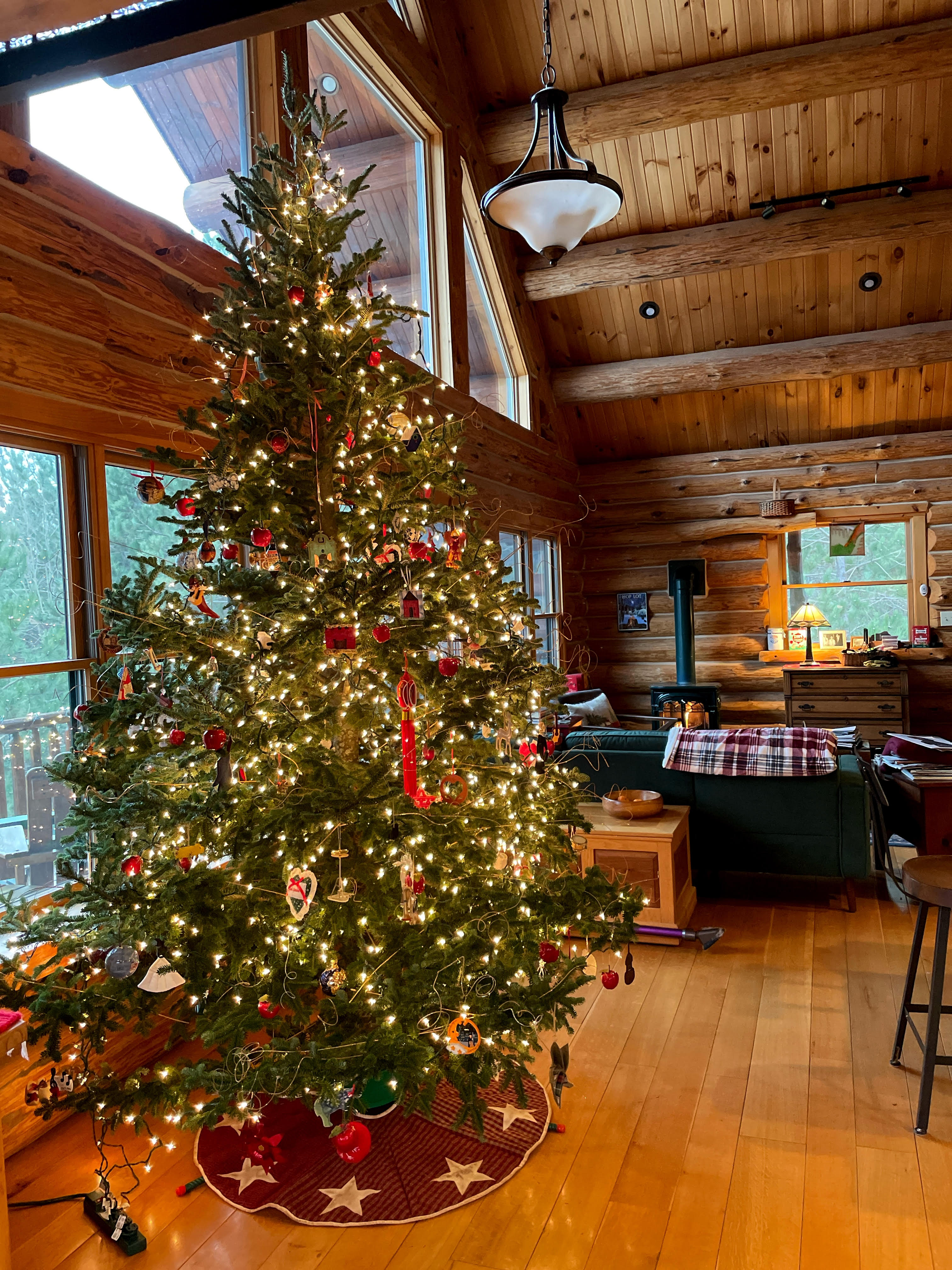
We have purchased beautiful live trees from three different local sources—two of which have gone out of business in the past decade. We are scaling back this year, with a 9-foot Fraser Fir (the photo, a 12-foot Fraser, is from two years ago). Neither of us wants to get on anything higher than a stepstool anymore.

The tree cost $60, a $10 increase over last year, with the elderly, babushka-ed lady at the cash register apologizing to each and every customer. They have to charge more, she says, to stay in business. There are lots of post-teens working—hard—in the miserable cold, probably the same ones who had summer jobs trimming trees with machetes.

Our tree was cut less than 24 hours before we took it home, bundled and tied into the back of our pickup by those same local guys. It can eventually be chipped into mulch. It smells nice.

Best of all, it’s a subtle strike-back at the wave of Artificial “Intelligence” rolling toward us.

O Tannenbaum. Wie Treu sind deine Blatter.

Happy Holidays to all Teacher in a Strange Land readers.

Are Schools the Problem?

I was somewhere between irritated and curious when I saw the headline: America’s Children Are Unwell. Are Schools Part of the Problem? The subhead: From A.D.H.D. to anxiety, disorders have risen as the expectations of childhood have changed.

Well, yeah. A.D.H.D. is now better defined and diagnosed. And I certainly believe that anxiety is on the rise with our youngest people—their world came crashing down five years ago with a global pandemic.

Although I don’t think the subhead writers were thinking of this, anxiety must be through the roof for children of the undocumented, attending school while praying that their mom will come home after work and that they will still be citizens after the Supreme Court gets another whack at the Fourteenth amendment.

But have our expectations of children really changed? And are schools at fault?

Annoying headline aside, there’s a lot of alarming data in the article:

‘One million more children were diagnosed with A.D.H.D. in 2022 than in 2016. The numbers on autism are so shocking that they are worth repeating. In the early 1980s, one in 2,500 children had an autism diagnosis. That figure is now one in 31. Nearly 32 percent of adolescents have been diagnosed at some point with anxiety; the median age of “onset” is 6 years old. More than one in 10 adolescents have experienced a major depressive disorder, according to some estimates.’

It’s actually an informative read. Diane Ravitch deftly reviewed the piece in a blog post entitled Our Pressure Cooker Schools Are Destroying Children and Childhood. In fact, people have been writing about the ever-growing pressure on kids to excel for decades (especially those in high schools where getting into the Ivies or considering a gap year is common).

A couple of decades ago, ironically, we were talking about high-pressure Asian schools and why Singapore topped the international test scores. Was that what our kids needed—a literal kick in the pants? More competition? And why wasn’t the school providing that?

Here’s the thing: Schools in general—more about that word in a minute—aren’t the cause of students’ mental health issues. Schools do what they can with what they’re given, and what they are directed to do, for the most part.

First, a “school” is not precisely defined. Let’s say a good school has competent teachers, capable and cooperative support staff, thoughtful administrators, a clean and safe facility and enough resources to serve the kids assigned there. Those features can all be undone by bad policies and the social factors surrounding the school.

When the halls are lined with buckets catching snowmelt, when there is no library or science equipment, when one of the children hid a gun in his backpackwhere do we place blame? On voters who turned down the school bond issue? On the beleaguered principal? The careless parents who set a bad example? State legislatures that take money away from high-poverty public schools and give it to those who can afford private schools?

To say that “schools” are responsible for an uptick in mental health issues for students is not only unfair—it’s not accurate. The world—especially in 2025—is a scary place. For many (not all, but many) kids, school is the safest place for them to be, and I include in that number children who live in nice houses and have plenty to eat.

Have our expectations for children changed? Yes, and often in damaging ways.

Just talk to teachers. They’ll tell you that kindergarten is the new first grade. They’ll share stories of kids whose behavior is driven by shame and frustration. They’ll tell you that 15 minutes of outdoor play is a benefit, not a waste of time better used on worksheets. They’ll testify that building a cooperative community is always the first step toward learning, in pre-school and in chemistry class. They can tell stories about seeing kids work through an academic roadblock, with patience and humor—not shaming and blaming.

Veteran teachers will also pinpoint the time at which screen time and access to inappropriate, even dangerous, content began to change the way kids talk to and about each other.

Maybe we start addressing mental health issues by understanding just what it is that is making children anxious and distracted, and putting our attention and resources there.

 Don’t misunderstand—I’m not saying that schools (in addition to all the other jobs they’re expected to do) can “fix” a child with failing mental health. But schools can be a significant factor in contributing to a child’s sense of security, belonging and worth.

Youth. For Christ? At School?

I should probably preface what I’m about to say by noting that I self-identify as a liberal Christian. Without getting too far into the theological weeds—or alienating those who are rightfully skeptical about some current Christian churches’ lack of commitment to feeding the poor, etc.—I have been a church member and/or employee for decades, off and on.

All the way back to the 5th grade, in fact, playing “Angels We Have Heard on High” on my flute and swapping out my little-kid animal ears for a white robe and tinsel halo in the church Christmas pageant. Good times.

Or maybe—not so good. I’ve dealt with the insertion of religious tunes into public school holiday programs for my entire career. It’s the evergreen issue for music teachers in December. Bottom line: Public schools need to tread lightly, when it comes to the separation of church and state, even at times when you are hearing angels on high in your local grocery store or used car lot.

I retired—for good—from my last church music director position after Easter, and have since had the pleasant experience of being asked to play in several local churches, which are always looking for free talent.

Last summer, I was surprised to play a service and see two dozen teenagers seated together. There was a junior trad-wife fashion sense for the girls, all with long, curled hair and cute summer dresses. The girls were mostly carrying Bibles; the boys, with their llama-head haircuts, were carrying phones (and scrolling on them during the sermon).

Later, I learned that they were a newly organized chapter of Youth for Christ, meeting with their leaders (an attractive, early-20s married couple), in their home for coffee and prayer before school. Several of them had been baptized by that couple in Lake Michigan, earlier that month.

The guy sitting next to me at the service whispered that he was hoping that these kids were associated with Charlie Kirk’s Turning Point USA, which claims over 1000 chapters in high schools across the country: ‘Turning Point USA is also getting an assist from Republican leaders. The U.S. Department of Education announced it was partnering with the organization, along with dozens of other conservative groups, to launch a coalition to produce educational programming for schools and universities in advance of America’s 250th birthday next year.’

Eek.

I can’t tell you, precisely, what made me most uneasy about seeing perhaps 25 teenagers attending a conservative church en masse. None of the small, rural churches in this county have dozens of HS-aged members, for starters—so their organizational point was obviously somewhere other than an actual church. And the occasional teenager who showed up at the church where I worked never came dressed like a candidate on Bama Rush or looking like a Department of Labor poster boy.

It turns out that the Youth for Christ leaders are salaried, and were posted here to start a chapter, a task they accomplished by volunteering at a local school district. They got some help from a friendly uncle (real estate here is sky-high), and found a place downtown to meet, then began recruiting the kids they met while volunteering as tutors and cafeteria supervisors.

And, miracle of miracles, parents in this conservative community didn’t like it. There were 78 non-consent forms, representing 109 minor children, filed with the Youth for Christ leaders and their organization, saying, essentially: Hands off our kids. If we want them to have religious experiences, we’re in charge of that.

It’s a small school—109 minor children represent a third of the school population. YFC is undeterred, planning to establish a ‘teen hangout’ in the tiny resort downtown, courtesy of Generous Uncle. And downtown merchants, perennially cramped for space, parking and business have turned this into a zoning issue. They might actually win—as I noted, this is a conservative, business-friendly town.

But I want to return to the Christianity—if that’s the right word—inherent in recruiting members for your religious club from a public school setting. When I think about all the angst about not referencing equity, inclusion or diversity in school curricula, and all the book-banning Moms 4 Censorship types showing up at school board meetings, shouldn’t there have been outrage over paid recruiters “volunteering” and proselytizing during lunch?

Not long after Charlie Kirk was killed, CA Governor Gavin Newsome remarked on his goal of organizing young men as effectively as the TPUSA model does. He asked why left-leaning young men have not collectively fought the ‘epidemic of loneliness’ with liberal activism. I don’t have an answer for that, but it’s a good question.

In the season where Jesus sneaks into the daily life of families and communities—Joy to the World!—I am in favor of parents’ careful attention to who’s recruiting their kids.