
Empathy. Again.

A couple of years ago, I was astonished to learn that the school where I taught, for over 30 years, had declared war on… empathy. Yes, empathy, a quality I assiduously cultivated in my music classes and was—at one time—referenced in our school mission statement, as the nurturing of ‘caring individuals of all ages.’

Later, I learned that empathy was now being targeted by the Heritage Foundation.

Since then, it’s become one of those words or concepts that you see everywhere. Including from Elon Musk, who called it the fundamental weakness of Western Civilization. This was, BTW, about the time he and Big Balls were stealing your personal data from the government, under the guise of rooting out fraud. No empathy for you!

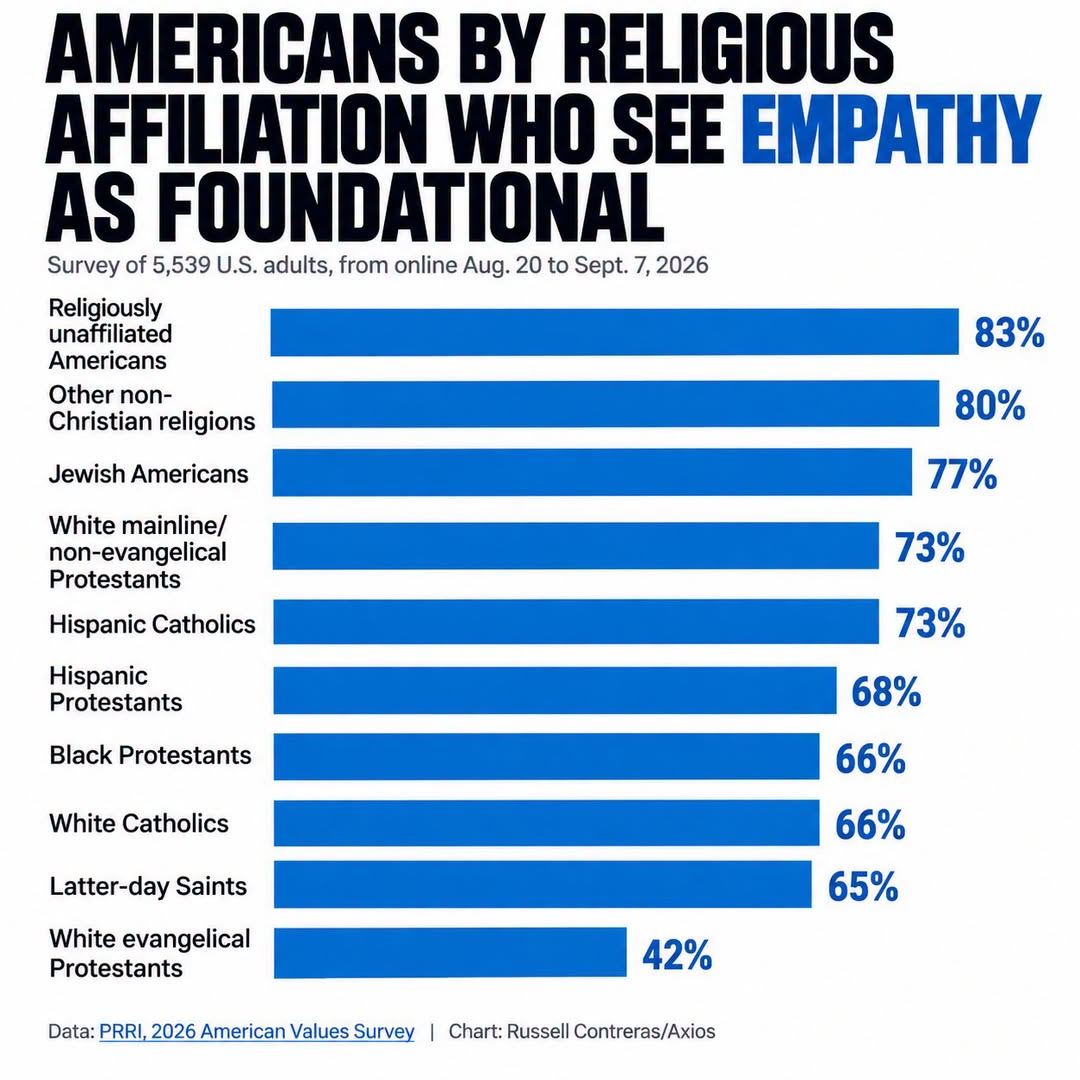
Here is some recent survey data from PRRI:

‘A new PRRI survey asked Americans whether empathy is a foundational moral value that helps build a healthy society. Among the religiously unaffiliated, 83% agreed. Among Jewish Americans, 77%. Among Latter-day Saints, 65%. Among white evangelical Protestants, 42%.

The same survey found that 54% of white evangelicals agree empathy can become dangerous when it leads people away from “a society guided by God’s truth.” No other major religious group put a majority behind that statement.

The widest split was over Christian nationalism. Of the people PRRI classifies as adherents, 38% called empathy foundational. Of those who reject it, 94%.’
I need to take a minute here to reflect on just what “God’s truth” means to white evangelicals. Even agnostics and atheists understand that there are some principles—love your neighbor as yourself—that are universal to world religions and pretty good guidelines for everyone, believer or non-, choosing peaceful lives. And weren’t we a nation FOUNDED on freedom of religion, or lack thereof?

I’m much more interested in the outcomes of building a school culture on caring for humans (and property, as stewardship of community resources), than the outcomes of a culture that cares first about competitive test scores.

One of my wisest teacher friends, Mary Tedrow, mused once that we used to talk about our historic purpose as teachers being building good citizens. Those citizens were our product—some went to college, some went into the workforce, some to the military, some to raising the next generation of students. Now, Mary said, our product is test scores.

And woe to the empathetic teacher who elevates building a community where students respect each other, feel responsibility for each other’s happiness and success, over competitive score-grubbing.

I’ve been thinking about the utter lack of empathy we’ve seen in midterm campaigns. If you Google “opposite of empathy” you get a range of unpleasant emotional responses, from apathy through insensitivity to contempt, heartlessness and sociopathy. None of which seems like something schools should be endorsing.

The poster child—poster ad, actually—for this lack of empathy is Vivek Ramaswamy’s zero-empathy-for- childhood-abuse advertisement featuring Amy Acton’s elderly, estranged and mentally ill mother. Salon points out that the ad also suggests there is another audience his campaign has in mind: aging MAGA voters who are obsessively angry about the phenomenon of parental estrangement.

You’ll never guess who MAGA blames for all this parental estrangement. Yup. Your local school, and its empathy-coded mission statement and libtard teachers willing to give other people’s kids extra help and second chances.

One of my favorite columnists, Jonathan V. Last at The Bulwark, takes a closer look at the PRRI data, and Christian Nationalism. Read it! Standout quote: Societies that lack empathy cannot sustain either liberalism or democracy.

I think—no data to back this up—that an overwhelming majority of public school educators would agree.

JV Last, again: ‘Cultural changes produce institutional changes. To a measurable extent, the culture of American Christianity among white Protestants and, increasingly, white Catholics, has shifted toward Christian nationalism. As such, large numbers of adherents now reject foundational principles of Christianity in order to reconcile the faith to their political preferences.’

And this, lest you think this is just a Trump thing:

JD Vance does not believe in the Christian doctrine of compassion, empathy, and help to those ailing and in need. Instead, he embraces the Musk/Thiel doctrine which puts self-love first and teaches that empathy is a blight on the world.

Repeating: Societies that lack empathy cannot sustain either liberalism or democracy.

Ball’s in our court, fellow voters.
Youth. For Christ? At School?

I should probably preface what I’m about to say by noting that I self-identify as a liberal Christian. Without getting too far into the theological weeds—or alienating those who are rightfully skeptical about some current Christian churches’ lack of commitment to feeding the poor, etc.—I have been a church member and/or employee for decades, off and on.

All the way back to the 5th grade, in fact, playing “Angels We Have Heard on High” on my flute and swapping out my little-kid animal ears for a white robe and tinsel halo in the church Christmas pageant. Good times.

Or maybe—not so good. I’ve dealt with the insertion of religious tunes into public school holiday programs for my entire career. It’s the evergreen issue for music teachers in December. Bottom line: Public schools need to tread lightly, when it comes to the separation of church and state, even at times when you are hearing angels on high in your local grocery store or used car lot.

I retired—for good—from my last church music director position after Easter, and have since had the pleasant experience of being asked to play in several local churches, which are always looking for free talent.

Last summer, I was surprised to play a service and see two dozen teenagers seated together. There was a junior trad-wife fashion sense for the girls, all with long, curled hair and cute summer dresses. The girls were mostly carrying Bibles; the boys, with their llama-head haircuts, were carrying phones (and scrolling on them during the sermon).

Later, I learned that they were a newly organized chapter of Youth for Christ, meeting with their leaders (an attractive, early-20s married couple), in their home for coffee and prayer before school. Several of them had been baptized by that couple in Lake Michigan, earlier that month.

The guy sitting next to me at the service whispered that he was hoping that these kids were associated with Charlie Kirk’s Turning Point USA, which claims over 1000 chapters in high schools across the country: ‘Turning Point USA is also getting an assist from Republican leaders. The U.S. Department of Education announced it was partnering with the organization, along with dozens of other conservative groups, to launch a coalition to produce educational programming for schools and universities in advance of America’s 250th birthday next year.’

Eek.

I can’t tell you, precisely, what made me most uneasy about seeing perhaps 25 teenagers attending a conservative church en masse. None of the small, rural churches in this county have dozens of HS-aged members, for starters—so their organizational point was obviously somewhere other than an actual church. And the occasional teenager who showed up at the church where I worked never came dressed like a candidate on Bama Rush or looking like a Department of Labor poster boy.

It turns out that the Youth for Christ leaders are salaried, and were posted here to start a chapter, a task they accomplished by volunteering at a local school district. They got some help from a friendly uncle (real estate here is sky-high), and found a place downtown to meet, then began recruiting the kids they met while volunteering as tutors and cafeteria supervisors.

And, miracle of miracles, parents in this conservative community didn’t like it. There were 78 non-consent forms, representing 109 minor children, filed with the Youth for Christ leaders and their organization, saying, essentially: Hands off our kids. If we want them to have religious experiences, we’re in charge of that.

It’s a small school—109 minor children represent a third of the school population. YFC is undeterred, planning to establish a ‘teen hangout’ in the tiny resort downtown, courtesy of Generous Uncle. And downtown merchants, perennially cramped for space, parking and business have turned this into a zoning issue. They might actually win—as I noted, this is a conservative, business-friendly town.

But I want to return to the Christianity—if that’s the right word—inherent in recruiting members for your religious club from a public school setting. When I think about all the angst about not referencing equity, inclusion or diversity in school curricula, and all the book-banning Moms 4 Censorship types showing up at school board meetings, shouldn’t there have been outrage over paid recruiters “volunteering” and proselytizing during lunch?

Not long after Charlie Kirk was killed, CA Governor Gavin Newsome remarked on his goal of organizing young men as effectively as the TPUSA model does. He asked why left-leaning young men have not collectively fought the ‘epidemic of loneliness’ with liberal activism. I don’t have an answer for that, but it’s a good question.

In the season where Jesus sneaks into the daily life of families and communities—Joy to the World!—I am in favor of parents’ careful attention to who’s recruiting their kids.