Teach Your Children Well

It used to be fairly common in Traverse City, Michigan—a Michael Moore sighting. I once stood in line behind him at a Coldstone Creamery on Front Street (no longer there, alas). During the summer TC Film Festival (also no longer in existence), he was everywhere, leading panel discussions and walks around TC’s beautiful, turn-of-last-century downtown neighborhoods.

Michael Moore’s star has faded here, for various reasons. He’s never been an easy person to watch on TV, full of himself and, sometimes, an explosive but unreliable narrator of what’s happening in this country. You certainly know where he stands—but he can be a grating spokesperson.

Nevertheless, I read his free newsletter and found his April 30 column on the Vietnam Warwhere he points out that we’ve never as a nation, admitted our guilt or apologized–moving and worth deep consideration:

“They kicked the ass of a military superpower — and sent 60,000 of our young men home to us in wooden boxes (nine of them from my high school, two on my street) and hundreds of thousands more who returned without arms, legs, eyes or the mental capacity to live life to its fullest, forever affected, their souls crushed, their nightmares never-ending. All of them destroyed by a lie their own government told them about North Vietnam “attacking” us and the millions of Americans who at first believed the lie. This past November 5th showed just how easy it still is for an American president, a man who lies on an hourly basis, to get millions of his fellow citizens to fall for it. 

I think we need to do this for our children’s sake, for our grandchildren, for the sake of our future if there still is one for us. We should take just one day every year and participate in a national day of reckoning, recollection, reflection, and truth-telling, where together we actively seek forgiveness, make reparations and further our understanding of just how it happened and how easy it is for the wealthy and the political elites and the media to back such horror, and then to get the majority of the country to go along with it… at least at first. And how quickly after it’s over we decide that we never have to talk about it again. That we can learn nothing from it and change nothing after it. 

Teach our children this truth about us. About our history. Give them this knowledge and with it comes the opportunity for us to change and make different choices for our future. To be a different people. A peaceful people. The Germans did it. The Japanese, too.”

And here we are, again, creating an unnecessary war—this time on our own city streets. And the question bubbles up: Are we teaching our children the truth about the place where they live? And, even more important, what will happen if/when they believe the lies their government is peddling?

I was interested in this observation from the new National Teacher of the Year, Ashlie Crosson, from Pennsylvania: “Teachers shouldn’t shy away from using challenging texts and conversations in their classrooms, even if they touch on divisive topics.

It’s a reasonable statement you might expect from any accomplished teacher—but one that could now get you fired in some states and districts. Chaos and fear and flooding the zone are part of media assessments of public education in June 2025, along with smiling photos of HS graduates and end-of-year academic honors.

Robert Reich said it well:
“Why is Trump trying to cancel “Sesame Street,” which has helped children learn to read and count for over half a century? Why is he seeking to destroy Harvard University? Why is he trying to deter the world’s most brilliant scientists from coming to the United States?

Because he is trying to destroy American education — and with it, the American mind.”

Is there anything teachers can do to stop the ongoing attack on becoming genuinely well-educated? To not be fearful of ideas or painful truths?

Individual teachers are seldom visible enough to draw widescale media-fed wrath (which is why I found the new National TOY’s remarks brave)—political opponents of public education generally target teacher unions, well-endowed universities, and programs that provide free breakfast and lunch or wraparound healthcare for kids who need it.

With the upcoming NO KINGS National Protests, I’ve seen lots of social media memes urging people to do what they can. To march and carry signs, of course—but also to speak to those in their circle of influence, to write, to model democratic principles. To behave as engaged citizens—and to teach their children the truth about our history, with the goal of becoming a peaceful people.

Let’s teach our children well. (click—it’s worth it)


RIP, Libraries and Museums

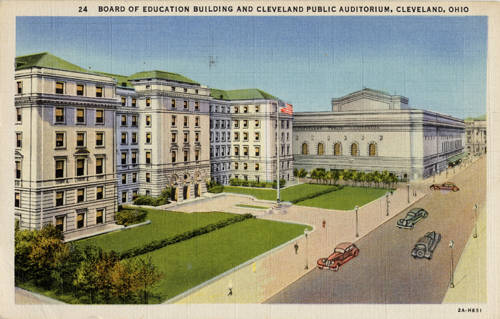
On our way home from the Network for Public Education conference, earlier this month, we jogged to the right and spent a night in Cleveland, so we could visit the Rock and Roll Hall of Fame. Our hotel, just a couple of blocks from the Hall of Fame, used to be the Cleveland Board of Education building, completed in 1931.

It’s a magnificent structure, all marble, soaring windows, colorful painted murals and wide hallways, with a bar named The Teachers’ Lounge. Who could resist?

It made me wonder about the value Cleveland currently places on their public schools, when a century ago they commissioned this monument to public education, likely assuming that generations of Ohio kids would be duly and proudly educated in Cleveland, and go on to do great things.

They don’t build ‘em like they used to—either our buildings or our midwestern dreams of progress.

The history of the Cleveland Metropolitan School District looks like the history of many big-city school districts, scarred by changing demographics and the public’s unwillingness to support all children with a free, high-quality, fully public education. Cleveland is not unique—there are still Pewabic pottery-tiled fireplaces in public schools built in the 1920s in Detroit. You can take a bike tour of historic, architect-designed schools in Chicago.

The ”high school movement”—when it became common for American youngsters to pursue education beyond the 8th grade—occurred in the first half of the 20th century. In 1910, the number of HS graduates in the United States was less than 10%, but by the outbreak of World War II, almost three-quarters of the student population attended high school. Many factors—mainly wars, rural-urban migration, and an economic depression—shaped the movement to make 12 years of education the norm.

And, of course, what was the norm for white kids did not necessarily apply to children of color. The Brown decision in the 1950s and school busing protests in the 1970s interrupted the rosy national vision of steadily increasing investment in our public services and institutions.

Not to put too fine a point on it, but America has always struggled with the concept of “all means all” –just who “deserves” to have nice things, like decent housing and basic health care. Schools. Libraries, museums and parks. A reliable, inexpensive postal service. Public universities. The kinds of services we share, places of mutual benefit. Our freedoms.

And now, we have elected a man whose fundamental life goal seems to be taking those things we share—the things we all deserve, and have worked for, as citizens in a constitutional republic– away from us.

Defunding public services and institutions. Privatizing the Post Office, which serves rural addresses that Federal Express won’t touch. Shutting down youth programs and the Summer Reading Club at your local library. Eliminating programs for veterans. Even—God help us—shutting down suicide hotlines for LGBTQ teens.

As I watch this wrenching tear-down of all the things that make for strong communities, I am staggered by this conundrum: Trump and his acolytes have embraced the idea of making America great again by attacking the very things that actually made us great, beginning with the solid belief in our future progress that drove the city of Cleveland to build a temple to public education, and finish it during the early years of the Depression, placing a statue of Abraham Lincoln on the manicured lawn in front.

Belief in our people and their future is behind untold numbers of beautiful, shared enterprises—theatres and hospitals, stadiums and churches. Monuments to philanthropy, and showcases for art and culture. National parks that tell our nation’s stories. Organizations established to help our fellow citizens.

What is behind the impulse to tear all this down, close it off, let it crumble, progress and humanity be damned? Who does this—and why?

None of this is genuinely about waste or fraud—or even evidence of out-of-control DEI thinking. How can there be too much equity or justice in a country that prides itself on inventing a new form of government?

From an article about Lindsey Halligan (see link for revelatory photo), now charged with “removing improper ideology” from Smithsonian museums:

“I would say that improper ideology would be weaponizing history,” Halligan says. “We don’t need to overemphasize the negative.” Halligan, 35, is a Trump attorney who seems to have tasked herself as a sort of commissioner — or expurgator, according to critics — of a premier cultural institution.

Trump is not much of a museumgoer. 

What he’s after is power and control and riches. The men who built the infrastructure of industrial America wanted power, control and riches as well. Some of them wanted to preserve the vile institution—slavery—that made their power and riches possible. We fought a bloody, devastating civil war over the very issue of who deserves to be represented in museums, check out books from the library, or send their children to free public schools.

And here we are, again.

The Rock and Roll Hall of Fame was wonderful. I’ve been a handful of times, and have taken 150 eighth graders—I’ve got stories—to wade around in the history of the music that has surrounded them since birth. The museum is 100% private, funded by wealthy donors and $39.50/per ticket fees. It will not be torn down, stripped for parts or sold to the highest bidder.

As I was wandering through the main exhibit hall on the lower level, I started thinking about how the roots of rock music, like the labor of enslaved workers, were essentially stolen from African-American blues and gospel singers, mixed with rough-edged country, hillbilly and western music. And then sold to the masses, after condescending  public dismissal as unimportant and vulgar.

Power and control and riches. Plus ça change, plus c’est la même chose.

A Veteran Teacher’s Thoughts about ADHD

I can remember the first time I heard about ADHD. It was in the early 1990s—and the person who was educating me was the mother of one of my students. His teachers—six of us, plus an admin—were sitting around a table, meeting to discuss his classroom behaviors (not good), when she whipped out stapled packets of articles on ADD.

He’d been officially diagnosed, and she was part of a parent support group, which provided materials for teachers. The packets she gave us were thick—maybe 50 pages—and filled with scientific-sounding information about diagnosis and treatment of this disease, then thought to apply to perhaps three percent of all students.

Reading through it (rather than round-filing it, as a couple of colleagues did), you could see what was coming. The Attention-Deficit Era had begun. He wasn’t hyperactive or oppositional-defiant, or a troublemaker. Not anymore. He had ADD.

Let me say, upfront, that I believe ADHD is a real thing, and using medication judiciously to treat it is often a lifesaver for parents and teachers. Let me also say that the way some classrooms operate is not conducive to deep learning for a range of students who need lots of movement and hands-on activities. And—side note– this is often not their teachers’ fault, given our increasing national focus on testing, compliance and narrowing the curriculum. Raising the damned bar.

I was horrified to read in Paul Tough’s excellent piece in the NY Times Magazine, Have We Been Thinking About A.D.H.D. All Wrong?  that nearly a quarter of 17-year old boys in the United States have now been diagnosed as having ADHD. Tough does a good job of tracking the factors—drug treatments, specifically—that have made one in four boys unable to focus in a quiet classroom without chemical assistance.

He rightfully notes that ADHD symptoms also look like a lot of other things: anxiety, head injury, lead exposure and many other traumas.

But the piece ends on a hopeful note, with lots of testimony from young adult men who have found the right jobs and life circumstances and seldom experience troublesome ADHD symptoms. Which makes me ponder what there is about school that makes the kids we used to call hyperactive need drugs to get by every day, even though the medicines don’t improve their learning.

“Believing the problem lay in their environments rather than solely in themselves helped individuals allay feelings of inadequacy: Characterizing A.D.H.D. as a personality trait rather than a disorder, they saw themselves as different rather than defective.”

The kid whose mother insisted he had a disease, rather than merely being disobedient? He was, in fact, hyperactive and prone to (cheerfully) destroying order in a classroom. Once, while I was moving band equipment, chairs and stands across the hall from the band room for an assembly in the gym, I instructed him to load percussion equipment on a flat pushcart. (Teacher tip: Always give restless students an important job.)  

Instead, he assembled the drum set on the cart, then had another kid push him down the hall while he pounded out a little Metallica. Down the hall—and past the office. It didn’t end well for either of us. He wasn’t a bad drummer, by the way. According to mom, it was his favorite class.

I looked him up on internet, and he’s now a multimillion-selling real estate agent. Go figure.

I taught for two more decades after that day I first heard of ADD. Lots more students were diagnosed with ADD, over time—then, ADHD. My colleagues and I talked often about accurate language, and accurate diagnoses, and the differences in kids when they were medicated. Sometimes, parents let teachers know their child had been diagnosed—sometimes, they didn’t.

I took kids to camp and on field trips where I had to administer their ADHD medications, or have conversations with their concerned parents about behavior issues when they were unmedicated—at an evening performance or band camp.

And I often felt grateful that I was teaching band, with 65 students at once, all holding noisemakers. There was a lot of stimulation in the band room, plenty of activity. There was also discipline (because otherwise there would be chaos), but my attention-deficit kids could tolerate rules and procedures, as long as they were moving and doing things. Mostly.

I also taught 7th grade math for two years. I found that maintaining student focus with 28 students in a desks-and-chalkboard setting was often way more difficult than keeping 60 band kids on track.

Read Paul Tough’s piece, if you get a chance. It’s nuanced and layered with contradictions, like most things about schooling, and raising healthy children. We could be doing lots more for kids who are immersed in screens and entertainment daily, and have difficulty staying on task when that task involves paper and pencils.

But then—we could be doing a lot more for many kids, who bring their various backgrounds and issues to school. If only we had the resources. And a genuine commitment to the next generation.

SRFilterFavoriteBlackwhitesoft: kSREffectControlIntensityKey =

The Reason We Still Need Conferences

I am just back from the Network for Public Education conference, held this year in Columbus, Ohio. Columbus is an eight-hour drive from my house, and we arrived at the same time as ongoing flood warnings. But—as usual—it was well worth the time and effort expended.

For most of my career—35 years—I was a classroom teacher. Garden-variety teachers are lucky to get out of Dodge and attend a conference with their peers maybe once a year. Teachers don’t get airfare for conferences in other states and often end up sharing rides and rooms, splitting pizzas for dinner. They go with the intention of getting many new ideas for their practice toolboxes—lesson plans, subject discipline trends and tips, cool new materials—and to connect with people who do what they do. Be inspired, maybe, or just to commiserate with others who totally get it.

In the real world (meaning: not schools), this is called networking. Also in the real world—there’s comp time for days missed at a weekend conference, and an expense form for reimbursements. Conversely, in schools, lucky teachers get a flat grant to partially compensate for registration, mileage, hotel and meals. In many other schools, nobody goes to a conference, because there’s just not enough money, period.

When you hear teachers complaining about meaningless professional development, it’s often because of that very reason—there’s not enough money to custom-tailor professional learning, so everyone ends up in the auditorium watching a PowerPoint and wishing they were back in their classrooms.

Back in 1993, when Richard Riley was Secretary of Education, his special assistant, Terry Dozier, a former National Teacher of the Year, established the first National Teacher Forum. (In case you’re wondering, the Forums lasted just as long as the Clinton administration, and Riley, were in the WH.) Teachers of the Year from all 50 states attended. The purpose of the conference was to engage these recognized teachers in the decision-making that impacted their practice. In other words, policy.

It was probably the most memorable conference I ever attended. I took nothing home to use in my band classroom, but left with an imaginary soapbox and new ideas about how I could speak out on education issues, engage policymakers, and assign value to my experience as a successful teacher. The National Teacher Forum literally changed my life, over the following decades.

But—the idea that teachers would start speaking out, having their ideas get as much traction as novice legislators’ or Gates-funded researchers, was a hard sell. Education thinkers aren’t in the habit of recognizing teacher wisdom, except on a semi-insulting surface level. In the hierarchy of public education workers, teachers are at the lowest level of the pyramid, subject to legislative whims, accrued data and faulty analyses, and malign forces of privatization.

Which is why it was heartening to see so many teachers (most from Ohio) at the conference. The vibe was big-picture: Saving public education. Debunking current myths about things like AI and silver-bullet reading programs. Discussing how churches are now part of the push to destabilize public schools. New organizations and elected leaders popping up to defend democracy, school by school and state by state.  An accurate history of how public education has been re-shaped by politics. The resurgence of unions as defenders of public education.

Saving public education.  A phrase that has taken on new and urgent meaning, in the last three months. Every single one of the keynote speakers was somewhere between on-point and flat-out inspirational.

Here’s the phrase that kept ringing in my head: We’re in this together.

The last two speakers were AFT President Randi Weingarten and MN Governor Tim Walz. I’ve heard Weingarten speak a dozen times or more, and she’s always articulate and fired-up. But it was Walz, speaking to his people, who made us laugh and cry, and believe that there’s hope in these dark times.

He remarked that his HS government teacher—class of 24 students, very rural school—would never have believed that Tim Walz would one day be a congressman, a successful governor and candidate for Vice-President. It was funny—but also another reason to believe that public schools are pumping out leaders every day, even in dark times.

In an age where we can hear a speaker or transmit handouts digitally—we still need real-time conferences. We need motivation and personal connections. Places where true-blue believers in the power of public education can gather, have a conversation over coffee, hear some provocative ideas and exchange business cards. Network.

Then go home–and fight.

Trump and his “Aptitude for Music”

There are so many things to be said about the ongoing demolition of the American government that your average reader—even someone who follows politics closely–can’t keep up. Everything from the Massive Erroneous Deportation to the Declaration of Independence in the Oval Office to the biggest upward transfer of wealth in history. Not to mention Goodbye to the Department of Education.

Lots of great writing about where we find ourselves as a nation, as well—I am learning to get along without the Washington Post, with the great political commentary coming from independent newsletters like The Contrarian, Meidas, Robert Reich, Heather Cox Richardson, Lucian Truscott, The Education Wars and the Bulwark, which are only the ones I’m currently paying for. Can’t add much, beyond my personal open-mouthed horror, to the wall-to-wall political coverage available.

However. Here’s one inane Trump declaration where I have considerable expertise: Touring Kennedy Center, Trump Mused on His Childhood ‘Aptitude for Music.’ 

In case you’ve missed it (and you’re forgiven if you have): President Donald J. Trump — who recently overhauled the once-bipartisan board of directors at the John F. Kennedy Center for the Performing Arts and installed it with loyalists who elected him to serve as its chairman — held court Monday in a place that he had not publicly visited during either of his terms in office: the Kennedy Center.

Remarks were made to the Washington Post by Trump officials who recently toured the arts venue and described it as “filthy,” noted that it “smelled of vomit,” and added that they “saw rats.”

But not to worry! Trump alone can fix the Kennedy Center. In fact, Trump—who could have been a superb musician, if his parents hadn’t pushed him into becoming an outstanding athlete and phenomenally successful businessman instead— can add “born arts connoisseur” to his  already-substantial resume’. Because ‘the test’ showed what we’ve all missed: the guy who bragged about punching out his music teacher in second grade was really an untapped musical genius.  

First of all: Hahhahahhahaha.

Like all Trump anecdotes—Sir! Sir!– this one is mainly bullshit: He told the assembled board members that in his youth he had shown special abilities in music after taking aptitude tests ordered by his parents, according to three participants in the meeting. He could pick out notes on the piano, he told the board members.

If you polled actual music teachers, all of them could tell you stories about small children whose parents considered them exceptional, because they could dance to a beat , clap a rhythm or pick out a tune on the keyboard. Many of them had a great-grandmother who taught piano or uncle who was a whiz on the saxophone—thereby confirming that their talent was inherent, according to mom.

Some of those kids (especially the ones whose parents encouraged practice and persistence, attending every concert) turned out to be good musicians, after some basic musical instruction. Others, not so much.

Second: Testing children’s innate musical ability has fallen out of favor, for the same reasons that other standardized testing has been rightfully criticized. In the post-war years, a ‘musical abilities test’—the Seashore Test—was popular, often used to determine who should get to use expensive school-owned instruments. I took it myself, in the 4th grade.

What the Seashore Test did, mostly, was identify kids who had some musical experience—piano lessons, singing in the church choir, music-making in their families. Because the more you do music, the better your ‘ear’ and sense of rhythm. Kind of like the way kids who go on family trips to the library or museum get a leg up on other kids, when tested on their reading abilities or content knowledge.

Is there such a thing as talent? Sure. But testing as a means of determining talent—or taste, or creativity—when the testee is a child is pointless. Genuine, exceptional talent emerges as a result of passion and tenacity and, sometimes, good luck.

Here’s a story about my own failing in assessing talent, as a music teacher.

Why did such testing fade away? Because it missed a lot of students who became strong musicians—singers and trombonists, the lead in the school musical—down the road.

Lesson learned: ALL children should all enjoy making music in our schools. Because you never know if someday your child might be Chair of the Kennedy Center Board.

Five Things Your Child’s Teacher Accomplished Last Week

When I first heard about Elon Musk’s email blast to over two million federal employees directing them to submit approximately five bullet points of what they accomplished in the previous week, I was reminded of a couple of school administrators from my past.

Eugene Robinson called Musk’s scheme “an exercise in contempt”—also a great description of some of the so-called professional development teachers routinely endure. When a principal doesn’t trust their professional staff to know what they’d like to do with time available for their own learning or planning, you end up with meaningless exercises like “five things I did last week.”

Ultimately, it’s about control.

Eugene Robinson, again: Thus begins the inevitable power struggle at the court of Mad King Donald, between his various ministers of state and his billionaire Lord High Executioner.

No word yet on whether the soon-to-be defunct Department of Education will demand five bullet points of the 3.8 million public school teachers in the U.S., given that 13.7% of the funding for public schools comes from the feds, give or take.

But there’s no need to put teachers through that particular, umm, wood chipper. I can supply the federal government with five bullet points that apply to all teachers, summarizing their most recent contribution to the education of America’s youth.

Here are five things that all teachers accomplished last week:

  • They showed up. They showed up when the driving was treacherous, even when their own homes were threatened by floods. They showed up when they were sick or hadn’t slept, because it’s easier to teach with a cold than find a sub. They showed up because it was test day, or the field trip, or opening night of the school play, or because a particular student didn’t do well with strangers at the head of the classroom. They showed up, because thanks to a global pandemic, we now know that virtual school is not the solution to cheap and easy public education. Personal relationships matter.
  • They planned a learning experience that failed. That’s par for the course, by the way. Most lesson plans fail to accomplish their goals, 100% and immediately. That’s because kids learn differently, through different means and at different rates. The slam-dunk lesson plan that teaches everyone all they need to know, challenging the brightest and scooping up the laggards, doesn’t exist. What happens when a lesson goes sideways today? Experienced teachers adapt and adjust–and reinforce tomorrow.
  • They dealt with diversity, equity and inclusion, even the AP teachers with classes of 12 well-behaved senior calculus students. D, E and I are endemic in K-12 education—not the fake shorthand of “woke,” but the bedrock truth-in-practice of embracing student differences, playing fair as a teacher, and building a learning community where everyone is valued.
  • They exposed themselves to the viral miasma of 30 small, touchy-feely children, or perhaps 150 sniffly teenagers, in their role as caretaker. Let me repeat that: they acted as caretakers, with the school being a safe and (key word) free place for children of all ages to spend their weekdays. The lack of affordable childcare across the country makes schools a first line of defense in an economy where parents need to be in the workplace.  And parents send their kids to school when they’re sick. #Truth                       
  • They did the intellectual heavy lifting of observation, instruction, assessment and accompanying record-keeping on the learning of a large number of children. This, of course, is a teacher’s actual job, and it’s harder than it looks to the casual observer. Teachers take their work home—not just grading and lesson plans but worries and concerns. Keeping tabs on the students in their charge—so they could learn.

Here are some things your child’s teachers did NOT do last week:

  • Go out for lunch at a nice restaurant and indulge in a glass of wine.
  • Use the bathroom whenever the urge arose.
  • Spend most of their day in an office or cubicle, blessedly alone with their thoughts and their work.
  • Talk to other adults for an extended time–on the phone, or in casual conversation.
  • Duck out for a medical appointment that had to be scheduled during the workday.
  • Decide to knock off early, and get in a round of golf.

So—should the Billionaire Lord High Executioner come after public school educators, further annihilating America’s once-proud, once-functional institutions, keep your heads down and just say no to the five bullets.

Who is in Favor of Authoritarianism? Are Schools Authoritarian?

In 2014, we went on a much-anticipated two week cruise—the Grand European, from Budapest to Amsterdam. On the first day, we took a day-long tour of Budapest, with a charming and articulate guide. First stop: Heroes Square.

Our guide was a proud and patriotic Hungarian, well-versed in her nation’s history, all the way back to Atilla the Hun. I am embarrassed to say I knew very little about modern-day Hungary, except for the fact that Hungarian citizens are universally musically literate, because of Zoltan Kodaly, whose method of teaching music to children is internationally renowned.

As the distracted touring group wandered around snapping pictures of the impressive statuary, our guide completed her thumbnail history and then, very quietly, said that Hungarians—so brave and bold—were losing their democratic independence to their authoritarian Prime Minister, Viktor Orban.

Glancing around, she spoke for perhaps two minutes about how he was suppressing freedoms and dismissing the courts, stealing money and power from the people. It was clear that she was nervous, and that this was not part of her assigned guide-spiel. Most of the Americans in this heavily American group were not paying attention to her final, whispered words: You Americans are lucky.

That was 10 years ago. Today, from a piece entitled The Path to American Authoritarianism:

Democracy is in greater peril today than at any time in modern U.S. history. America has been backsliding for a decade: between 2014 and 2021, Freedom House’s annual global freedom index, which scores all countries on a scale of zero to 100, downgraded the United States from 92 (tied with France) to 83 (below Argentina and tied with Panama and Romania), where it remains.

The country’s vaunted constitutional checks are failing. Trump violated the cardinal rule of democracy when he attempted to overturn the results of an election and block a peaceful transfer of power. Yet neither Congress nor the judiciary held him accountable, and the Republican Party—coup attempt notwithstanding—renominated him for president. Trump ran an openly authoritarian campaign in 2024, pledging to prosecute his rivals, punish critical media, and deploy the army to repress protest. He won, and thanks to an extraordinary Supreme Court decision, he will enjoy broad presidential immunity during his second term.

While this is a powerful statement, it is not difficult to find a dozen pieces, by credible authors, in credible publications, saying pretty much the same thing, over the last three weeks. We are headed toward Hungary (Global Freedom Score: 65) or perhaps Saudi Arabia (GFS: 8), where our President is now going to sell out Ukraine (GFS: 49).

It’s clear we are not the land of the free anymore. Nor are we the home the brave. We’re the home of the partisan cowardly and the feckless appeasers.

It is easy to point fingers at the clueless voters who wanted cheaper eggs (and, one hopes, a corresponding end to galloping and threatening bird flu). It’s a short distance from there to wondering why schools are turning out more and more dumb people. If people understood the importance of preserving our liberties, we wouldn’t find ourselves with a completely incompetent president. Again.

This—the ‘let’s blame schools’ rationale—is always popular when things are shaky politically. Richard Nixon blamed ‘bums blowing up campusesfor political unrest, rather than his own disastrous foreign policy. Academic and political scholars spent decades comparing Johnny and Ivan, invariably coming to the same conclusion: our schools suck, when it comes to preparing upstanding and industrious citizens. That we are now preparing to aid Russia in its criminal intent to capture some or all of a struggling democracy, Ukraine, is the ultimate irony.

Schooling is actually one of those public institutions where a kind of benign authoritarianism—because I said so—is commonplace, even approved. When Alabama Senator Tommy Tuberville suggested that kids who have ADHD don’t need medication—they need to be whipped with a belt—there were plenty of MAGA types nodding in agreement.

The rise in book-banning, the faux outrage over the fewer than 10 trans athletes (out of a half-million) in college sports, the equally faux outrage over “CRT” and “DEI” (both of which should require scare quotes)—these are happening because public education is funded and controlled by the government (as accountability requires).

There’s a reason why the Department of Education is being so quickly dismantled. It’s not a business (as everyone is fond of saying). It doesn’t make money. It’s entirely dependent on a mixture of public funding streams. There are accountability strings (state and federal) on nearly every aspect of the way public education runs, from where the money goes, qualifications for workers, rules for instructional materials and practices, punishments for low test scores, how to get kids to school, even when they prefer not to go.

For the current administration, bent on “saving” federal dollars for their own preferences, breaking up this monolith will be a giant display of power that impacts some 50 million students and their families. Think you’re in charge of your local school, your classroom? Think again. Easy peasy.

No, the federal government–and supporting Republicans and conservative courts–say. No, we don’t want your media literacy classes. No, we don’t want kids nosing around in issues like fairness and equity in our recent history. No speaking Spanish. No arts classes or events to help students make sense of the world they live in. No vaccines to protect them, or accurate health information.

No, we don’t want you out there teaching kids to ferret out the truth.

I think about our Hungarian guide all the time, especially recently, watching Tucker Carlson gush about what an amazing, transformative job Viktor Orban has done. At the time, she seemed a little desperate, sharing her political beliefs with American strangers.

Now, she seems like a prophet. Guard what you have. You never know when you’re going to elect a despot. Before our schools crumble, I hope every teacher will gather up their courage and speak truth to power, even to first graders.

As Steven Bechloss wrote: Despite this onslaught of gaslighting, aggression and attacks on facts, don’t assume we are powerless to respond. This is our duty to the future and the truth.

Diversity and Tracking

If you were in the classroom, as I was for well over three decades, you will have had some experience with tracking— ability grouping, or dividing the class into the Bluebirds, the Orioles and the Buzzards at reading time. And you will know that some teachers strongly resist the impulse to sort and label students, while others endorsed the practice of dividing students by their—key word alert!—perceived differences.

I taught 7th grade math for two (non-consecutive) years. Students were leveled into math groups both times, although the labeling process was different. The first time, there were four levels—Honors, Advanced, Basic and Remedial—and I taught Basic math.

The math faculty, understanding that ability differences were, indeed, perceived rather than scientifically determined—and that skills and understanding were also likely to shift, over the course of a semester or two—proposed testing the students quarterly, using the same test. Any student whose test scores were wildly out of line with their perceived peers could be moved. Up or down.

Except—this was a lot less feasible in practice. Most kids (and their parents) had internalized their math labels. Honors or Advanced? Try suggesting, after nine weeks, that their skills were really… kinda basic.

I also had a couple of kids in my “basic” group who, right off the bat, were obviously sandbagging. Their actual skills and math sense were so far above the norm that I wondered immediately how and why they were placed in the Basic group.

After a few weeks, however, I started to understand how behavior issues impacted the sixth grade teachers’ divvy-up process at the end of the previous year. Act like an attention-seeking four year old? No Honors for you! The only African American kid in the 7th grade? Basic.

Point being: Leveling students, in most academic settings, has limited and conditional value. More importantly, grouping students is often about things totally unrelated to academic ability or potential.

There is probably no education writer who has influenced me more than Alfie Kohn, whose book No Contest inspired me to stop using chairs and challenges, something band directors everywhere see as a normal practice. (I wrote about how that actually improved my school bands, HERE.)

Alfie Kohn just wrote a rather brilliant essay: Heterogenius; Why and How to Stop Dividing People into Us and Them. It’s well worth the read, packed with evidence-based observations and sharp analysis, and incredibly timely in an era when we have to be reminded that diversity, equity and inclusion are actually good goals—especially when teaching children—not merely “DEI,” a catch-all trigger for the people currently in power to run roughshod over the rest of us, including our future citizens.

Here’s a sampling from Kohn’s column, on the measurable, research-supported benefits of diversity:

The idea of minimizing homogeneity has a great deal to recommend it even on a biological level. Genetic diversity allows for adaptation to a changing environment. Species diversity makes for more robust ecosystems. Plant diversity (for example, through crop rotation) protects against pests and disease. Even nature, in other words, seems to be saying “Mix it up!”

As for human interaction, the experience of being in a heterogeneous group not only attenuates tribalism but can enhance performance on various tasks. Social psychologist Adam Galinsky put it this way: “Diversity increases creativity and innovation, promotes higher quality decisions, and enhances economic growth because it spurs deeper information processing and complex thinking…[whereas] homogeneous groups run the risk of narrow mindedness and groupthink (i.e., premature consensus) through misplaced comfort and overconfidence.”

It’s that last quote that explains why Trump, after raving about–and winning an election on—his goal of deporting millions of brown people, has now decided to welcome White “refugees” of European descent from South Africa.

It’s all out in the open now—how politicized the pushback against diversity and equity are. Long-time right-leaning ed-research houses like Fordham keep pumping out anti-diversity reports, in favor of reserving education goodies for the top layer of (white and Asian) HS students. However:

As the report notes, research does support the finding that many students are insufficiently challenged. The research is also mixed on how best to design schools to avoid any students languishing academically. But the report fails to take seriously the decades of research showing the harms of the tracking and ability grouping systems in secondary schools that have stratified opportunities to learn. After muddling the research evidence, the report then recommends the practice most harmful to equity: increased tracking (called, “readiness grouping in separate classrooms”).

Ah. You’re not tracking kids. You’re readiness grouping them. In separate—but decidedly unequal—classrooms.

A blithe quote from the Wall Street Journal:  On day two of his administration, President Trump ordered federal agencies to terminate “diversity, equity and inclusion” programs in the government and combat them in the private sector. The order follows through on his promise to forge a colorblind, merit-based society and to end the engineering of race and sex into every aspect of American life.

Jamelle Bouie: This is the “merit” two-step. First, you strongly imply or state outright that the presence of anyone who isn’t a straight, able-bodied white man is unfair “DEI,” then you argue that just because an institution is all-male and lily-white doesn’t mean there is discrimination. That’s just merit!

Been there. And had those conversations with my fellow math teachers, back then. One of the words to watch for: deserve.

As in: He’s going to be an engineer, like his Dad. He deserves to be in Honors math, even though his score is a little low. Or: She doesn’t turn her homework in—says she has to babysit. Even if she aces the test, she doesn’t deserve to be in Advanced math.

Because tracking (stratifying, merit-based clustering, readiness grouping, whatever) happens at the school level, it is something local schools and districts have some control over, despite Donald Trump’s empty threats against Stuff He Doesn’t Like in schools resulting in pulling federal funding.

Teachers, even threatened, fearful teachers, can hold firm to the time-honored principle of doing their best to challenge every child, to look for and support their strengths, without arbitrarily dividing them into academic stars and lesser lights. They can also honor the principle of diversity, knowing diversity makes a classroom, a school and society stronger.

As Alfie Kohn says:
That’s a message that children need to hear — and to see modeled for them — by the adults in their lives: a commitment to inclusiveness whose implication is that there is no future in tribalism, no justice in “just us.” Every day our kids should watch us encounter and talk about others in a way that highlights how those people are not alien beings; they’re like us with respect to the things that matter — and, at the same time, their qualities can’t be reduced to membership in any category.

TIASL Best Blogs of 2024

I used to blog for Education Week—for nine years, in fact. And at the end of each year, the teacher bloggers were asked to choose our ten best blogs and post a piece about them. We were given viewership statistics (for our personal blog only), so we’d know which ones got the most eyeballs. And invariably, the most popular ones—the winners–were my least favorite pieces.

I’m writing for myself and like-minded readers these days, so I’m not sharing the most-read 2024 columns from Teacher in a Strange Land. I’m sharing eight blogs that I think best reflect the, well, Strange Land we find ourselves in, educationally speaking.

Before I list them, I’d suggest you read two recent—important– blog posts from Peter Greene. The first informs his regular readers (I’m among them): If you have ever had an urge to send money my way, I ask that you transfer that urge to someone whose work you appreciate and who has, however shyly or boldly, held their hat out. Plunk down some bucks for the work that you value and that you want to see staying in the world.

You’ve probably noticed that the most famous people who write about education are often not educators. The best—most accurate, most creative, most humane—writing about schools and learning comes from people (like Peter) who’ve done the work and have first-hand observations about doing right by children. In 2024 alone, I have subscribed to seven newsletters, paying a modest fee and developing an informed reading habit on screens, rather than newspapers and magazines. Some of those writers have interactive publishing modes and write back.

I have favorite ed writers—and it is those writers who introduce me to other ed writers. Which is Peter Greene’s second point: Share the good stuff. If you’re wondering who to read, click here. There are dozens of suggestions, curated by Greene. But first, subscribe to his blog, because his work is terrific, soaked in reality. And free.

Here are my eight picks:

Do Core Democratic Values Belong in Schools? Some Say No.
When looking at curricular change over the past five years—immediately preceding the onset of the COVID pandemic—it’s easy to see that there were plenty of precursors to the anti-wokebook-banningteacher-punishing mess we find ourselves in as we slowly recover from that major shock to the public education system.

The scariest thing to me about the abuse teachers are taking, across the country, is its impact on curriculum. Here’s the thing: you really can’t outsource teacher judgment. You can prescribe and script and attempt to control everything that happens in the classroom, but it doesn’t work that way.

My Research is Better Than Your Research:

Simple theoretical questions—like “which method produces greater student understanding of decomposing geometric shapes?”—have limited utility. They’re not sexy, and don’t get funding. Maybe what we need to do is stop ranking the most influential researchers in the country, and teach educators how to run small, valid and reliable studies to address important questions in their own practice, and to think more about the theoretical frameworks underlying their work in the classroom.

Ignoring the Real World in the Classroom:

What happens when teachers can’t take questions about the daily news? It makes us look like idiots, for starters. Uninformed content-dispensers, unable to connect facts to causes or outcomes. What have our students learned from our unwillingness to discuss national crises, like 9/11?

Weaponizing Empathy and other Heritage Foundation Rhetoric for School Reform:

I was dumbstruck on hearing this little clip from a recent school board meeting.

Board member says: “This gets into the weaponization of empathy, where empathy is taught as the highest goal, the highest order. Do we teach empathy to the effect where students disregard parental authority—and accept anything and everything? Do we teach kids that any kind of judgment is bad?”

Wait. What? Who is he accusing? And what is the weaponization of empathy?

Too much empathy leads to kids defying their parents, evidently. The moral ambiguity of school confuses students. That’s their big fear?

DIS-Information in Schools:

There are, indeed, public schools where media literacy is a formal part of the curriculum. There are outstanding digital literacy resources for students, supported by high-quality research. What’s missing is the will and the urgency of the need to educate kids about distinguishing between truth and whatever it is they’re getting on TikTok.

Or, unfortunately, at their kitchen tables or their church or on the bus. Misinformation—can you remember Things You Used to Believe?—has always been a factor in growing up and becoming educated. Disinformation is a darker thing altogether. Especially when it comes from people who should, theoretically, represent integrity. Legislators, for example.

What do parents know about public education:

Adults’ perceptions of what’s happening in public schools mainly come from their own personal experiences (and this includes people with no K-12 children in the home). The percentage of people who read books or articles, watch cable news or videos, or listen to podcasts about education is small. People who get their education news from newspapers? Fifteen percent. Second highest source of ed news? Social media.

That’s a lot of guesswork, memes and faulty memories.

Man with Sixteen College Degrees Can’t Read:  

Things that ARE apparent in this article:

  • Third grade is WAY too early to label ANY child a non-reader (or punish them by retaining them). It’s too early for labels, period.
  • When it comes to effective learning (the kind that sticks, and can be applied), experiences trump worksheets.
  • Continuously reading to your children, even when they are supposedly “reading to learn” at age eight, is absolutely the right thing to do.
  • Visual interpretation of text symbols is not more efficient or of higher value than hearing that text read aloud.
  • Many, many children are “bright but different.”

The Return of the Trad Teacher:

It strikes me that tradwives are just another glitzy, social media-driven facet of a larger wave of backlash against a whole lot of un-trad trends in American society: Full-blown reproductive freedom. The continued shrinkage of mainline religions. Honoring personal sex/gender choices. Women running for office and corner offices–and winning. And so on.

I also see lots of pushback against untraditional teaching, curriculum and school organization models. The whole “Science of Reading” battle rings very familiar to those of us who started teaching in the 1970s, when teachers were pushing back against the “Why Johnny Can’t Read” –because teachers theoretically weren’t teaching phonics–crusade in the late 50s.

Thanks for reading. Remember: Share the good stuff.

Whiplash: Worst Teacher Movie Ever

If you’ve been paying attention to the DOGE Brothers—Elon-n-Vivek—lately, as they explain their personal theories around the failures of American parents to instill tenacity and a work ethic in our young citizens, you may have seen Ramaswamy’s rant on our deficit culture: A culture that venerates Cory from “Boy Meets World” or Zach & Slater over Screech in “Saved by the Bell” … will not produce the best engineers. More movies like “Whiplash,” fewer reruns of “Friends.”

Ramaswamy goes on at some length, all Tiger Dad, about the virtues of immigrant parenting vs. native-born slacker parenting. As a veteran teacher, and thus long-time observer of American parenting, I think he’s flat-out wrong. True, there are parents who simply want to make things easy for their kids. But there are also plenty of non-immigrant parents who run a tight ship, academically, pushing their kids toward competitive excellence, breathing down their necks. The idea of hard work leading to a better life is not exclusive to immigrants.

It’s tempting to ignore the DOGE boys’ blah-blah on Twitter, although our incoming President has anointed them fixers of the entire political economy. It’s hard to see how your average Trump voter will suddenly decide that it’s time to claw their way to STEM careers via choosing the right TV characters to admire, or deciding not to (Vivek’s words) venerate mediocrity any more.

But we’re not going to nurture talent and work toward genuine accomplishment via movies like Whiplash, which is possibly the worst movie about education ever produced.

OK, maybe not the worst movie ever. But a stylish, seductive acting tour de force based on All the Wrong Stuff. An excellent showcase for two major talents–J.K. Simmons and Miles Teller–but with precisely the wrong message, for young people who want to excel in spite of setbacks, for educators, and for anyone who ever hoped making music was a rewarding, life-affirming pleasure instead of just another competition.

Several years ago, I had a very talented drummer–call him “Zach”– in one of my middle school bands. Zach was a natural–great innate rhythmic sense, great unforced stick technique and most important, a kind of fearlessness you don’t often see in an 8th grade percussionist. When something went wrong in the music-reading process he–perfectly illustrating the cliché– never missed a beat. Zach was what teachers call a “good kid,” to boot–polite, friendly, and willing to let other kids have the spotlight often, even though he knew he was a better drummer.

Zach’s mother was a physician, and at our first parent-teacher conference, she let me know that my ace drummer’s biological father (someone he now saw only sporadically, once or twice a year) was also a musician. She was clear: her son’s formal musical education would be ending with 8th grade; it was “too risky” to have Zach get involved in the high school band program, even though he was interested in doing so.

Zach was bound for better things than music, she said, adding a few bits of folk wisdom about how musicians aren’t trustworthy, goal-oriented or even rational, and make terrible husbands and fathers. It was her story, and she was sticking to it.

When I saw Whiplash I remembered that conversation with Zach’s mother. Because Whiplash is pretty much a dishonest conflation of myths (the only way to pursue excellence is through cut-throat competition) and truths (a lot of music teachers embrace that myth, the blood-and-thunder school of music teaching). The artist as anti-social and single-minded, driven stereotype.

When I watched J.K. Simmons, playing Fletcher, the tyrannical jazz band director, scream “MY tempo! MY tempo!” I flashed back to all the petty dictators I’ve seen on the conductor’s box, over 50 years of being a professional musician and school music teacher. I’ve witnessed at least a dozen school band directors say the exact same thing, transforming into little Napoleans, using their baton as weapon, “proving” that students must be prodded into worshipful obedience in order to play well.

Here’s the thing: you can be a superb, meticulous, demanding music teacher without being a hostile jerk. You can also be a driven, determined, even obsessed music student, bent on creative brilliance and perfection, without being inhuman or ruthless.

In a movie supposedly about “what it takes” to achieve true excellence in performance, we never saw Fletcher teach, or drummer Miles Teller’s ambitious character, Nieman, learn anything about music via guidance, example or instruction. Everything that was accomplished happened via psychological manipulation: Terror. Lies. Tricks. Bodily abuse. Even, God help us, suicide.

It was a movie designed to prove Zach’s mother right: music is a rough, vicious game, filled with people whose talent means more to them than family or human relationships. It’s about ego–and winning.

Except–it isn’t, really. Music is available to everyone, from the supremely talented to the amiable, out-of-tune amateur. It’s what we were meant to do as human beings–sing and play and express our own ideas.

Let’s not turn anyone away, Mr. Ramaswamy.