Teach Your Children Well

It used to be fairly common in Traverse City, Michigan—a Michael Moore sighting. I once stood in line behind him at a Coldstone Creamery on Front Street (no longer there, alas). During the summer TC Film Festival (also no longer in existence), he was everywhere, leading panel discussions and walks around TC’s beautiful, turn-of-last-century downtown neighborhoods.

Michael Moore’s star has faded here, for various reasons. He’s never been an easy person to watch on TV, full of himself and, sometimes, an explosive but unreliable narrator of what’s happening in this country. You certainly know where he stands—but he can be a grating spokesperson.

Nevertheless, I read his free newsletter and found his April 30 column on the Vietnam Warwhere he points out that we’ve never as a nation, admitted our guilt or apologized–moving and worth deep consideration:

“They kicked the ass of a military superpower — and sent 60,000 of our young men home to us in wooden boxes (nine of them from my high school, two on my street) and hundreds of thousands more who returned without arms, legs, eyes or the mental capacity to live life to its fullest, forever affected, their souls crushed, their nightmares never-ending. All of them destroyed by a lie their own government told them about North Vietnam “attacking” us and the millions of Americans who at first believed the lie. This past November 5th showed just how easy it still is for an American president, a man who lies on an hourly basis, to get millions of his fellow citizens to fall for it. 

I think we need to do this for our children’s sake, for our grandchildren, for the sake of our future if there still is one for us. We should take just one day every year and participate in a national day of reckoning, recollection, reflection, and truth-telling, where together we actively seek forgiveness, make reparations and further our understanding of just how it happened and how easy it is for the wealthy and the political elites and the media to back such horror, and then to get the majority of the country to go along with it… at least at first. And how quickly after it’s over we decide that we never have to talk about it again. That we can learn nothing from it and change nothing after it. 

Teach our children this truth about us. About our history. Give them this knowledge and with it comes the opportunity for us to change and make different choices for our future. To be a different people. A peaceful people. The Germans did it. The Japanese, too.”

And here we are, again, creating an unnecessary war—this time on our own city streets. And the question bubbles up: Are we teaching our children the truth about the place where they live? And, even more important, what will happen if/when they believe the lies their government is peddling?

I was interested in this observation from the new National Teacher of the Year, Ashlie Crosson, from Pennsylvania: “Teachers shouldn’t shy away from using challenging texts and conversations in their classrooms, even if they touch on divisive topics.

It’s a reasonable statement you might expect from any accomplished teacher—but one that could now get you fired in some states and districts. Chaos and fear and flooding the zone are part of media assessments of public education in June 2025, along with smiling photos of HS graduates and end-of-year academic honors.

Robert Reich said it well:
“Why is Trump trying to cancel “Sesame Street,” which has helped children learn to read and count for over half a century? Why is he seeking to destroy Harvard University? Why is he trying to deter the world’s most brilliant scientists from coming to the United States?

Because he is trying to destroy American education — and with it, the American mind.”

Is there anything teachers can do to stop the ongoing attack on becoming genuinely well-educated? To not be fearful of ideas or painful truths?

Individual teachers are seldom visible enough to draw widescale media-fed wrath (which is why I found the new National TOY’s remarks brave)—political opponents of public education generally target teacher unions, well-endowed universities, and programs that provide free breakfast and lunch or wraparound healthcare for kids who need it.

With the upcoming NO KINGS National Protests, I’ve seen lots of social media memes urging people to do what they can. To march and carry signs, of course—but also to speak to those in their circle of influence, to write, to model democratic principles. To behave as engaged citizens—and to teach their children the truth about our history, with the goal of becoming a peaceful people.

Let’s teach our children well. (click—it’s worth it)


What Europeans Think of Trump

Just got home from a two-week vacation in the Czech Republic and Germany, including a week in what used to be East Germany. All of us learn from travel, of course, but this trip—planned long before last year’s election—was an incisive tutorial on how the rest of the Western world sees where we’re headed.

As of today, there are warnings against travel to the United States for citizens of Canada, Germany, England, Denmark, Netherlands, and France—probably the easiest and most accessible nations for Americans to visit.

I grew up in Michigan, where Canada hardly felt like a foreign country. I have friends who live in Windsor, but work in Detroit. College students in Michigan have routinely made pilgrimages to Ontario, where the legal drinking age is 19. Losing that easy camaraderie is huge—and that’s without taking into account the auto industry’s dependence on Canadian-made parts and trade.

I was interested and a little anxious about what the vibe would be in Europe. I’m too old for rail passes/backpacks/hostels travel—we’d be staying in hotels and led by English-speaking guides—but if you pay attention, in between historic dates and landmarks, you can hear and see what daily life is like in places that used to be Russian-controlled territories, how they see themselves in the world, and their fears for the United States.

I was also curious about my fellow American travelers. Would they agree with Jim Acosta, who said: Think of the damage done to America’s standing in the world, in the minds of young people across the globe. They see a president who is often out of touch with the real world, thoroughly corrupt and vengeful, beginning his second term launching a crypto scheme and turning government against vulnerable migrants as well as his enemies, both real and imagined.

We began our journey in Prague, a gorgeous medieval city that has been overrun by competing rulers for centuries, part of the Holy Roman Empire as well as the Kingdom of Bohemia. The old core of the city was almost untouched by WWII, but our local walking tour guides–find ‘em on the internet–occasionally pointed out architectural anomalies, calling them Communist buildings, which (local joke) come in three colors: light gray, medium gray and dark gray.

Because the walking tour groups were nationally diverse, the focus was on the enchanting city and its rich history—including the Velvet Revolution of 1989, wherein the Czechs reclaimed their own heritage and autonomy.

Traveling into Germany—the former GDP, East Germany—was revelatory. Guides were excellent—they all knew the historical markers but would often tuck bits of human perspective in their remarks.

  • Our guide in Wittenberg was born in the 1950s and grew up there. In secondary school, she said, she studied Russian. It was the only “foreign” language available. She also studied Russian in college. When she was in her 30s, and the Wall came down, she decided she wanted to learn English—and did. I never wanted to speak another word of Russian, she said darkly.
  • In Potsdam, we visited the estate where the Potsdam conference was held and the iconic photo of Truman, Stalin and Churchill was taken, before Germany was carved up. Potsdam is a beautiful town, including the upscale neighborhood where Vladimir Putin and his KGB comrades lived, in the1980s, considering what other beautiful villages and terrain they might appropriate.
  • In Dresden, we got a quick tutorial on how much of Dresden was bombed into smithereens, in February of 1945. American woman (who should, IMHO, know better) asks the guide: Who bombed this city? The allies, he replies, tactfully. You mean us? She says. Why would we do that? Well, the guide says— revenge, maybe? Later, I hear the woman ask her husband if the Germans are communists, leaving me to wonder just what we are teaching in World History classes.
  • In Torgau, where the allied armies met the Russian army, effectively shoving the tattered German army out of their homeland, April 25, 1945, five days before Hitler took his own life in a bunker. We looked at the site where the armies met, on the Elbe river. Flags from the United States, Russian and Germany have flown there for 75 years, in a memorial. The flagpoles are now empty—and have been since earlier this year, when Germany decided the peace agreement no longer applied.

Our guide in Torgau pointed out that there were a few things—free child care, for one—that made living in East Germany easier (these kindergartens were shut down as “too socialist” after the reunification). On the other hand, the omnipresent occupying Russian soldiers were brutes. His great-grandmother was shot dead in the town square, for resisting the attentions of one of them. He reminded us that Hitler came to power peacefully, and stayed there, courtesy of the Nazi party.

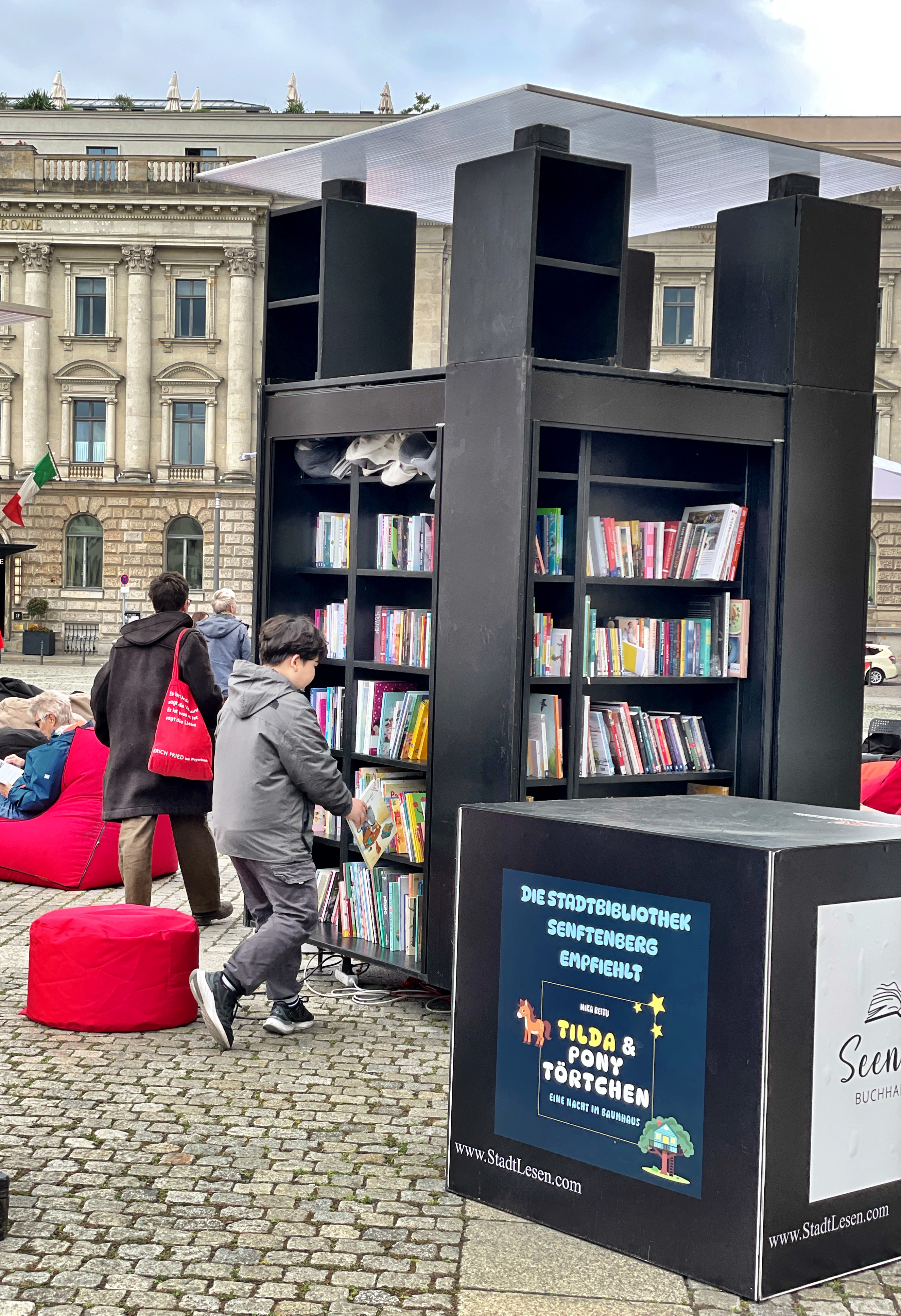
  • Berlin, of course, is a kind of living museum. Most powerful moment in Berlin? The square where, in May of 1933, the Nazis held their first book-burning. There’s a memorial there. Our guide said, quietly: First they burn books. Then, they burn people. But there is a little free library in the square, with hammocks and beanbag chairs. It was a chilly day—but there were children there, reading. Hope.

Everywhere we went, people were kind and hospitable. And honest. Aware of how long it takes to overcome the destruction of a great nation.  As Jen Rubin wrote, this morning:

Other countries, much older than the United States, have gone through grim, even disastrous years, decades, or centuries. And yet in Europe, the spirit of liberal democracy (however imperfect) remains alive and well. A sense of the public good still thrives, and millions of people strive to keep the achievements of Western Civilization from the clutches of fascism, xenophobia, know-nothingism, and conspiracy-mongering. The world is carrying on, albeit with dismay, as Americans struggle through its Dark Age.

Amen.

The Reason We Still Need Conferences

I am just back from the Network for Public Education conference, held this year in Columbus, Ohio. Columbus is an eight-hour drive from my house, and we arrived at the same time as ongoing flood warnings. But—as usual—it was well worth the time and effort expended.

For most of my career—35 years—I was a classroom teacher. Garden-variety teachers are lucky to get out of Dodge and attend a conference with their peers maybe once a year. Teachers don’t get airfare for conferences in other states and often end up sharing rides and rooms, splitting pizzas for dinner. They go with the intention of getting many new ideas for their practice toolboxes—lesson plans, subject discipline trends and tips, cool new materials—and to connect with people who do what they do. Be inspired, maybe, or just to commiserate with others who totally get it.

In the real world (meaning: not schools), this is called networking. Also in the real world—there’s comp time for days missed at a weekend conference, and an expense form for reimbursements. Conversely, in schools, lucky teachers get a flat grant to partially compensate for registration, mileage, hotel and meals. In many other schools, nobody goes to a conference, because there’s just not enough money, period.

When you hear teachers complaining about meaningless professional development, it’s often because of that very reason—there’s not enough money to custom-tailor professional learning, so everyone ends up in the auditorium watching a PowerPoint and wishing they were back in their classrooms.

Back in 1993, when Richard Riley was Secretary of Education, his special assistant, Terry Dozier, a former National Teacher of the Year, established the first National Teacher Forum. (In case you’re wondering, the Forums lasted just as long as the Clinton administration, and Riley, were in the WH.) Teachers of the Year from all 50 states attended. The purpose of the conference was to engage these recognized teachers in the decision-making that impacted their practice. In other words, policy.

It was probably the most memorable conference I ever attended. I took nothing home to use in my band classroom, but left with an imaginary soapbox and new ideas about how I could speak out on education issues, engage policymakers, and assign value to my experience as a successful teacher. The National Teacher Forum literally changed my life, over the following decades.

But—the idea that teachers would start speaking out, having their ideas get as much traction as novice legislators’ or Gates-funded researchers, was a hard sell. Education thinkers aren’t in the habit of recognizing teacher wisdom, except on a semi-insulting surface level. In the hierarchy of public education workers, teachers are at the lowest level of the pyramid, subject to legislative whims, accrued data and faulty analyses, and malign forces of privatization.

Which is why it was heartening to see so many teachers (most from Ohio) at the conference. The vibe was big-picture: Saving public education. Debunking current myths about things like AI and silver-bullet reading programs. Discussing how churches are now part of the push to destabilize public schools. New organizations and elected leaders popping up to defend democracy, school by school and state by state.  An accurate history of how public education has been re-shaped by politics. The resurgence of unions as defenders of public education.

Saving public education.  A phrase that has taken on new and urgent meaning, in the last three months. Every single one of the keynote speakers was somewhere between on-point and flat-out inspirational.

Here’s the phrase that kept ringing in my head: We’re in this together.

The last two speakers were AFT President Randi Weingarten and MN Governor Tim Walz. I’ve heard Weingarten speak a dozen times or more, and she’s always articulate and fired-up. But it was Walz, speaking to his people, who made us laugh and cry, and believe that there’s hope in these dark times.

He remarked that his HS government teacher—class of 24 students, very rural school—would never have believed that Tim Walz would one day be a congressman, a successful governor and candidate for Vice-President. It was funny—but also another reason to believe that public schools are pumping out leaders every day, even in dark times.

In an age where we can hear a speaker or transmit handouts digitally—we still need real-time conferences. We need motivation and personal connections. Places where true-blue believers in the power of public education can gather, have a conversation over coffee, hear some provocative ideas and exchange business cards. Network.

Then go home–and fight.

Boys

I’m old enough to remember…

When we were all sharing data in the 1990s about how boys got called on more often, and their comments got more affirmative responses from their female teachers. We actually had a professional development session at my school on the topic, urging us to self-monitor our teaching practice, to encourage girls to speak up in class and to acknowledge their skills. There was, of course, pushback, mainly from veteran (male) teachers. But we were dedicated to the idea of building confidence in girls.

I’m also old enough to remember an honors assembly where a (female) math teacher in my middle school, when presenting a top award from a statewide math contest to a young lady, remarked to everyone in the assembly that “the girls don’t usually try very hard on these competitive tests.” Parents and teachers seemed to take her comment in stride—and when I asked her about it later, she defended the remark and expanded on her belief that boys were just naturally better at math.

It must be scary for folks whose ingrained beliefs about male vs. female proclivities are now riding up against data on the next generation of our most powerful professions, while local community colleges are trying to attract male students by offering courses in bass fishing?

In ABA-accredited law schools, women now constitute 56.2% of all students, outnumbering men for the eighth consecutive year. Historically, law schools were dominated by men. In the 1970s, only 9% of law students were women.

According to the Association of American Medical Colleges (AAMC), in the 2023-2024 academic year, women accounted for 54.6% of medical school students in the United States. This marks the sixth consecutive year that women have made up the majority of medical school enrollees. 

So–I was eager to read a recent article in Edweek: Middle School Is Tough for Boys. One School Found the ‘Secret Sauce’ for Success.

Who doesn’t want to know the secret sauce for boys, since their dominance seems to be fading and their profile as reluctant learners rising?

Let’s cut to the chase. That sauce, those school leaders say, consists of reducing rules, trusting the boys, giving them more hands-on responsibilities and real-world applications for the things they learn (like DJ-ing a dance, designing a vehicle in teams—or not requiring hall passes).

Now, all those ideas sound fine to me. They worked when I used them, for 30 years or so. Treat your students (male, female, anywhere on the gender spectrum) with trust and give them real tasks to do. Challenge them, but build personal autonomy. Easy peasy.

However– why would we save that good stuff just for boys?

How much influence do schools have on boys’ ambition, effort and moral formation? And what’s happened to American boys in the past decade or so?

Lately, there’s been a lot of chatter about Adolescence, a four-episode drama about an angelic-looking 13-year old boy who kills a female classmate. I can’t watch stuff like that, but I am horrified by comments from teachers who say that “incel culture” depicted in the show is growing, in middle and high schools: Teachers described boys uttering sexual slurs about them in the classroom, talking about their bodies or just generally expressing a loathing of women. One boy, who had been harassing [teacher] all year, ended up spitting in her water bottle. Witnessing the harassment of their female students was also painful for these teachers. 

And here’s a fact that scares the daylights out of me. In the 2024 election, in the group of voters aged 18-25, the gender gap was 20 points.  Way more young white men–63%, first and second-time voters–cast their ballots for Trump, a man convicted of sexual harassment, a man who ordered 26,000 images removed from the Pentagon’s database and website, because they featured people of color and women.

As author and educator John Warner writes:  All progress has been met with backlash and Trump II could really be seen as a backlash presidency, a man who proudly preys on women as President, surrounded by others who seem similarly oriented. What is the positive message about gender equality for young men when joining the broligarchy seems to have real-world benefits?

While it’s important for boys to have personal agency in their learning, and be trusted by their teachers, boys need to have role models, as well. Who are we offering up as heroes, men whose lives and actions are worthy and admirable? Men worth emulating, who care for their spouses and children, men whose values serve as guardrails, men who are civically engaged?

Boys are growing up in schools where their neighbors on the school board worry about “weaponizing empathy.”  Where men at the highest levels of government power are uninformed bullies, careless in their actions but never held accountable.  

I attended graduation ceremonies annually in the mid-sized district where I taught. Usually, I was directing the band, but sometimes, I sat on the stage with any of my faculty colleagues who felt like giving up a Sunday afternoon and putting on a gown and academic hood.

The students sat in the center section of the auditorium, and I was always bemused by the front row of boys—how many of them were wearing shorts under their gowns, and rubber shower slides, with or without white socks. They were manspreading and snickering with each other, and I thought about how many of them were already 19, having been held back in preschool or kindergarten so they’d be bigger, and more likely to make first string, come middle school.

In another age, those young men would be on their own, perhaps married, perhaps working toward a house or business, perhaps serving in the military. But we gave them an extra year in school.

When perhaps what they really needed was real responsibilities, and someone to model how to live a life of integrity.

Coming to Life: Woodchippers and Community Builders

Maybe it’s 35 years of working in a classroom, but here’s what I think: it’s too bad that there aren’t more teachers in Congress.

Teachers generally know how to encourage recalcitrant students, stand up to student bullies, kick butt and make it stick, not to put too fine a point on it. Congress is acting like that 7th hour class with the wrong mix of kids, people who just can’t seem to work together. And if you have to ask why it’s important for students to work together, you’ve obviously never been a teacher.

As I watch what I hope is the nascent rise of a nation coming to life, reclaiming its identity, I am reminded again and again of the basics of K-12 community-making: Be kind, a team player. Show up and persist. Build some joy into whatever you’re doing. And keep your promises. We’re in this together.

If your job involves teaching 30 unwilling 4th graders to master two-digit division, you have to show up and persist—and also build some fun into the persisting. Because joy is the end goal—having the skills to pursue a good life. Accomplishing something important.

Not sure what’s happening where you live—but here in Northern Michigan, people are paying attention and organizing. Plenty of social change movements fade away (I knit 16 pussy hats and can only locate one at the moment), but the upcoming events calendar is full. If it only takes 3.5% of the population to foment change, we can do this.

What’s on my agenda? A Zoom messaging workshop. A book group that is reading and discussing Project 2025. Even a sermon, last Sunday, on “Embracing Diversity.”

On Saturday, there was an empty-chair Town Hall, featuring a cutout of Jack Bergman, Congressional Representative for the largest—geographic—district (CD One) in Michigan. Bergman is not a Michigan native, and in fact his primary residence appears to be in Louisiana.  In 2016 and 2018 the Bergmans listed a metal storage building at 5070 South Cisco Lake Road as their single family residence. The problem with this is the fact that the building has electricity, but no rooms nor septic field and was used to store trailers and boats.

And yes, I think that it’s Michigan’s responsibility to offload an election denier and traitor to the military, where he was once a Brigadier General—especially since he has shown zero evidence of caring about his constituents, many of whom live in Michigan’s poorest and most remote counties. The ones where hospitals are dependent on Medicaid, for example. There are no Tesla dealerships in the entire Upper Peninsula.

The Town Hall was wonderful—seating was limited (and the weather was dicey) but over 1000 people attended, in person or via livestream. Questions were not pre-screened. Just people taking turns at the microphones, pouring out their anger, their pain, their uncertainty. A special education teacher (who got a rousing ovation). A ‘recovering psychiatrist’ who warned us (acknowledging the ethics violation) that we were being governed by a malignant narcissist. Moms, nurses, dishwashers, authors and physicians.

And this comment from a veteran:
“My son is a veteran. I am a veteran. My father is a veteran. My grandfather is a veteran. And my great-grandfather is a veteran. Jack Bergman, you are a veteran. You’re a jarhead like my dad… and like my father, like my entire family, you took a vow; a very important vow. You vowed to (and here, the audience joined in) defend the Constitution and the Republic against all enemies, foreign and domestic.

Where the [expletive] are your vows, Jack? You are a disgrace to the uniform. You are a disgrace to the office that you hold. You are a disgrace to this country. And Jack, if you are too feeble and too afraid to stand up for what is right and to fulfill your vows, then it is time for you to step aside and let somebody else do it. Semper Fi.”

Turning to see the speaker, I noticed that the man behind me, in camo zip-up and olive drab beanie, had tears streaming down his cheeks.

I think something is happening. What we need now is showing up and persisting, keeping the faith. Remembering to have fun—because we want to live joyfully, to move forward.

In two weeks, I’ll be at the Network for Public Education conference in Columbus, Ohio.

Trump (or Musk, or whoever’s running the country) is putting public education through the woodchipper at the moment. There is already a bill filed in the MI (yes, Michigan) legislature to support shutting down the federal Department of Education, essentially saying ‘just send us the money—we’ll take it from there.’

It’s all pretty grim. I need to get together with my people, which is what I’m planning to do in Columbus. We’re in this together.

Trump and his “Aptitude for Music”

There are so many things to be said about the ongoing demolition of the American government that your average reader—even someone who follows politics closely–can’t keep up. Everything from the Massive Erroneous Deportation to the Declaration of Independence in the Oval Office to the biggest upward transfer of wealth in history. Not to mention Goodbye to the Department of Education.

Lots of great writing about where we find ourselves as a nation, as well—I am learning to get along without the Washington Post, with the great political commentary coming from independent newsletters like The Contrarian, Meidas, Robert Reich, Heather Cox Richardson, Lucian Truscott, The Education Wars and the Bulwark, which are only the ones I’m currently paying for. Can’t add much, beyond my personal open-mouthed horror, to the wall-to-wall political coverage available.

However. Here’s one inane Trump declaration where I have considerable expertise: Touring Kennedy Center, Trump Mused on His Childhood ‘Aptitude for Music.’ 

In case you’ve missed it (and you’re forgiven if you have): President Donald J. Trump — who recently overhauled the once-bipartisan board of directors at the John F. Kennedy Center for the Performing Arts and installed it with loyalists who elected him to serve as its chairman — held court Monday in a place that he had not publicly visited during either of his terms in office: the Kennedy Center.

Remarks were made to the Washington Post by Trump officials who recently toured the arts venue and described it as “filthy,” noted that it “smelled of vomit,” and added that they “saw rats.”

But not to worry! Trump alone can fix the Kennedy Center. In fact, Trump—who could have been a superb musician, if his parents hadn’t pushed him into becoming an outstanding athlete and phenomenally successful businessman instead— can add “born arts connoisseur” to his  already-substantial resume’. Because ‘the test’ showed what we’ve all missed: the guy who bragged about punching out his music teacher in second grade was really an untapped musical genius.  

First of all: Hahhahahhahaha.

Like all Trump anecdotes—Sir! Sir!– this one is mainly bullshit: He told the assembled board members that in his youth he had shown special abilities in music after taking aptitude tests ordered by his parents, according to three participants in the meeting. He could pick out notes on the piano, he told the board members.

If you polled actual music teachers, all of them could tell you stories about small children whose parents considered them exceptional, because they could dance to a beat , clap a rhythm or pick out a tune on the keyboard. Many of them had a great-grandmother who taught piano or uncle who was a whiz on the saxophone—thereby confirming that their talent was inherent, according to mom.

Some of those kids (especially the ones whose parents encouraged practice and persistence, attending every concert) turned out to be good musicians, after some basic musical instruction. Others, not so much.

Second: Testing children’s innate musical ability has fallen out of favor, for the same reasons that other standardized testing has been rightfully criticized. In the post-war years, a ‘musical abilities test’—the Seashore Test—was popular, often used to determine who should get to use expensive school-owned instruments. I took it myself, in the 4th grade.

What the Seashore Test did, mostly, was identify kids who had some musical experience—piano lessons, singing in the church choir, music-making in their families. Because the more you do music, the better your ‘ear’ and sense of rhythm. Kind of like the way kids who go on family trips to the library or museum get a leg up on other kids, when tested on their reading abilities or content knowledge.

Is there such a thing as talent? Sure. But testing as a means of determining talent—or taste, or creativity—when the testee is a child is pointless. Genuine, exceptional talent emerges as a result of passion and tenacity and, sometimes, good luck.

Here’s a story about my own failing in assessing talent, as a music teacher.

Why did such testing fade away? Because it missed a lot of students who became strong musicians—singers and trombonists, the lead in the school musical—down the road.

Lesson learned: ALL children should all enjoy making music in our schools. Because you never know if someday your child might be Chair of the Kennedy Center Board.

Eve of Destruction: How Close Are We?

From a brilliant essay with scholarly references by Laurie Winer, on Timothy Snyder’s Substack:

As we brace for further actions from a cabinet catering to a serial fabulist, it is important to note that the president’s abstruse nonsense is not random. It has a history. A history that takes us in only one direction, to catastrophe.

Winer gives us six researched markers of what will happen, on this eve of destruction. The first one:

It was this observation that made me decide to read the rest of the column, because it’s precisely where most of my somewhere-on-the-liberal-scale friends and colleagues are, right now.

I belong to two women’s groups that meet regularly and that’s exactly what we’ve been doing for the past four months—agonizing about the headlines over pastries and coffee. If that’s what the well-meaning housewives of Dachau were chatting about in 1933– Was baut Herr Hitler da drüben?—we are in serious trouble. Because a fair chunk of the population isn’t paying attention yet.

Is this a constitutional crisis? Or is this an existential crisis, as evidenced by collaborative Democrats yesterday (including one of my own senators)?  

America is facing an existential crisis. This is a fight for the survival of our democracy. Yes, a government shutdown is a terrible thing, but it would have created the conditions for a real fight against the intolerable and quickening plummet into oligarchy and fascism. The surrender also fails to recognize the useful role that public protests would have played during a shutdown to push back against the Republicans.

Are we, truly, on the Eve of Destruction? I ask this because young people in 1965, when P.F. Sloan wrote the song Eve of Destruction, are now drawing Social Security checks. Are they ready to return to the streets in unrelenting public protests, the kind that ended the Vietnam war or took Nixon down? Is it going to take messing with Social Security and Medicaid for Boomers to wake up?

It’s easy to laugh at Eve of Destruction today—kind of a one-hit wonder, reminiscent of flower power, that was banned by radio stations across the country for being “too controversial:”

Think of all the hate there is in Red China
Then take a look around to Selma, Alabama
Ah, you may leave here for four days in space
But when you return, it’s the same old place
Hate your next door neighbor but don’t forget to say grace

Sixty years later—and with the knowledge that the republic did, indeed, survive and even thrive—this all feels pretty idealistic, even innocent. But not all constitutional/existential crises are survivable, mere storms that rock, but don’t sink, the great ship.

Here are the other historical markers shared by Laurie Winer (read the linked essay):

  • People around you will forget that they once were anti-Trump.
  • The administration will issue absurd denunciations of opponents whose expertise is needed.
  • There will be parades and possibly mandatory public displays of support for the administration.
  • News sources will disappear or be radically altered.
  • MAGA will continue to believe what the leader says up until the very brink of disaster.

Any of those resonate?

When I saw Trump being driven around the Daytona 500 track, I remembered how he wanted military parades in his honor, missile trailers destroying the concrete of Washington streets, and camo-clad, heavy-booted soldiers carrying weapons.

Nobody’s talking him down from his bad decisions and co-conspirators—the ‘cabinet catering to a serial fabulist,’ per Winer—any more.

Surreal, indeed.

Goodbye to the Department of Education

Lots of my fellow ed-bloggers are musing fretfully about what appears to be the imminent demise of the Department of Education (ED, in DC insider parlance). There’s a lot to say about laying off half the employees at a vital federal institution and crushing its ongoing critical functions. Some are hanging on to the idea that only Congress can disappear the ED, but I have my doubts.

Chasten Buttigieg, spouse of the former Transportation Secretary (and person who lives near me) suggested on Bluesky today: If Linda McMahon and the Department of Education believe in “efficiency and accountability” (after laying off half of the department), then I’m sure they’ll gladly publish a list of every position that has been eliminated and why that position is no longer needed.

As if.

Speaking as a person who was already four years into her teaching career when Jimmy Carter got the ED through Congress and running, I clearly remember the parade of Famous Political Operatives (including Reagan, the Republican party and various right-wing caucuses) who pooh-poohed the idea that education was important enough to have its own Department and Secretary.

They were all operating from the same standpoint: Too much tax money for public education, too much federal say-so on what should be state and local decisions. Classic conservative positions. The Detroit News has been referring to public education as a massive entitlement program for years.

Those reasons were not enough to take down the ED, however. And the Department went merrily on, as bureaucratic institutions do, making things better for kids with disabilities and establishing programs to continuously improve public education. Theoretically.

Some of those programs and laws administered by ED—NCLB, grandchild of the ESEA, springs to mind—were not popular with those staffing the 13,000+ public school districts in the U.S. But the ED had a core function that we all could get behind, beautifully illustrated yesterday by this AP headline: The Education Department was created to ensure equal access. Who would do that in its absence?

Without the department, advocates worry the federal government would not look out in the same way for poor students, those still learning English, disabled students and racial and ethnic minorities.

There was a time when I would entertain arguments about whether the Department of Education was entirely a force for good. I was disabused of this notion by Renee Moore, a brilliant and dedicated educator who taught in the Mississippi Delta. Without a federal force to protect public education, she pointed out, Mississippi could easily slide backward into the segregated, utterly neglected public schools that made up its past. We can’t trust states to equitably take care of the children who live there, especially those in poverty, she said. The federal government gives us a backstop.

I thought about Renee this morning, when I read this statistic: The share of K12 funding provided by the federal government ranges from 23% in Mississippi to 7% in New York. Overall, in 2021-22, average federal education spending was 17% in states that voted for Trump in 2024 versus 11% in states that voted for Harris.

Education Week also had an interesting piece up today, Can Trump Do That? Which Actions on Education Are Legal, and Which Ones Aren’t? It’s paywalled, but the gist is that in 11 federal education programs that Trump has indicated he will destroy, in some way, he’s on legal (but distasteful) footing in only one. The rest, he technically can’t do, via a wave of his magic Elon-wand.

But we all know where Trump and Musk are going. We see it with our own disbelieving eyes. Rules, schmules. And the states that are going to get hurt the most are his most loyal base.

Lots of Trump’s executive orders are easily reversible. Don’t take your Sharpie to the Gulf of Mexico. But destroying the Department of Education is a Category Five injury to the concept of a free, high-quality education for every American child, regardless of what they bring to the table.

Diversity, Political Culture and Middle School Band

Like all educators, I’ve been following the repercussions of the “Dear Colleague” letter the federal government sent to public schools, threatening to cut off funding for schools that dabble in things like human rights and accurate history. The fact that the poor, strapped (snort) Department of Education used some of their evidently dwindling resources to set up a snitch line so parents could rat out teachers and school leaders is telling.

Dear Colleague, my ass.

More like Big Brother is watching. Or Here’s Our Grand Portal of baseless conspiracy theories and fear-mongering to support so-called “parents’ rights”—jump right in!

To make this all seem “normal,” the ED sent out a nine page read-what-our-lawyers-say explainer that further muddies the waters. The purpose of this second epistle seemed to be upping the threat while appearing to be efficient and legal-ish.

Many times, in my long career as a vocal and instrumental music teacher, I’ve had dear colleagues (ahem) express mild envy over that fact that the general public saw my subject discipline as what we used to call a “frill”—nice, but neither substantial nor essential.

Parents, these teachers suggested, didn’t really care about what kids were learning or singing in music class. It was an elective, not part of the more important career-preparation/serious-academics curriculum. In other words, my students were not being tested on the music curriculum, like theirs were. In band and choir class, we were just, you know, playing around. Fluff.

As you may imagine, I’ve written countless blogs and think pieces about what kids take away from a quality music program. If you think that the arts are a value-free zone—not tested, so not important—I’ve got news for you.

The classroom where I spent more than 30 years, teaching secondary vocal and instrumental music, was a platform for learning about lots more than the fingering for Eb and how long to hold a dotted quarter note. It was a place where we could explore how the music that students are marinating in, 24/7, came to be—a cultural voyage, through time and place, and the human response to make art reflecting the artist’s circumstances.

Proof of that–a couple of days ago, a young band director, on a Facebook page for instrumental music, asked his dear virtual colleagues for advice on this dilemma: His 8th grade band had been preparing Moscow 1941, a terrific composition, for an upcoming performance. Given the current fluctuating official opinion on Russia, Russia, Russia, he was stymied by his middle schoolers asking if they were playing a Russian march to show support for the Trump administration.

What do I do? he asked. Do I tell them Russians were the good guys in 1941, but not now? Do I say it’s just notes and rhythms, forget the title? Do I just pick something else? The kids like the piece and we have it ready for performance. Also—I’ve already talked to the kids about great Russian composers and the dark and moody music they have produced, over centuries.

First—I love that there’s an online forum for discussing these professional issues. Responses were mostly thoughtful, ranging from “tell kids the truth about Russia, then and now” (including a couple of good resources) to “get your principal involved.” There were also a few “avoid conflict, always—dump the piece” responses, which I took as evidence that teachers, in general, are rightfully anxious about threats from federal, state and local officials. Music programs are chronically in the crosshairs and choosing music that Trump-voting parents could misinterpret could be risky.

The discussion morphed into examples of band directors who chose music to represent Ukraine, and other masterworks inspired by political events, like Karel Husa’s Music for Prague, 1968. This is what the arts are supposed to do—help us make sense of the world.

Back in the 1990s, I bought a piece for my middle school bands called A Lantern in the Window, a musical depiction of the Underground Railroad. There was a quiet, spooky opening, followed by a pulse-pounding chase, and the piece ended with a richly harmonized quote from an old Negro spiritual, Steal Away to Jesus.

I programmed Lantern often, every two or three years, because it was a perfect teaching piece. There were multiple tempos and styles, and I could talk about the use of familiar songs, how a few measures could remind us of a powerful cultural idea.

Students always wondered why an enslaved person would believe in Jesus—and yes, these conversations had to be carefully handled. But they were worth it. They illustrated the power of music to tell an important story. And that, I thought, was the heart of my job.

Last week, “The President’s Own” Marine Band quietly canceled a concert program originally billed as the “Equity Arc Wind Symphony.” The performance was to be the culmination of a “multi-day music intensive with musicians from ‘The President’s Own’” and high school musician fellows selected through auditions organized by the Chicago-based Equity Arc, a nonprofit organization that provides “specialized mentoring support for young BIPOC musicians and helps institutions take meaningful steps toward equity and inclusion.”

When I see stories like this in the news, I wonder how music teachers, specifically, can stand against federal threats. Our job—our low-paying, high-importance, mega-stressful job—is to give children of all ages, colors and abilities the chance to love, understand and perform music. Politicizing that—for whatever stupid reason—is both wrong and damaging to children and to our American culture. That’s a good reason to push back.

I have empathy for teachers, like the band director worried about Moscow, 1941, but I also know that huge masses of the middle class workers will have to stand against the takeover of our government and our national culture in order to stop the carnage going on right now.

Deep breath. Buck up. There is lots of work to do.

Five Things Your Child’s Teacher Accomplished Last Week

When I first heard about Elon Musk’s email blast to over two million federal employees directing them to submit approximately five bullet points of what they accomplished in the previous week, I was reminded of a couple of school administrators from my past.

Eugene Robinson called Musk’s scheme “an exercise in contempt”—also a great description of some of the so-called professional development teachers routinely endure. When a principal doesn’t trust their professional staff to know what they’d like to do with time available for their own learning or planning, you end up with meaningless exercises like “five things I did last week.”

Ultimately, it’s about control.

Eugene Robinson, again: Thus begins the inevitable power struggle at the court of Mad King Donald, between his various ministers of state and his billionaire Lord High Executioner.

No word yet on whether the soon-to-be defunct Department of Education will demand five bullet points of the 3.8 million public school teachers in the U.S., given that 13.7% of the funding for public schools comes from the feds, give or take.

But there’s no need to put teachers through that particular, umm, wood chipper. I can supply the federal government with five bullet points that apply to all teachers, summarizing their most recent contribution to the education of America’s youth.

Here are five things that all teachers accomplished last week:

  • They showed up. They showed up when the driving was treacherous, even when their own homes were threatened by floods. They showed up when they were sick or hadn’t slept, because it’s easier to teach with a cold than find a sub. They showed up because it was test day, or the field trip, or opening night of the school play, or because a particular student didn’t do well with strangers at the head of the classroom. They showed up, because thanks to a global pandemic, we now know that virtual school is not the solution to cheap and easy public education. Personal relationships matter.
  • They planned a learning experience that failed. That’s par for the course, by the way. Most lesson plans fail to accomplish their goals, 100% and immediately. That’s because kids learn differently, through different means and at different rates. The slam-dunk lesson plan that teaches everyone all they need to know, challenging the brightest and scooping up the laggards, doesn’t exist. What happens when a lesson goes sideways today? Experienced teachers adapt and adjust–and reinforce tomorrow.
  • They dealt with diversity, equity and inclusion, even the AP teachers with classes of 12 well-behaved senior calculus students. D, E and I are endemic in K-12 education—not the fake shorthand of “woke,” but the bedrock truth-in-practice of embracing student differences, playing fair as a teacher, and building a learning community where everyone is valued.
  • They exposed themselves to the viral miasma of 30 small, touchy-feely children, or perhaps 150 sniffly teenagers, in their role as caretaker. Let me repeat that: they acted as caretakers, with the school being a safe and (key word) free place for children of all ages to spend their weekdays. The lack of affordable childcare across the country makes schools a first line of defense in an economy where parents need to be in the workplace.  And parents send their kids to school when they’re sick. #Truth                       
  • They did the intellectual heavy lifting of observation, instruction, assessment and accompanying record-keeping on the learning of a large number of children. This, of course, is a teacher’s actual job, and it’s harder than it looks to the casual observer. Teachers take their work home—not just grading and lesson plans but worries and concerns. Keeping tabs on the students in their charge—so they could learn.

Here are some things your child’s teachers did NOT do last week:

  • Go out for lunch at a nice restaurant and indulge in a glass of wine.
  • Use the bathroom whenever the urge arose.
  • Spend most of their day in an office or cubicle, blessedly alone with their thoughts and their work.
  • Talk to other adults for an extended time–on the phone, or in casual conversation.
  • Duck out for a medical appointment that had to be scheduled during the workday.
  • Decide to knock off early, and get in a round of golf.

So—should the Billionaire Lord High Executioner come after public school educators, further annihilating America’s once-proud, once-functional institutions, keep your heads down and just say no to the five bullets.