Youth. For Christ? At School?

I should probably preface what I’m about to say by noting that I self-identify as a liberal Christian. Without getting too far into the theological weeds—or alienating those who are rightfully skeptical about some current Christian churches’ lack of commitment to feeding the poor, etc.—I have been a church member and/or employee for decades, off and on.

All the way back to the 5th grade, in fact, playing “Angels We Have Heard on High” on my flute and swapping out my little-kid animal ears for a white robe and tinsel halo in the church Christmas pageant. Good times.

Or maybe—not so good. I’ve dealt with the insertion of religious tunes into public school holiday programs for my entire career. It’s the evergreen issue for music teachers in December. Bottom line: Public schools need to tread lightly, when it comes to the separation of church and state, even at times when you are hearing angels on high in your local grocery store or used car lot.

I retired—for good—from my last church music director position after Easter, and have since had the pleasant experience of being asked to play in several local churches, which are always looking for free talent.

Last summer, I was surprised to play a service and see two dozen teenagers seated together. There was a junior trad-wife fashion sense for the girls, all with long, curled hair and cute summer dresses. The girls were mostly carrying Bibles; the boys, with their llama-head haircuts, were carrying phones (and scrolling on them during the sermon).

Later, I learned that they were a newly organized chapter of Youth for Christ, meeting with their leaders (an attractive, early-20s married couple), in their home for coffee and prayer before school. Several of them had been baptized by that couple in Lake Michigan, earlier that month.

The guy sitting next to me at the service whispered that he was hoping that these kids were associated with Charlie Kirk’s Turning Point USA, which claims over 1000 chapters in high schools across the country: ‘Turning Point USA is also getting an assist from Republican leaders. The U.S. Department of Education announced it was partnering with the organization, along with dozens of other conservative groups, to launch a coalition to produce educational programming for schools and universities in advance of America’s 250th birthday next year.’

Eek.

I can’t tell you, precisely, what made me most uneasy about seeing perhaps 25 teenagers attending a conservative church en masse. None of the small, rural churches in this county have dozens of HS-aged members, for starters—so their organizational point was obviously somewhere other than an actual church. And the occasional teenager who showed up at the church where I worked never came dressed like a candidate on Bama Rush or looking like a Department of Labor poster boy.

It turns out that the Youth for Christ leaders are salaried, and were posted here to start a chapter, a task they accomplished by volunteering at a local school district. They got some help from a friendly uncle (real estate here is sky-high), and found a place downtown to meet, then began recruiting the kids they met while volunteering as tutors and cafeteria supervisors.

And, miracle of miracles, parents in this conservative community didn’t like it. There were 78 non-consent forms, representing 109 minor children, filed with the Youth for Christ leaders and their organization, saying, essentially: Hands off our kids. If we want them to have religious experiences, we’re in charge of that.

It’s a small school—109 minor children represent a third of the school population. YFC is undeterred, planning to establish a ‘teen hangout’ in the tiny resort downtown, courtesy of Generous Uncle. And downtown merchants, perennially cramped for space, parking and business have turned this into a zoning issue. They might actually win—as I noted, this is a conservative, business-friendly town.

But I want to return to the Christianity—if that’s the right word—inherent in recruiting members for your religious club from a public school setting. When I think about all the angst about not referencing equity, inclusion or diversity in school curricula, and all the book-banning Moms 4 Censorship types showing up at school board meetings, shouldn’t there have been outrage over paid recruiters “volunteering” and proselytizing during lunch?

Not long after Charlie Kirk was killed, CA Governor Gavin Newsome remarked on his goal of organizing young men as effectively as the TPUSA model does. He asked why left-leaning young men have not collectively fought the ‘epidemic of loneliness’ with liberal activism. I don’t have an answer for that, but it’s a good question.

In the season where Jesus sneaks into the daily life of families and communities—Joy to the World!—I am in favor of parents’ careful attention to who’s recruiting their kids.

Absence Makes the Smart Go Wander

Recently, Bridge Magazine—a Michigan-focused news venue—ran a series of articles on the appalling numbers of absences that Michigan schoolchildren have been racking up since (and, let’s be honest, before) the pandemic.

Last year, more than a quarter of Michigan students, nearly 388,000, were considered “chronically absent,” which includes excused and unexcused absences — everything from sickness and appointments to skipping school without parents’ knowledge. Before the pandemic, there were 290,000 chronically absent students, or 19.7% of public school students. 

The definition of chronically absent? Ten percent of the school year, or 18 days. There’s a handy little infographic where you can see how your district ranks, and how their absence rate has fared in the past six years. I was happy to see that the suburban school where I taught for more than 30 years, and the district where I now live and volunteer have low absence rates, generally a mark of an economically secure community. Kind of like test scores.

Also—like test scores—high rates of absenteeism are something that outside observers (read: Bridge Magazine) seem to want to pin on school districts. Here’s a headline: Unlike Michigan, Indiana got tough on missing school. It’s already working. Bridge features a story about the low absence rate in Fremont, Indiana, just across the border, with a photo of a motherly kindergarten teacher and her (white) students.

‘New [Indiana] laws standardize school response to absences, threaten criminal action against students and families and create a reporting system that streams data daily from individual classrooms to state officials.

Fremont has fewer economically disadvantaged students (about 40%), which researchers tie to increased absenteeism, but district leaders say they also have stepped up effort to help get kids in school. Small buses pick up homeless students, schools offer telehealth and dentistry care and a countywide “teen court” serves as a first accountability step for some truant teens.’

Well, bully for Indiana—especially for picking up homeless kids and offering wraparound services for those who might be inclined to skip school because they can’t get there, or their clothes are dirty, or their tooth hurts. I’m guessing that if Michigan schools could lower their rate of disadvantaged students our absence rates would also drop. As for threatening criminal action—truancy has been a recurring issue since forever, and carrots work better than sticks in encouraging positive habits and behaviors.

In one of Bridge’s articles about the Shocking Absence Crisis, this interesting tidbit appeared:

‘Last year, 162 school districts — 59 traditional and 103 charters — faced potential financial penalties for school days when fewer than 75% of students showed up. In five districts, all charter schools, the 75% threshold wasn’t met at least 22 days, according to data provided to Bridge Michigan by the Michigan Department of Education.’ 

There are about 540 fully public (not charter) school districts in Michigan, and around 300 charter schools. Data is murky—but thumbnail math says that just over 10% of fully public school districts (which includes many large urban districts and small, remote rural schools) have serious attendance problems. Meanwhile, over a third of charter schools (which are smaller and more select) are struggling with absences—and the most egregious rates (the ones dragging down the statewide numbers) come from charter schools.

Bridge did not provide that analysis. Interesting.

When thinking about the results of so many kids missing school, Bridge naturally turns to test scores. I’m not even going to summarize, because it’s exactly what you’d expect: kids who don’t go to school very often get lower test scores and struggle to learn to read. But that doesn’t mean they’re dumb, or unworthy. It means we’re not digging into the real roots of the problem.

The more essential questions are why kids aren’t attending, and how to bring them back into the gotta-go-to-school fold. What people and programs might fill their needs, invite them into a safe community?

With elementary students, absences are tied to parent behaviors—so Fremont, Indiana has the right idea: buses, free health and dental care, after-school programs, etc. With older students, building communities—sports, clubs, co-ops, supervised hangouts—are lures, but in the end, teenagers come to school to learn, to let their minds wander. When that doesn’t happen, if there’s nobody dragging you out of bed in the morning, why bother?

Here’s a footnote to the discussion: Should Kids Miss School for Vacation? Parents Say Yes, Teachers Aren’t So Sure. Synopsis: Parents are defensive about getting better prices on a Disney or skiing vacation and pulling their kids from school for family fun. Teachers are resentful about being required to rustle up packets and other busy work while Kid misses classroom discussions and contributions to group projects. Grades become an issue.

Speaking personally, I’ve never flipped out over kids missing a few days, especially if you get advance warning and a request for work that comes back completed. Learning is never uniform and predictable, and learning (not filling boxes in the gradebook) is the ultimate goal. Right?

I’ve been asked to excuse a two-month absence for a boy traveling to Egypt with his energy engineer father, and dealt with a championship snowboarder who missed most of a marking period but came back with Olympic and career goals, and a fistful of medals.

The first boy was an A student. He couldn’t make up what he missed—but the life experience more than made up for that. The second boy read at a 2nd grade level, a fact reinforced by several teachers when his parents told us about the tour of events he’d entered. Finally, his mother said: So we shouldn’t let him do what he’s so great at—we should make him stay here and fail all his assignments? How does that help him?

I have thought about her many times. Partly about the privilege well-heeled white parents have in managing their children’s absences—but also in considering why students stop coming to school.

If kids aren’t showing up to school, maybe it’s not about better data streams or legal threats, or texting their parents at the right time.

Maybe they don’t want to stay in school and fail their assignments, convinced that nobody cares much. What should we be doing about that?

Teachers are Patriots! Who Knew?

The world of education research is replete with studies that feel… unnecessary to folks who have spent their careers in front of K-12 classrooms. Primarily because so much good research is ignored in practice, and so much bad research becomes conventional wisdom.

For example—scientific inquiries  affirm that the best age to begin formal reading instruction would be about seven years old. Ask any early childhood teacher what our literacy success rate would be were we to initiate two-hour formal reading blocks in second grade, leaving room in kindergarten and first grade for lots of read-alouds, rhyming, picture books, letter-sound correspondence activities and development of oral language.

It’s more than that. Teachers with a few years under their belt have well-developed opinions about the best special education placements, the benefits of free play, and why taking your students outdoors yields physical and intellectual growth. Teachers can speak articulately about the post-pandemic changes in student behaviors.

How do they know about these things? Experience. Paying attention to what happens in their daily practice.

You might say that teachers’ observations and informal experiments—Teach it this way? Or that?—are the most valuable action research data to build a successful practice. But don’t say it too loud, because research is tied tightly to the source of the money that funds it—and the commercial products and politics that drive educational change.

There are lots of reasons why education research is suspect—or products are published to great fanfare, then sink like an oversized silver bullet:  An analysis of 30 years of educational research by scholars at Johns Hopkins University found that when a maker of an educational intervention conducted its own research or paid someone to do the research, the results commonly showed greater benefits for students than when the research was independent. On average, the developer research showed benefits — usually improvements in test scores —  that were 70 percent greater than what independent studies found.

Hmmm. I’d put my money on teacher perspectives about instructional strategies and materials, especially if teachers were in charge of their own professional work and offered ongoing opportunities to assess worthy curricula and teaching techniques.

Keeping the problems with ed research in mind (a book-length topic), I was amused to see this headline in Education Week this morning: Teachers Value ‘Patriotic’ Education More than Most Americans.

(Dangerous but brave) subheading: The findings stand in contrast to conservative rhetoric about ‘indoctrination’ in the social studies. And surprise! The polls themselves were conducted by EdChoice, a nonprofit advocacy organization supporting school choice, and the Morning Consult Public Opinion Tracker.

‘More than 80% of K-12 teachers thought it was “very” or “extremely” important to teach students about the Constitution’s core values, and 62% found it similarly crucial to teach that America is a fundamentally good country. In both cases, teachers were more likely than parents or the public at large to favor teaching these concepts.’

Least surprising education research result, ever. Kind of shoots holes in the ‘teachers practice leftist brainwashing’ theory that the privatizers and public school vandals keep advancing. The study showed that 57 percent of parents thought schools should overtly teach patriotism and loyalty to the United State—the exact same percentage as teachers.

There’s more: ‘Both Democratic and Republican teachers were less likely than similarly affiliated members of the public to think it important to teach students to question government actions and policies.’

Again—totally predictable. Schools are inherently moderate and cautious, politically. Your teenager is far more likely to become radicalized—in either direction—via their online presence. Online—where there isn’t a caring and educated adult moderating the decontextualized content they are reading.

I am a retired teacher, but I spent more than three decades explicitly teaching my students about being an engaged citizen, and appreciating the cultural mix that is America. I am a patriot.

Like most teachers, I am grateful to be an American. I didn’t need research to tell me so.

The Legislature Goes to the Bathroom

I remember the first time I encountered unisex bathrooms.

I was traveling, with a backpack and not much money, in Europe, staying in youth hostels and tourist rooms, often in the homes of women I would meet at train stations holding up signs saying Zimmer zu vermieten. 

Near the end of the trip, an eight-week journey which I funded with just under $1000, I was in Munich, trying to find a cheap (really, really cheap) place to stay. Someone told me about a hostel camp, maybe an hour’s hike from the train station—a field outside the city where you could stay in a huge tent. If you got there early enough, there was also food.

I schlepped out there and stayed the last two nights of the trip, also visiting Dachau on my final day. It was bare bones—BYO sleeping bag and ground pad. There were unisex flush toilets in wooden cubicles, in a single concrete building of the type you’d find in any state park campground today. There were also warm-water showers, in a large room with no dividers for males and females. BYO towels and soap, as well.

The hardest part of adjusting to this was trying to act casual, as if I were used to waiting in line to use the toilet between Hans and Karl, or nonchalantly showering with a couple dozen mixed-gender strangers. Everyone else seemed pretty blasé about it. The vibe at the camp was international, friendly and very safe.

The year was 1976, the 200th anniversary of the home of the brave, land of the free.

Now, nearly a half-century later, some people have their knickers in a twist over newly remodeled unisex bathrooms in Michigan State University’s Campbell Hall, a beautiful dormitory on the oldest part of campus, which houses the Honors College.

The retrofitting took traditional community baths and turned them into lockable, fully enclosed private stalls, each with a shower, toilet and sink.  For a quick hand-wash or teeth brushing, there are also community sinks.

Apparently, the MSU Board got a letter of outrage from a parent, although students (who had to apply to live there) seem to be fine with the plan. There were some comments at the Board meeting about walking around after showering in a towel, but I chalk those up to people with too much time on their hands, wallowing in trad-nostalgia or perhaps sexual fantasies.

Back in the1970s, I lived in a co-ed dorm with community bathrooms. There were four floors—two community baths for women, two for men—although the dorm rooms alternated between men and women. I can’t tell you how many times I went to the women’s bathroom and found some dude walking out of a stall, because he didn’t feel like going upstairs. Lockable stalls with all you need sound vastly preferable to stumbling upon your roommate and her boyfriend showering together in the community bathroom.

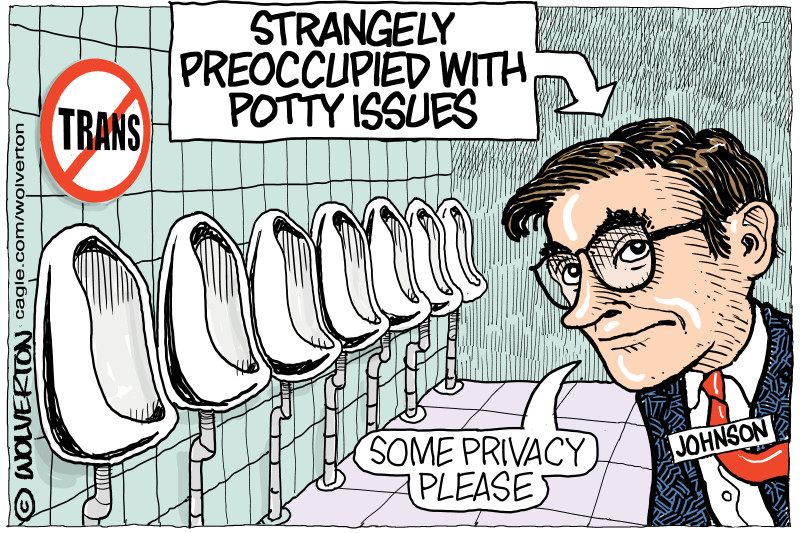
Makes me wonder why Republican legislators always bring up bathrooms when they want to gin up fear around gender expression. There really isn’t anything moral or magic about using the bathroom, with either gender.

There’s this: ‘Opposition to transgender inclusion has become a rallying cry for many conservatives. The debate is at the heart of a bill advancing in Michigan’s Republican-led House that aims to restrict bathroom use at schools and colleges on the basis of biological sex. 

Sponsoring Rep. Joseph Fox, R-Fremont, suggested Wednesday that allowing transgender students to use bathrooms of the gender they identify with is “traumatizing little girls.” He called it a “safety issue.”’

Then there’s this: “Michigan must stop making references to gender identity in sex educational materials provided to schools or risk losing millions of dollars in federal funding, according to President Donald Trump’s administration.” 

The State Board of Education is also currently hearing testimony on a new set of standards for sex education in Michigan:

“A recommendation that schools include instruction about gender identity or expression and sexual orientation by eighth grade has prompted criticism from several parental rights groups and Republican politicians. 

“These proposed standards cross into deeply personal and spiritual territory, normalizing behaviors that many families find harmful and contrary to their faith.’”

Traumatizing little girls? Normalizing behaviors that contradict families’ religious beliefs? And not being allowed to talk about it, in eighth grade sex ed classes, even if your parents say it’s OK?

It’s all about what’s happening in American bathrooms, evidently.

Gender-neutral bathrooms are commonplace in Europe.  Why is that? What do they understand that we don’t?

How about a Pause on the Race to Embed AI in Schools?

I haven’t written much about AI and education, for several reasons.

First, there are already many people writing compellingly and with considerable expertise about the uses and misuses of AI in the classroom. Some of those people will show up in this blog. Follow them. Read what they write.

Also, some years ago I developed a reputation for being a cranky Luddite. I wrote pieces about the downside of the ubiquitous online gradebook, accessible to parents 24/7, and other uses of computer programs that added to teachers’ workloads and didn’t fit with the important content and skills I was teaching students (lots of students) the old-fashioned way. The real costs of “free” programs and apps, no matter how glittery and hip, seemed obvious to me. Why didn’t other educators see this?

This came to a head when I was invited to be part of an online panel on ed technologies. Presenters sent me the language they planned to use to introduce me—did I approve? I confirmed, and then they messaged back: the bio had been created by ChatGPT. Ha-ha.

Finally, I haven’t written much about AI because I just find it hard to conceptualize how it could be useful in the classroom. In other fields, perhaps—with a lot of caveats, oversight and suspicion—but it runs contrary to the essential purpose of teaching and learning. Doesn’t it?

It’s never seemed right to let machines do the ‘thinking’ or ‘creating’ that is better done, or at least attempted, daily, by children. In short, I don’t get it. Maybe that’s because I haven’t been enlightened? So—shut up already?

I think many, if not most, practicing educators are in the same boat: Unclear about what AI actually is, and what use could be made of AI tools in their vital mission to make children independent thinkers, evaluators and creators.

For starters, who’s cool with Big Data collecting info on our public school kiddos’ engagement with their products? NEPC Report on digital platforms:  

While educators may see platforms as neutral tools, they are in fact shaped by competing interests and hidden imperatives. Teachers, students, and administrators are only one market. The other market involves data on performance, usage patterns and engagement—data flowing to advertisers, data brokers and investors, often without users’ knowledge or consent.’ 

A pretty good synopsis of what AI is, from Josh Marshall, Talking Points Memo:

“AI is being built, even more than most of us realize, by consuming everyone else’s creative work with no compensation. It’s less ‘thought’ than more and more refined statistical associations between different words and word patterns.” He goes on to make the salient point that the AI “products” being produced that will be “privately owned and sold to us.”

Doesn’t sound like something that schools need to quickly embrace, what with all our other problems, like teaching kids to read, rising absence rates and budgets stripped of our ability to feed children a nutritious breakfast and lunch.

Add in the environmental concerns and rampant intellectual property theft to teachers’ uncertainty about dumping more new, unvetted toys into an already-crammed curriculum. So I was thoroughly surprised to see the AFT get on the “AI in the classroom!!” bandwagon.

Why not take a pause—let’s call it a shutdown—on the race to embed AI in our schools? Why not sort through those competing interests and hidden imperatives? We’ve been bamboozled by climbing on attractive but ultimately damaging educational bandwagons before. Just who wants us on this one?

Well, scammers. And the folks who turned DEI into something to be avoided. Clueless Tik-Toking middle schoolers could up their game with AI. And right-wing edu-site The 74 says educators can save six hours a week by using AI to make worksheets, tests and exit tickets. Really? That’s an awful lot of worksheets.

Wouldn’t it make more sense to approach this transformative technology with great caution, holding fast to the evergreen principle of teaching and learning being a social endeavor? To look at the available research before being bedazzled by something new?

‘Participants, mostly undergraduate and graduate students, who constructed essays with the assistance of ChatGPT exhibited less brain activity during the task than those participants who were asked to write on their own. The AI-users were much less likely to be able to recall what they had written and felt less ownership over their work. Independent evaluators who reviewed the essays found the AI-supported ones to be lacking in individuality and creativity.’

If you want to read better pieces on AI, many are hyperlinked in this blog. But here are a few folks whose words and thoughts come from places of deep knowledge and experience:

Audrey Watters, the best Ed-Tech thinker on the planet,
for my money.

Pete Buttigieg, who thinks ahead of trends. Stop worrying about when he’s going to run for President and start absorbing his ideas on politics and relevant policy. Including AI.

Lucian Truscott, who writes about many things and made me understand why AI may ultimately fail: The men who run the big AI companies would do well to think through what they are doing with all those big buildings and all that electricity they consume. The “answer,” such as it is, to what they are seeking to accomplish may not exist, or it may be simpler than they think.

Educator Alfie Kohn, who points out that those most receptive to this technology are the people who know the least about it. This piece made my skin crawl.

My friend Peter Greene does a better job of debunking AI crapola than anyone I know. I credit this to his decades of classroom experience, during which he Paid Attention to Things—things more important than launching new products and making the big bucks.

So why should anyone pay attention to what a tech skeptic writes about AI in schools?

Because we’ll all be lured into making photos come to life, or relying on a questionable AI answer to an important question, or laughing at Russ Vought as Grim Reaper. Sticky and fun, but ultimately shallow, inconsequential.  Not what school-based learning should be.

Earlier this year, on a day when I made a (delicious) strawberry pie, I clicked on a song-writing app. Give us some lyrics, and a musical style, and we’ll write a song for you.

Here is my song: Strawberry Pie. Sticky and fun, but not much effort on my part.

A “Moment of Reckoning” or Just More Empty Hysteria?

I’ve been more or less off the grid for the past two weeks, vacationing in Alaska and determined not to let the repellent Epstein Saga or other assorted travesties spoil the snow-capped mountain vistas. Which means that a whole lot of education-related stories have been waiting in my mailbox.

Lurking bad news, for the most part (even Trump “returning” five-point-something billion to schools is tainted by the knowledge that we’ll see those cuts againand more). Most of the bad news is cuts, in fact—or scams, like this voucher doozy in Arizona.

Can I just say that education journalists could do the citizenry a solid by continuously reporting all the resources—human and material—that have already been lost? Or by informing parents and communities about residual effects of a global pandemic or unwarranted attacks on public education?

Instead, we get idiotic headlines like this one: A Moment of Reckoning for Michigan Schools. (Cue disaster music.)

The headline is followed up with a series of articles with titles like Michigan spent big to fix schools. The result: Worse scores and plenty of blame. And Mississippi turned around its schools. Its secret? Tools Michigan abandoned.

The “effective tool” that Michigan abandoned? Our late-but-not-lamented Third Grade Flunk law, valid critiques of which centered on the damage done to kids by being forced to repeat a grade, the financial burden on schools as they are compelled to provide an additional year of instruction to large segments of their elementary population, and the complete lack of proof that these laws work.

Makes you wonder where this unsubstantiated condemnation comes from—that’s the disappointing part. These articles (and more just like them, hacking away at our public schools) are from Bridge Magazine, a fairly centrist, nonpartisan publication that focuses on issues in the Mitten State.

I interviewed its founder, eminent journalist Phil Power, shortly after Bridge launched, in 2011, and invited him to speak to the Michigan Teacher Forum, where he proclaimed his undying support for public education and especially for the hard-working teachers in Michigan public schools. Bridge seems to have moved on from those ideas, however, adopting a common politicized perspective: Oh no! Our state is falling behind other states!

There’s a lot to debunk in the series of Bridge articles (wherein I found precisely one veteran teacher quoted, mildly suggesting that the silver-bullet “Science of Reading” prescription was only one of the ways that students learned to read), but I am too jet-lagged to tackle these, point-by-point, at the moment.

State Senator Dayna Polehanki, a former teacher, did some debunking, however. From her Facebook post:

“While I won’t denigrate Mississippi’s efforts to improve its academics, the picture being painted by at least one Michigan publication that Mississippi is outperforming Michigan on the NAEP reading test (“The Nation’s Report Card”) is MISLEADING.

While Mississippi has *scored higher than Michigan ONE TIME over the past decade on the Grade 4 NAEP reading test . . .

Michigan has *scored higher than Mississippi EVERY TIME over the past decade on the Grade 8 NAEP reading test.

The assertion in the Michigan publication that Michigan “abandoned” our 3rd grade read-or-flunk law to our detriment is not supported by test score data.

It’s not surprising that states that flunk their “worst” 3rd grade readers achieve elevated results ahead of the Grade 4 NAEP reading test, but these elevated test scores tend to flatten over time (by Grade 8 NAEP reading), like they do with Mississippi.

This is borne out in NAEP data from other states as well, like Florida, which also flunks its worst performing 3rd grade readers.”

In fact, there are plenty of pieces debunking the “Mississippi Miracle,” from its deceptive gaming of the system, to right-wing blah-blah claiming that raising 4th grade reading scores isn’t enough—that Mississippi needs vouchers, immediately, to solve its poverty-related education problems.

What all these pieces have in common might be called uninformed–or “lazy,” take your pick–journalism. Education data is not easy to interpret, nor is it truth. One example: A NAEP score of “Proficient” doesn’t mean “on grade level” as most people (including some education journalists) seem to think it does.

Worse, relying solely on test scores doesn’t tell us how successful schools actually are. For that, we need to look at a wide range of factors. It’s interesting that, two weeks before Bridge launched its so-called Moment of Reckoning, they published a piece noting that only 9% of the state’s public schools currently have a full-time librarian.

Think that has anything to do with our faltering reading scores?    

In the end, schools are comprised of people and programming. The more instruction is tailored to the students in that school, the more dedicated and skilled the personnel are, the better the results. Score competitions with other states are pointless.

There are hundreds of ways to improve student learning: Universal free preschool attached to high-quality childcare. Smaller classes, especially for our youngest learners. Recruiting, training and paying a long-term teaching force. Stable housing and health care for all children. A hot breakfast and lunch, plus plenty of recess time. Government supports for public education. I could go on.

None of these are free, or likely to come down the pike in Michigan or anywhere else in the near future.

Are we reckoning with that?

Teachers Work in Systems We Did Not Create

Back in the day, I used to go to ed-tech conferences, especially the Michigan Association for Computers Users in Learning (MACUL) gathering. Like everyone else, I was there to find that elusive app or device that would make my work easier.

For maybe a decade, MACUL was the hot ticket, worth burning a personal day, sitting in ballrooms looking at guys in logoed polo shirts and khakis, narrating fast-paced product-focused PowerPoints with amusing memes sprinkled throughout. The first question you got, wandering through the massive exhibits hall was “Are you in charge of tech purchases for your school?”

Nope, I wasn’t.

What I was looking for was new ways of thinking about education, specifically music education. It seemed to me that music, as a human endeavor, was way more than what I was teaching: how to play an instrument and replicate pre-written pieces, as accurately as possible. These were skills that were fairly easy to standardize and grade, but 180 degrees away from creativity and improvisation, the capacity to play with musical ideas, and evaluate your own results. Not to mention things like joy and fun.

I was working in a system that privileged the standard school band, including competitions evaluating fidelity to everything from instrumentation to tempo markings. The party line on music education is that it’s creative, but secondary music education often leaves little room for students’ imagination or original work. The teamwork and drive for excellence are valuable, but usually end when a student graduates.

Don’t get me wrong—learning to play a musical instrument and read music are useful, foundational skills in ways that many folks don’t see or appreciate. If I ran the world, all kids would learn to play an instrument, to understand and create their own music, and play daily with others.

But how could I encourage my students to try out their own musical ideas? To have fun, even jam, without a conductor and sheet music and—God forbid—weekly playing tests, speaking of pre-set system reqs… This seemed to be something that technology might do.

 Now, 20 years later, there are plenty of creative music apps to carry around on your phone or tablet. But what the techies were selling, back then, fell into three buckets:

The first was programs to make school administration easier— attendance, budgets, scheduling,etc. The second group were things to make teachers’ non-instructional duties easier—grading, standards, lesson planning, and so on. The third cluster was programs for students, most of which were usable by classes, in computer labs and directed by teachers.

There was lots of new! exciting! software, but nobody seemed to be interested in developing programs that let students experiment with the tools of music. At least, not for schools, where performing concerts and musical events for parents and the community were the ultimate curricular goals.

It was a system I didn’t create, and innovative technologies were no help in budging it. Even in ways that I knew would be good for kids, building their confidence and exploring their individual musicianship.

I thought about that today when I read this article in WIRED: Microsoft, OpenAI, and a US Teachers’ Union Are Hatching a Plan to ‘Bring AI Into the Classroom.’  The National Academy for AI Instruction will make artificial intelligence training accessible to educators across the country, a first-of-its-kind $23 million initiative funded by the tech companies to bring free training to teachers.

First thought: Do teachers WANT to bring AI into their classrooms? If so, for what purposes?

Second thought: Why is the AFT jumping on this bandwagon? To “get ahead” of some imaginary curve? To get “free” (and none of this is truly free) stuff?

Third thought: Since AI is essentially composed of stolen content, what does this do for teachers who still believe in nurturing students’ imagination? Somebody created all the literature, art and other media that goes into the giant maw of AI, so there are also ethical questions.

Final thought: Why are we ‘training’ educators to do what OpenAI thinks they should be doing? Did we ask teachers first—what would you like to know about AI? How do you think it could be useful in your classroom?

Once again, we’re forcing teachers into systems they did not create. And that’s never a good idea.

Are Women the Cause of Reluctance to Read?

I remember learning–perhaps in a grad class or professional development session, years ago–that boys didn’t like to read about girl things. You know—relationships, communication, emotions, the finer points of making a home or enriching family life. Boys wanted to read stories about adventures, we were told. Starring, naturally, other boys.

Ergo, if we wanted to turn boys into enthusiastic readers, we needed books where boys did boy stuff—creeks, animals, cars, fights, danger, you name it. Write it and they will come.

I thought about this when re-reading A Separate Peace this month. My book club is doing a “Books You’ve Already Read—or should have read” month, and I thought it was time to re-read a book that I put on my Top Ten list for decades.

(Seriously—I kept continuously updated top ten lists of books, movies and LPs until I had both children and a full-time job. There are still some gems on those lists—but also some really embarrassing stuff.)

I wouldn’t, however, call Separate Peace an embarrassing pick. I read it in high school, although not as a class novel. In the late 60s, my public high school adopted a choice-based language arts curriculum. Instead of English 9/10/etc, there was an array of semester-long courses. I took journalism, speed reading and Great Books, a totally wonderful class where students did nothing but read books, then journal their impressions.

There was a list of great books (SP was on it), but you could also deviate, with the teacher’s permission. It was that teacher—Mrs. Palmer—who introduced me to Daphne du Maurier, Virginia Woolf, and Madeleine L’Engel.

It’s hard for me to put my finger now on why I loved Separate Peace so much. Partly, it was the boarding school setting—what it would be like to live in dorms, with other students whose parents weren’t scraping to pay the mortgage, for whom college was a certainty, not a stretch.

Mostly, though, I think it was because—spoiler—there’s a death in the book, under unusual circumstances, leading the reader (this teenaged reader, anyway) to muse on Big Meaningful Issues. In case you’re wondering whether I noticed the homoerotic flavor of the relationship between the narrator and his best friend, the answer (1969) is no and (2025) yes.

But here’s what really jumped out at me, some 50+ years later: there are no women in this book. Aside from a couple of sentences mentioning a screechy school nurse, and a sentence describing a classmate’s mother as kindly, there is zero female presence in this book. There’s plenty of adventure, danger, scrapes and disobedience. Even a student-led tribunal, and a World War. But not a single woman, or girl.

From a recent article in The Guardian, about a newly formed publishing house that intends to publish only books by men: 

Cook said the publishing landscape has changed “dramatically” over the past 15 years as a reaction to the “prevailing toxic male-dominated literary scene of the 80s, 90s and noughties”. Now, “excitement and energy around new and adventurous fiction is around female authors – and this is only right as a timely corrective”.

“This new breed of young female authors, spearheaded by Sally Rooney et al, ushered in a renaissance for literary fiction by women, giving rise to a situation where stories by new male authors are often overlooked, with a perception that the male voice is problematic,” he said.

Hunh. I wasn’t really paying attention to any toxic literary scene in the 1980s and 90s, due to the aforementioned family and job. But I was still reading a lot—and was deeply involved in whether and what my students were reading. Or not reading.

It was a time when getting any kind of reading material—from comic books to Captain Underpants— into kids’ hands was the prescription for reluctant readers. There was a rolling bookshelf in my band room, filled with books about music and musicians. Some had some vaguely naughty photos. I purchased all of them, and they were well used.

My take on any reduction in male readers in the 21st century is that omnipresent screens, not problematic masculine voices, are responsible.

Still. What I notice about this (well-meant, I assume) announcement is that it only took a couple of decades for men to perceive that women were “ushering in a renaissance,” then set up their own literary clubhouse, no girls allowed.

There’s also this:
Less than half of parents find it fun to read aloud to their children, new research shows. Only 40% of parents with children aged 0 to 13 agreed that “reading books to my child is fun for me”, according to a survey conducted by Nielsen and publisher HarperCollins. The survey shows a steep decline in the number of parents reading aloud to young children, with 41% of 0- to four-year-olds now being read to frequently, down from 64% in 2012.

A significant gender disparity was identified, with 29% of 0- to two-year-old boys being read to every day or nearly every day compared with 44% of girls of the same age.

Plus this, ominously: Many parents focus on the literacy element of reading, seeing it as a skill, rather than encouraging a love for reading in their children.

So—who’s not reading, and why?

If you talk to the Science of Reading crowd, boys’ reading difficulties and reluctance to read can be laid at the feet of teachers who were never taught the only correct protocols for reading instruction, or—worse—fail to use them with fidelity, a word I have come to loathe when applied to pedagogy.

And since the overwhelming majority of early-grades teachers are women, this can be construed as another way in which women are not paying attention to the needs of boys. But it’s so much more complex than phonemic awareness, yada yada.

The Great Books class at my high school only lasted a few years, then fell when the “cafeteria curriculum” became outmoded, in favor of … what? I forget. Back to Basics? One of our cyclical returns to The Canon—in which white male-authored books have literally always been deemed more worthy of study?

All children deserve to be read to, daily, even when they’re able to read themselves. Stories about both boys and girls. Because that’s how they learn to be curious about the real world.

Version 1.0.0

A Veteran Teacher’s Thoughts about ADHD

I can remember the first time I heard about ADHD. It was in the early 1990s—and the person who was educating me was the mother of one of my students. His teachers—six of us, plus an admin—were sitting around a table, meeting to discuss his classroom behaviors (not good), when she whipped out stapled packets of articles on ADD.

He’d been officially diagnosed, and she was part of a parent support group, which provided materials for teachers. The packets she gave us were thick—maybe 50 pages—and filled with scientific-sounding information about diagnosis and treatment of this disease, then thought to apply to perhaps three percent of all students.

Reading through it (rather than round-filing it, as a couple of colleagues did), you could see what was coming. The Attention-Deficit Era had begun. He wasn’t hyperactive or oppositional-defiant, or a troublemaker. Not anymore. He had ADD.

Let me say, upfront, that I believe ADHD is a real thing, and using medication judiciously to treat it is often a lifesaver for parents and teachers. Let me also say that the way some classrooms operate is not conducive to deep learning for a range of students who need lots of movement and hands-on activities. And—side note– this is often not their teachers’ fault, given our increasing national focus on testing, compliance and narrowing the curriculum. Raising the damned bar.

I was horrified to read in Paul Tough’s excellent piece in the NY Times Magazine, Have We Been Thinking About A.D.H.D. All Wrong?  that nearly a quarter of 17-year old boys in the United States have now been diagnosed as having ADHD. Tough does a good job of tracking the factors—drug treatments, specifically—that have made one in four boys unable to focus in a quiet classroom without chemical assistance.

He rightfully notes that ADHD symptoms also look like a lot of other things: anxiety, head injury, lead exposure and many other traumas.

But the piece ends on a hopeful note, with lots of testimony from young adult men who have found the right jobs and life circumstances and seldom experience troublesome ADHD symptoms. Which makes me ponder what there is about school that makes the kids we used to call hyperactive need drugs to get by every day, even though the medicines don’t improve their learning.

“Believing the problem lay in their environments rather than solely in themselves helped individuals allay feelings of inadequacy: Characterizing A.D.H.D. as a personality trait rather than a disorder, they saw themselves as different rather than defective.”

The kid whose mother insisted he had a disease, rather than merely being disobedient? He was, in fact, hyperactive and prone to (cheerfully) destroying order in a classroom. Once, while I was moving band equipment, chairs and stands across the hall from the band room for an assembly in the gym, I instructed him to load percussion equipment on a flat pushcart. (Teacher tip: Always give restless students an important job.)  

Instead, he assembled the drum set on the cart, then had another kid push him down the hall while he pounded out a little Metallica. Down the hall—and past the office. It didn’t end well for either of us. He wasn’t a bad drummer, by the way. According to mom, it was his favorite class.

I looked him up on internet, and he’s now a multimillion-selling real estate agent. Go figure.

I taught for two more decades after that day I first heard of ADD. Lots more students were diagnosed with ADD, over time—then, ADHD. My colleagues and I talked often about accurate language, and accurate diagnoses, and the differences in kids when they were medicated. Sometimes, parents let teachers know their child had been diagnosed—sometimes, they didn’t.

I took kids to camp and on field trips where I had to administer their ADHD medications, or have conversations with their concerned parents about behavior issues when they were unmedicated—at an evening performance or band camp.

And I often felt grateful that I was teaching band, with 65 students at once, all holding noisemakers. There was a lot of stimulation in the band room, plenty of activity. There was also discipline (because otherwise there would be chaos), but my attention-deficit kids could tolerate rules and procedures, as long as they were moving and doing things. Mostly.

I also taught 7th grade math for two years. I found that maintaining student focus with 28 students in a desks-and-chalkboard setting was often way more difficult than keeping 60 band kids on track.

Read Paul Tough’s piece, if you get a chance. It’s nuanced and layered with contradictions, like most things about schooling, and raising healthy children. We could be doing lots more for kids who are immersed in screens and entertainment daily, and have difficulty staying on task when that task involves paper and pencils.

But then—we could be doing a lot more for many kids, who bring their various backgrounds and issues to school. If only we had the resources. And a genuine commitment to the next generation.

SRFilterFavoriteBlackwhitesoft: kSREffectControlIntensityKey =

The Reason We Still Need Conferences

I am just back from the Network for Public Education conference, held this year in Columbus, Ohio. Columbus is an eight-hour drive from my house, and we arrived at the same time as ongoing flood warnings. But—as usual—it was well worth the time and effort expended.

For most of my career—35 years—I was a classroom teacher. Garden-variety teachers are lucky to get out of Dodge and attend a conference with their peers maybe once a year. Teachers don’t get airfare for conferences in other states and often end up sharing rides and rooms, splitting pizzas for dinner. They go with the intention of getting many new ideas for their practice toolboxes—lesson plans, subject discipline trends and tips, cool new materials—and to connect with people who do what they do. Be inspired, maybe, or just to commiserate with others who totally get it.

In the real world (meaning: not schools), this is called networking. Also in the real world—there’s comp time for days missed at a weekend conference, and an expense form for reimbursements. Conversely, in schools, lucky teachers get a flat grant to partially compensate for registration, mileage, hotel and meals. In many other schools, nobody goes to a conference, because there’s just not enough money, period.

When you hear teachers complaining about meaningless professional development, it’s often because of that very reason—there’s not enough money to custom-tailor professional learning, so everyone ends up in the auditorium watching a PowerPoint and wishing they were back in their classrooms.

Back in 1993, when Richard Riley was Secretary of Education, his special assistant, Terry Dozier, a former National Teacher of the Year, established the first National Teacher Forum. (In case you’re wondering, the Forums lasted just as long as the Clinton administration, and Riley, were in the WH.) Teachers of the Year from all 50 states attended. The purpose of the conference was to engage these recognized teachers in the decision-making that impacted their practice. In other words, policy.

It was probably the most memorable conference I ever attended. I took nothing home to use in my band classroom, but left with an imaginary soapbox and new ideas about how I could speak out on education issues, engage policymakers, and assign value to my experience as a successful teacher. The National Teacher Forum literally changed my life, over the following decades.

But—the idea that teachers would start speaking out, having their ideas get as much traction as novice legislators’ or Gates-funded researchers, was a hard sell. Education thinkers aren’t in the habit of recognizing teacher wisdom, except on a semi-insulting surface level. In the hierarchy of public education workers, teachers are at the lowest level of the pyramid, subject to legislative whims, accrued data and faulty analyses, and malign forces of privatization.

Which is why it was heartening to see so many teachers (most from Ohio) at the conference. The vibe was big-picture: Saving public education. Debunking current myths about things like AI and silver-bullet reading programs. Discussing how churches are now part of the push to destabilize public schools. New organizations and elected leaders popping up to defend democracy, school by school and state by state.  An accurate history of how public education has been re-shaped by politics. The resurgence of unions as defenders of public education.

Saving public education.  A phrase that has taken on new and urgent meaning, in the last three months. Every single one of the keynote speakers was somewhere between on-point and flat-out inspirational.

Here’s the phrase that kept ringing in my head: We’re in this together.

The last two speakers were AFT President Randi Weingarten and MN Governor Tim Walz. I’ve heard Weingarten speak a dozen times or more, and she’s always articulate and fired-up. But it was Walz, speaking to his people, who made us laugh and cry, and believe that there’s hope in these dark times.

He remarked that his HS government teacher—class of 24 students, very rural school—would never have believed that Tim Walz would one day be a congressman, a successful governor and candidate for Vice-President. It was funny—but also another reason to believe that public schools are pumping out leaders every day, even in dark times.

In an age where we can hear a speaker or transmit handouts digitally—we still need real-time conferences. We need motivation and personal connections. Places where true-blue believers in the power of public education can gather, have a conversation over coffee, hear some provocative ideas and exchange business cards. Network.

Then go home–and fight.