How People Vote. How People Choose a “Good” School. Is it Common Sense?

When my son—a Korean adoptee—was in 5th grade, he had a student teacher who was Korean-American. Alex idolized Mr. Thacker, one of the very few Asian faces in our 96% white community. Mr. Thacker took him fishing. When the district hired Mr. Thacker to teach 6th grade, I requested that Alex be placed in Mr. Thacker’s class the following year.

Alex’s 5th grade teacher caught me in the hallway after school, at the end of the year. You know Mr. Thacker is a newbie teacher, she said—and there are some excellent choices among the 6th grade veterans. This will be his first year of teaching. Someday, he’s going to be a great teacher, but…

I’d already had that conversation in my head—and gone with my heart. What mattered most to me was having a great role model. Even if that role model was still filling his instructional toolkit and mastering the curriculum. Kids learn more when they’re seen, acknowledged for who they are.

I think that’s how people vote, as well. When the candidate—for County Commission, Township Supervisor or President—acknowledges YOU and your beliefs, rings your chimes, you’re going to vote for them. Even if they’re racist, traitorous and don’t make a lot of sense.

Some of this is partisan, some mere habit. But driving downstate, along the western Michigan coastline last week, through largely white, economically stressed communities, I was stunned by the number of Trump signs. These are the people who think they were better off when their loved ones were dying from COVID but gas, which OPEC couldn’t get rid of, was $2 a gallon.

A couple days after Trump was elected, in 2016, there was a dust-up in a middle school cafeteria in Royal Oak, Michigan, with kids shouting “Build That Wall.”  It was handled quickly by school personnel, but a video surfaced, and was widely shared by teachers.

Here it comes, we said to each other. Chaos and racism have been set loose.

For anyone who has spent lots of time in a classroom, it’s clear that the attitudes and speech and actions of the wider world (and especially parents) show up– quickly– in the things their children do and say in school.

The campaign to demean public schools and teachers, ongoing since 2016 (and put on steroids in the pages of Project 2025), is reflected in the despicable remarks of the right-wing commentariat. Despicable remarks about Gus Walz and Ella Emhoff—not going to link to those—and top-of-ticket candidates will draw some voters in.  And those remarks will harm kids. Kids in our schools.

It’s easy to label them low-information voters—they are, in fact. But they’re also responding to old beliefs and stereotypes. They’ve been explicitly taught to reject mainstream media and fact-checking. They go with their gut and “their own research,” such as it is.

From a great piece in New Yorker:

Scott, who works in private equity, stuck by his guns… “I think Monica goes directly to sources of information.” This, he suggested, was not the right approach. “Use common sense,” he went on. “Food is much higher now. There’s so many things against restaurants right now.” The Biden-Harris Administration was at fault, he concluded. “They created this.” 

Maybe “common sense” isn’t all that it’s cracked up to be. Or easy to define.

Maybe “common sense” lies in a PR firm’s ability to give people license to embrace their biases, as well as their fantasies: Morning in America.  Boots, not flip-flops.  Make America Great Again.

With the wave of education ‘reform’ that started when Boots-not-Flipflops took office, and tried to recreate the Faux Texas Miracle nationally, lots of people who should have known better got on board. Tests! That’s the ticket! Now we’ll know how to identify a good school—data!

School choice orgs and spokespersons revved up the charters/vouchers machine. Every child deserves a good school—who could disagree? Not me, certainly.

But as the whole NCLB juggernaut lurched along, many of those reformers were dismayed to notice what choices untrained, garden-variety parents valued: Winning sports teams. Transportation. After-school childcare.  Programming for their kids that didn’t necessarily result in higher test scores, like an orchestra, drama club or robotics.

Maybe people choose schools—or teachers—the same way they vote. With their gut.

I taught school with guys like Tim Walz for more than three decades—the coach who taught Social Studies. Walz, as Jan Ressenger notes in this fine piece, is an unabashed apologist for public education:

What does it mean that after two decades of attacks—first with No Child Left Behind’s branding schools by their test scores as “failing,” and now since 2019, with blaming schools and teachers for school closures during COVID—someone running for Vice President of the United States just casually drops a comment celebrating public schools as America’s great contribution?

My favorite Tim Walz meme, making the rounds right now: This is a real thing that happened: Tim Walz was inducted into the West Mankato HS Sports Hall of Fame. He stuck around after the ceremony to help put the chairs away.

As I said—I know this guy. And thousands like him. The kind of teacher and coach who draws families to the local school, so their kids can have a role model. Someone who sees their kids and acknowledges them for who they are.

For those who think this is low-information, sentimental baloney: Walz, a former public school teacher and football coach in Mankato, Minnesota, draws on his experience as an educator to inform his political persona and policy beliefs, saying in a 2007 interview with Education Week—after he was elected to Congress—that teachers are “more grounded in what people really care about.”

As governor of Minnesota, he acted on that philosophy of caring by pushing for and signing into law a $72 billion state budget in May 2023 that significantly increased funding for the state’s public schools, provided for a new $1,750-per-child tax creditfree college tuition for families earning less than $80,000 per year, funding for free school meals for K-12 students statewide, and paid sick leave for workers, as well as a paid family and medical leave.

So there’s your policy.

As for Mr. Thacker? Still teaching. Still taking kids fishing. Still the kind of guy who hangs around and helps put the chairs away.

 Welcome to the Three-month Campaign! Seriously. Welcome.

More than four years ago, in April 2020, I wrote this ridiculously optimistic piece: A Dozen Good Things that Could (Just Maybe) Happen as a Result of this Pandemic.

Every now and then, I pull it up, shaking my head over the concept that an unprecedented global pandemic could shake loose great ideas and get folks to—tick-tock!—act on them, a kind of “if you only had six months to live…” scenario for the nation.

In my own defense, I had barely been out of the house for weeks and had been fixated on the horrifying numbers and clown-show daily ‘briefings’ from the White House. Doom-scrolling and baking aren’t conducive to embracing political realities.

I still think they were good, actionable options for change, however. Where I was totally wrong: the communal lessons that might be learned from surviving a pandemic, together. In fact, I was most wrong about the “together” part, which never really got a toehold, even as the virus took its terrible toll.

Some of us are uniters. And some are dividers. Lately, the dividers have been winning.

Response to the blog could be summarized as: I wish. People wished that the pandemic would lead to better health care, better air and water quality, renewed friendships. But they didn’t see even a global catastrophe moving the needle here in the land of the brave. The one good thing that came from the pandemic where I live? A third of my county finally got the internet.

In April of 2020, Joe Biden had just been named the presumptive nominee for President. In the previous ten months, we’d been exposed to 11 debates, with so many candidates (20) that they were sometimes split into two groups, debating on different nights. It seemed pretty clear that a full year and a half of campaigning did nobody (except perhaps the 2020 incumbent) any good.

Here’s what I wrote, in April of 2020:

How about a complete re-do of American elections?  For once, the hype is true: this election matters more than any in your lifetime. If the Democrats hang tough (and they should), we might get national mail-in voting with other policies that make registration and voting easier for the November election. Americans overwhelmingly want this.

There could be even more, given a Democratic Congress and Executive branch in the fall. We could jettison or alter the Electoral College.  We could also pass a law limiting the presidential primary, given the headaches, unnecessary spending and ultimate results we got. Canada, our closest and most similar neighbor, elected its last prime minister in eleven weeks.

Thought experiment: Imagine that Congress passed a law limiting primaries to six months, still way longer than other first-world nations, and set a national primary date with top-three, rank-order voting. That would mean campaigning for November 2020 would begin next month! Knowing what we know now about the world—would debates be about more than the horse race and which state votes first and gotcha questions? If we overturned Citizens United, and set spending limits (again, like other nations), we might ultimately get ourselves a reasonable set of qualified candidates and a fair election.

Am I glad Joe Biden eventually prevailed in 2020? Absolutely. And I agree with all the commentary about his successful presidency and heroic decision to stand down.

But I am flat-out amazed at what has happened in the past week, with so little primary-like fuss and fanfare, soundbites, rallies and pounced-on gaffes. And I can’t help wondering why we haven’t shut down the perpetual campaign machine in favor of limiting the time and money spent, given the results we get. Is this about the media and revenue streams?

I wish I had a dollar for every time someone complained about TV ads, mailings, yard signs and repellent messaging. And if I had a dollar for every voter who didn’t pay attention to politics, I’d be in the Forbes 500.

The three-month campaign ahead of us feels positively refreshing. It will be intense—it should be—but it will be over soon. Michigan voters can send in their ballots 40 days before November 5th. The end of September.

There’s been some talk about how risky the Harris candidacy is, floating the possibility of a mini-primary or reasons to re-think promoting the Vice President. But I think Rebecca Traister gets this exactly right in this column: The Case for Being Unburdened by What Has Been. The thrill of taking a huge risk on Kamala Harris.

 Our national political narrative [is] finally accurately mirroring our national reality: Everything is scary, we have never been here before, we don’t know if we can do this, and precisely because these stakes are so high, we are at last going to act like it, by taking unprecedented, untested, under-polled, creative measures to change, grow and fight at a pitch that meets the gravity of the urgent, existentially important task in front of us.

The word I like most here is “urgent.”  Things can go wrong with a long, leisurely primary season where a party eventually settles on just the right candidate. (See: 2016.) They’ve gone wrong in any number of elections, convention or primary, over two centuries plus. Sometimes, making a good-faith choice and jumping off the electoral cliff works out.

In the meantime, listen to Keb Mo. He’s got the right idea.

Critical Issues and Minutiae of Public Education

I have been fascinated, in the past 48 hours, by online conversations about the tumultuous political week we have just lived through—especially the comments and questions generated by teachers.

Non-teachers are heartbroken or thrilled or both, by the Biden step-down. They’re nosing out the negative PR and potential VP picks of the presumptive new nominee. There are running threads and analyses around the assassination attempt, a mass shooting where everyone knew the intended (again, presumptive) target, a change from the faceless victims—many children, damn it—of other mass shootings.

So much is in flux. So many building blocks of democracy, teetering on the edge. Including public education.

But we’re approaching (in many parts of the country) the beginning of the school year. Much of the ongoing cyber-conversation around public education centers on clearing back-to-school lists (i.e., teachers begging for essential supplies the school can’t afford), the futility of professional development for yet another silver-bullet reading program, why teachers aren’t paid for setting up their classrooms and other garden-variety School Stuff. The kinds of issues and beefs we see annually.

There are a hundred things that weigh heavily on teachers’ minds as they prepare for another year. What I’m wondering is if teachers are focused on the trees, rather than the destruction of the public education forest. Because focusing on bulletin boards and class lists instead of the section of Project 2025 that deals with education feels do-able, not overwhelming. Or terrifying.

Washington Post advice columnist Carolyn Hax posted a letter about a “rude” teacher who created individual certificates for each of her students at the end of the year. The mother who wrote the letter was upset that individual kids were nicknamed Class Clown and Social Butterfly and–gasp!–her daughter was designated “Miss Manners.” So upset that she reported her ire to the superintendent, after the principal gently suggested these certificates were warm-hearted, not criticisms of children’s character.

Aside from the fact that many parents would be delighted or relieved were their child awarded recognition for having excellent manners—the letter bothered me way more than it should have. Because I have been that teacher, striving at the end of the year to recognize and acknowledge students’ achievements, but also their individual quirks, their signature traits, their contribution to the musical community we built.

Hax rightfully chides the mom for attacking a well-meaning second grade teacher, on the last day of school, no less. But what most folks—non-teachers—will miss is that the success of any teacher, broadly defined, lies in building honest relationships with kids who bring varying intellectual and emotional strengths to school.

Not everyone is an academic superstar or natural helper. Many students will need to be coaxed or cajoled into effort, participation and belonging. Those skills are just as important as content expertise, a full toolbag of instructional techniques and endlessly logged data.

My own end-of-year awards included every band kid. Now—decades later—I still hear from students who remember the last full day of school (after the instruments were all oiled and stored for the summer, the music sorted and filed, and the sink—yuck—cleaned and shiny): The thank-yous. The in-jokes for band members. The Jolly Ranchers. The camaraderie. I recently heard from a woman who remembered winning the “Most Improved Section” award—and she was the only oboe. She included a smiley face.

The Hax column drew hundreds of responses from teachers.

Today, I have been watching teachers on social media saying:  Be kind to the social studies teachers in your building. We’ll be working on overdrive!

Well, yes. You go, teachers. The world is on fire, and your job is to pretend that the only thing that matters is following the prescribed curriculum and keeping your head down in the classroom. We get it—and we love and support you.

But as we launch 2024-25, it is incumbent upon all of us whose livelihoods are not threatened by free speech to keep education policy and the very real threat to public education bubbling up every day on social media and in our friend groups.

 It’s been a wild couple of weeks. But keep your eyes on both the threat and the prize.

Man with Sixteen College Degrees Can’t Read

I mostly stay out of the Reading Wars. Not because I don’t have opinions on reading instruction. I emphatically do.  I avoid the controversy because—as a lifelong music teacher—expressing that opinion inevitably leads to a pack of Science of Reading enthusiasts pointing out that I am not a reading teacher, and therefore what do I know?

This is deeply ironic, as those same SOR fans also spend lots of time criticizing experienced reading specialists. Also–I have taught in the neighborhood of 4000-5000 kids, over 30+ years, to read music, relying on a wide array of pedagogical techniques.  But that form of reading instruction evidently carries no water with the SOR bullies.

I was intrigued today by a story in NY Times Magazine about Benjamin Bolger:

Benjamin B. Bolger has been to Harvard and Stanford and Yale. He has been to Columbia and Dartmouth and Oxford, and Cambridge, Brandeis and Brown. Overall, Bolger has 14 advanced degrees, plus an associate’s and a bachelor’s.

Bolger, who is now 48, got off to a rough start, with a disastrous car accident when he was two years old that seemed to trigger the breakup of his parents’ marriage.

Bolger’s mother spent much of her money in the ensuing custody battle, and her stress was worsened by her son’s severe dyslexia. In third grade, when Bolger still couldn’t read, his teachers said he wouldn’t graduate from high school. Recognizing that her boy was bright, just different, his mother resolved to home-school him — though “home” is perhaps not the right word: The two spent endless hours driving, to science museums, to the elite Cranbrook Academy of Art outside Detroit for drawing lessons, even to the Smithsonian’s National Air and Space Museum in Washington. At night she read to him: epic works of literature like “War and Peace” but also choose-your-own-adventure books and “Star Wars” novelizations.

It would be easy to project the next part of the story—he somehow “learned to read” and then caught up to his classmates. But that’s not what happened.

At 11, he began taking classes at Muskegon Community College. Still reading below a third-grade level, Bolger needed his mother to read his assigned texts out loud; he dictated papers back to her. At 16, he enrolled at the University of Michigan, moving with her into an off-campus apartment. He recorded his lectures so he could listen to them at home; his mother still read to him. Majoring in sociology, he graduated with a 4.0. He was 19.

There were some failures (as we traditionally define failure). Bolger dropped out of law school at Yale due to the heavy reading load. But then, of course, he got back up on the academic horse, and pursued other degrees—including a PhD from Harvard, successfully completed. He also married and has two rather beautiful children, for whom he’s designed an experience-intensive home-schooling program.

What’s interesting to me is that the NYTimes Magazine article doesn’t dwell on Bolger’s inability to read well (whatever that means). Only on the fact that he has more degrees than only one other person in the nation (who’s also from Michigan, for whatever that’s worth).

Given the laser focus, in 2024, on determining which reading program yields the best test scores, I am surprised that a long-form article in a major publication does not explore the question of how one gets a master’s in the Politics of Education from Columbia, for example, without being an expert at deciphering complex texts, close reading.

But the “does he read or doesn’t he?” question—the one where we now expect to see evidence or data—never gets raised again. The article does say he has multiple master’s degrees in writing, obtained after his dissertation was completed.

Things that ARE apparent in this article:

  • Third grade is WAY too early to label ANY child a non-reader (or punish them by retaining them). It’s too early for labels, period.
  • When it comes to effective learning (the kind that sticks, and can be applied), experiences trump worksheets.
  • Continuously reading to your children, even when they are supposedly “reading to learn” at age eight, is absolutely the right thing to do.
  • Visual interpretation of text symbols is not more efficient or of higher value than hearing that text read aloud.
  • Many, many children are “bright but different.”

This is where we morph into wondering why every child in America doesn’t get the hothouse treatment Bolger did, with his own personal learning coach/secretary/guidance counselor/mom. Worth noting: Bolger’s mother, at the time of the accident, was a schoolteacher.

I would be the first to say that such an individualized education is far beyond what any public school could be expected to provide for a bright-but-different child. Given the ongoing strenuous campaign to strip resources from public education, we’re not likely to see public schools turn their limited energies and resources to meeting individual needs in whatever ways parents demand.

Nor is this a pitch for home-schooling. Most kids are educated in public schools, and if the hundreds of pictures on my social media feeds are any indication, kids in 2024 are graduating, going to college, working at summer jobs or finishing the fourth grade a little taller and smarter. Bolger, in other words, just got lucky.

This is a pitch for not writing students off, at any point in their academic career.

You may be wondering what Benjamin Bolger does for a living. He’s a full-time private college-admissions consultant, charging clients $100K for four years’ of services, which I was surprised to learn is kind of cheap in Admissions Consultant World.

I find Bolger’s story rather amazing, an exploration of what it means to be intelligent, and well-educated. Many historical figures bypassed traditional education models and found their way to greatness and influence via their natural smarts and leadership. Bolger embraced the traditional path to success— degrees from prestigious colleges—but got there without the benefit of the K-12 college rat race. Or the ability to read at “grade level.”

There should be a lesson for the SOR devotees in there somewhere.

Ten Questions that Felt Worth Answering

Cleaning out some files, I came across these questions (in a file creatively labeled Ten Questions). I have no clue where/when they originated. It was either answer them or plunk myself in front of, you know, the Trial, on TV.

Grande Soy Green Tea Frappuccino with Extra Whip or House Blend Black?

(Sing to the tune of “Holy, Holy, Holy”):

Coffee, coffee, coffee. Praise the strength of coffee. Early in the morn we rise, with thoughts of only thee.

If you were going to write a book, what would its title be?

“The Genuinely Professional Teacher: Way Overdue”

Rate graphic novels on a scale of 1-10, with 1 representing “useless” and 10 representing “simply amazing.”

Two or three. Just not worth the effort to scale down the words in favor of stylized art. I realize this is not a popular opinion and the fault may lie with me, as geriatric reader.


What member of your digital network has had the greatest impact on your professional growth?

There are an awful lot of people I see only online who have made me a better thinker, writer and activist, and their impact has waxed and waned (and sometimes waxed again) over time. Blogging for Ed Week where I had a good editor helped tighten and tone down my writing, and helped me understand the difference between well-supported opinion and simply venting. When it comes to education blogs, Jan Ressenger’s writing is what I aspire to, if I had to name someone.


How do you feel about the holidays?

Which holidays? Oh—those holidays. It’s the most wonderful time of the year?
What is the best gift that you’ve ever gotten?

A piccolo. Completely unexpected. And an item I would prefer to pick out myself. But–in one of those rare, grace-filled moments–I got the perfectly chosen present that I didn’t even know I wanted.

If you had an extra $100 to give away to charity, who would you give it to?

The World Central Kitchen.

What are you the proudest of?

Choosing to follow my principles rather than a paycheck, on a couple of memorable occasions.


What was the worst trouble that you ever got into as a child?

My parents bought me a two-wheeler for my 6th birthday, and I was afraid to ride it without training wheels. My mother told me if I didn’t work up the courage to ride it, they’d take it away. So I got up on the bike, went forward about 25 feet, then had to turn, to stay on the sidewalk. The bike wobbled, tipped, and I fell, hitting my head on a large rock placed at the corner of the sidewalk and driveway, giving myself a concussion. In my first grade school photo, you can see the bruising—and the shiner.

What was the last blog entry that you left a comment on? What motivated you to leave a comment on that entry?

Peter Greene’s Curmudgucation– he’s written 5000 blogs, a ridiculous number, especially considering he wrote most of them while teaching full time (and parenting twins). And his blogs have only gotten sharper (and funnier). He’s an excellent role model for teachers who want to write about what happens every day in their classroom—and why public education is worth saving. Peter also serves as Curator in Chief for Ed-Blog World, at the Network for Public Education. If you want to read a selection of great education writers, check out NPE’s Blog Post of the Day.

Feel free to share your own answers—all ten or selected queries.

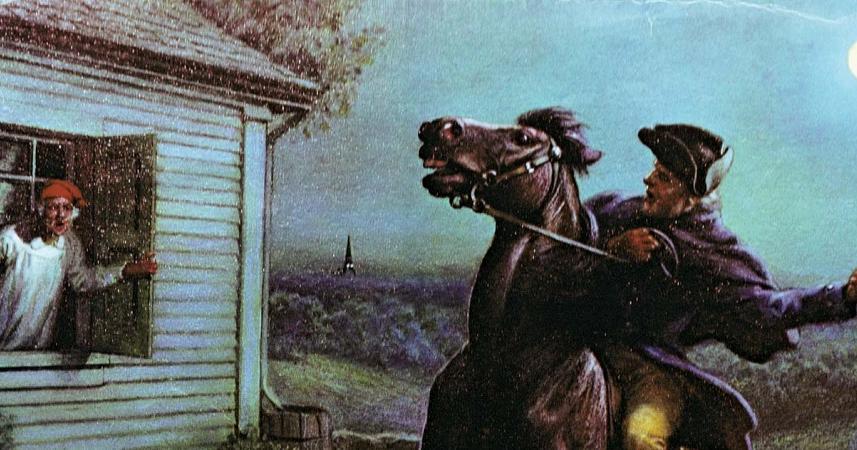
The 18th of April…

 Does “the 18th of April” ring any bells for you?

Years ago, in a graduate seminar in education leadership (full of would-be superintendents working on PhDs at my well-respected university), our professor entered the room, struck a dramatic pose and said…

“On the 18th of April” (long pause, class attentive)

“In seventy-five” (long pause, dead silence)

“What?” (gray-haired Prof scans the room)

In a small voice, I say,

“Hardly a man is now alive
who remembers that famous day and year.”

(another pause, Professor smiling, nodding)
I clear my throat and say…

“It’s the one that begins ‘Listen my children…’”

(blank faces)

“and you shall hear…”

(still nada)

“of the midnight ride…”

(a couple of people are getting it now)

“of…?”

(muttered) “umm, Paul Revere?”

Prof points to me and says “Don’t answer!” Then he asks: “Who’s the poet?”

When nobody–not one of the 20-odd people in the room– could answer, or would even try, he lets me tell the class. Longfellow.

“When did you learn that?” he asks.
Fifth grade. And I only know an abridged version. But still.

I learned “O Captain, My Captain” (speaking of anniversaries) in 8th grade.

And the prologue to “Romeo and Juliet” in high school. Still with me, along with memorized King James scripture, lots of Cummings, Dickinson and Frost and an embarrassingly large cache of song lyrics.

Why aren’t we using poetry to teach history?

Well, two roads diverged in a yellow wood…

And we chose easily measured standardized test questions.

Quote of the Day

Sometimes, Facebook bubbles up a worthy glimpse of the past. This awesome quote– from 12 years ago– appeared on my page this morning, causing me to reflect on how much we’ve lost in the past decade. Wood is reflecting here on a remarkably different era– where Michelle Rhee was on the cover of TIME magazine, brooming out “ineffective” teachers, and Teach for America was growing, not shrinking and re-branding. His school was building on the reforms of the 1990s, with student-focused programming and the valuing of teacher expertise. If nothing else, it rebuts the tired cliche’ that “factory model” schools have not changed in the past century– schools have changed radically in just a dozen years. George Wood’s school was in Ohio, where “reformers” see their #1 goal as expanding private school vouchers.

“For the past 18 years, I have worked as a HS/MS school principal alongside a dedicated staff and a committed community to improve a school. In that time, we have increased graduation and college-going rates, engaged our students in more internships and college courses, created an advisory system that keeps tabs on all of our students, and developed the highest graduation standards in the state (including a Senior Project and Graduation Portfolio).

But reading the popular press and listening to the chatter from Washington, I have just found out that we are not part of the movement to ‘reform’ schools. You see, we did not do all the stuff that the new ‘reformers’ think is vital to improve our schools. We did not fire the staff, eliminate tenure, or go to pay based on test scores. We did not become a charter school. We did not take away control from a locally elected school board and give it to a mayor. We did not bring in a bunch of two-year short-term teachers.

Nope, we did not do any of these things. Because we knew they would not work.”

George Wood

Ever Had a Student Like Taylor Swift?

Ever had a student like Taylor Swift?

The question I’m asking is not “Did you ever have a student who turned out like Taylor Swift after they were a full-grown adult—unbelievably well-known and well-off?”

It’s this: Did you ever have a student you felt was full of promise? A kid for whom you could foresee a big future—in any number of arenas, from business to politics to entertainment?

A kid who looked and acted like Taylor Swift in this video, when she was 16 and a sophomore at Hendersonville High School? You can see the talent, drive and ambition from a mile off, and you think the student will end up doing something remarkable with their one wild and precious life.

In the video, however, we see Taylor pledging allegiance, solving a math problem and sort-of mouthing off to her mom. Her comments on camera reveal an atypical mountain of 16-year-old self-confidence, something that can be annoying in a classroom. As it happens, the video was shot near the end of her time actually attending high school, as her career took off, and she finished high school via homeschooling. A practical solution. And, I have to say (quoting Paul Simon), her lack of education hasn’t hurt her none.

My follow-up question: What happened to your student like Taylor Swift—the ultimate prize-winning science geek, the creative senior whose novel you expected to buy in the future, the talented trumpeter headed off to Julliard? Did they rise to greatness? Fizzle? Run into a roadblock and blow all that talent and potential?

Speaking only for myself, I would say that of course some students show enormous promise, but nobody’s future is guaranteed—or even predictable. I have had many former students end up in positions of leadership and acclaim, even fame, in varying fields—just as their teachers expected. And others who made a wrong turn someplace, sometimes disastrously.

What’s more interesting to me is those students of whom little was predicted, who leapfrogged over a lackluster secondary school presence into a successful adulthood. I had a student in my 7th grade math class whose homework was perennially missing, and whose test scores were abysmal. We had tons of meetings around this kid with his beleaguered parents—how to get him to focus on schoolwork, benefit from extra tutoring, knuckle down and pass the seventh grade, etc. etc.

You know what’s next, right? By the time he was 21, Mr. Anti-math was a million-dollar real estate salesman, back when selling a million dollars’ worth of real estate meant something. His little headshot, with its cool haircut, appeared in every edition of the local news. Presumably, he had someone else doing his taxes, and drawing up contracts.

I also know that many of my middle school students’ future goals were centered on riches and fame. You don’t often meet a pre-teen who hopes to live their life humbly, in service to others. Self-effacement and altruism are difficult when you’re not really sure of who you are, to begin with. Besides, aiming high will please your parents and your teachers.

Celebrity, however, is not all that it’s cracked up to be:

When a celebrity is that prominent, they are always in danger of becoming the figurehead of cultural and societal frustrations. Which is one of the many reasons celebrities periodically recede from the public eye: no matter how many people love you, there comes a point when the structure of a star image cannot shoulder the weight of the star’s meaning and import. The history of celebrity is filled with examples of people who did not or could not protect themselves from this scenario — because of their youth, because of addiction, because of others’ greed, including our own as consumers and fans — and careers and lives that imploded because of it.

Taylor Swift’s ‘meaning and import,’ in 2024, have made her the target of a whole segment of American society:

She’s doing too much, except when she’s not doing enough, and she’s always doing it wrong… a pretty blonde dating a handsome football player should, at least for white people of a certain age, evoke all the simpler bygone vibes (Friday-night lights, milkshakes with two straws, letterman jackets) that conservatives could want. Except — oops! — the pretty blonde endorses Democrats. And Travis Kelce, the football hero, appears in commercials for vaccines (bad) and Bud Light (somehow worse).

And why does she hog the spotlight at his games? She’s Yoko Ono-ing him and jinxing his team, the Kansas City Chiefs, except when she misses a game — and is still, somehow, jinxing the team, which made it to the Super Bowl anyway, proof right there, somehow, of a vast left-wing conspiracy.

Taylor even gets people like the execrable Jesse Waters claiming she is a left-wing asset.  And worse.

Here’s the thing about Taylor Swift: she is a genuine talent, who writes her own material. As a life-long musician and music teacher, that fact alone elevates her above many, if not most, popular music superstars, to me. Of all the amazing things she’s accomplished, I most admire her reclaiming her own music by re-recording albums released when she was younger, and under the thumbs of record producers whose goals centered on promotion more than artistry and message.

That makes her a role model for all girls who want to speak with their own, authentic voice.

And that’s a goal that teachers can get behind, with all their students. Wealth and glory are often fleeting, but knowing who you are and what you stand for can be accomplished by all students.

The picture below was shot at the Musical Instrument Museum in Scottsdale, AZ, one of my favorite places on the planet, eight years ago this month. If you go on a weekday, you are likely to run into a field trip in progress. And even though there were Chinese drums to pound, and John Lennon’s Steinway (on which he composed “Imagine”) to reverently view, where were the students clustered? In front of Taylor Swift’s sparkly dress and banjo, mouthing the words to her songs.

Those kids are probably 20-something now. Let’s hope they’re claiming their own voices.

I’m Not That Kind of Christian

I was eager to read Tim Alberta’s new book: The Kingdom, the Power and the Glory: American Evangelicals in an Age of Extremism. I follow Alberta’s magazine pieces, in the Atlantic and Politico, his appearances on cable and mainstream news and podcasts. I read his previous book, American Carnage: On the Front Lines of the Republican Civil War and the Rise of President Trump, and found it well-written but disappointing, an overly detailed defense of country-club Republicanism that missed the ugly underpinnings of how we ended up with President Donald Trump.

But—cutting to the chase—The Kingdom, the Power and the Glory is a fantastic book. Highly recommended, even though the burgeoning Christians-are-what’s-wrong-with-this-country crowd may be irritated by Alberta’s persistent, conservative choir-boy insistence that the church is a force for good.

I should mention here that I had a front row seat for the rise of the Cornerstone Evangelical Presbyterian juggernaut in Brighton, Michigan (nothing like your mainstream Presbyterian, btw). We moved to Livingston County around the same time as Richard Alberta, long-time pastor at Cornerstone and Tim Alberta’s father. When we were looking for a church, we heard repeatedly about the great things going on at Cornerstone, which was just a few miles down the road—the rapid growth of the congregation, the inspiring sermons, the youth group with 100 members. Pretty soon there would be a school, too—ultimately, there would be six major building expansions in 30 years.

One Christmas Eve, we decided to give Cornerstone a try. My son was three or four at the time and had zero capacity for quiet behavior in a strange place. When heads began turning, my husband took him out into the narthex. After the service, he was holding our coats and standing by the door. We’re not coming back here, he said.

Out in the car, he pulled a fistful of brochures and monographs out of his pocket, collected as he chased our son around the lobby area. Take a look, he said. There were predictable anti-abortion pieces—but also literature supporting capital punishment, and the usual Old Testament scourges against divorce, dark (Harry Potter) magic and homosexuality. We’re not exposing our kids to this, we agreed. We found another church.

But Cornerstone, which eventually grew to 2000 families, held a lot of power and influence in Brighton. Richard Alberta enjoyed stirring up local controversy—when a downtown coffee shop put a tiny rainbow sticker on its door, he wrote a letter to the newspaper, suggesting customers who were willing to order coffee in such a sinful place consider going to “Sodom and Gomorrah” (his too-clever name for Ann Arbor, 25 miles south), instead. The shop closed a few months later.

At Christmas time, when many churches collected gifts for needy families, he declared that there really was no excuse for being needy in well-off Livingston County. Instead, his church filled up a semi-truck with evangelical goods and household items and shipped them to Russia, to support struggling Christians there.

Alberta broke up the Brighton Ministerial Association because he refused to meet with a local gay minister. He brought in “security” specialists when my church, St. Paul’s Episcopal, called a Black rector, claiming that criminals “from Detroit” (code language) would now be getting off I-96 and endangering congregants in Brighton churches’ parking lots.

He went after my church, probably the most liberal mainstream congregation in town, repeatedly and viciously —in the newspaper and any other media outlets he could find, pre-social media. When a reporter at the local newspaper asked for an in-depth interview, he had a putting green set up in his office, and spent the interview nonchalantly practicing his short game, as she sat and took notes.

Many of my students attended Cornerstone and went on mission trips to save the unchurched of West Virginia or wherever. One of my band students’ father was an associate pastor at Cornerstone; at Parent-Teacher conferences, this pastor asked me to call the fees for his son’s upcoming band field trip a “donation” for tax purposes. He came with a typed-up statement for me to sign (I didn’t).

There’s much more, but you get the picture.

Tim Alberta’s book begins with the death of his father, in 2019, and his surprise at learning formerly dedicated congregants were leaving Cornerstone for more MAGA churches. Funeral attendees criticized Tim for his openly non-MAGA thinking (a well-deserved potshot at Rush Limbaugh). Followed up, of course, with the righteous assurance that they were praying for him to see the real truth.

My thought: The Buddhists were right about karma. You reap what you sow.

Which is, bottom line, where Tim Alberta is going in this book. He takes the reader through right-wing congregations, colleges and organizations around the country, a wide-ranging array of appalling examples of religious malfeasance. Mercedes Schneider posted some hot quotes from the book in her blog, if you want to get a sense of the flavor of his writing, and the practices he explores and condemns.

Alberta is careful to note that Trump was merely an accelerant, a permission-giver for bad behavior in the name of the Lord, not the root cause of what has happened to the Evangelicals. But he pulls back the curtain on some distinctly repellant, un-Christian conduct and people, both the globally famous and the local yahoos in Brighton.

He resists passing judgement on more inclusive, mainstream churches, although his conservative perspective is never hidden. He also has the scholarly and personal background to dissect theological and biblical questions raised by the commercialization and politicization of the spiritual. He writes with great confidence and clarity, relishing the opportunity to counter every lazy iteration of “Well, the Bible says…” He spends a half-dozen pages on abortion that are well worth reading.

I learned a great deal from the book. For starters, I began to understand where MAGA and its tribal beliefs and actions come from, how conservative Christians moved rightward—the triggers, the entitlements, the power-hoarding. This was personal for me, too, a look at how all the nice white kids from nice white families in my school district shifted their world-framing and let casual racism, sexism and xenophobia emerge.

It was also clear how the pandemic was a huge political trigger, dividing congregations that wished to protect their more vulnerable members from those who saw vaccines and restrictions as the state trying to control the church, and COVID deaths as God’s will.

Alberta ends the book with some signs of hope—the most convincing of which, ironically, come from women who have been sexually abused and actually fought back—Jennifer Lyell and Rachel Denhollander. Aside from Paula White, Trump’s hottie “spiritual advisor,” the main characters in this book’s framework are men. White men. When Alberta travels, as research, he visits men—genuine pastors, scoundrels posing as clergy, insufferable jerks, the egomaniacal, the greedy and the scheming. Women take a subordinate role in all of the churches and organizations. This is so obvious, in all 500 pages, that it feels like a blind spot. He thanks his wife for essentially raising their three boys in his absence, in the acknowledgements, but it feels like an afterthought, the cookies and coffee after the meat of an intelligent sermon.

Nonetheless, Alberta seems to have had a religious epiphany, taken a well-researched and critical look at what evangelical Christians have become, and bravely wrote about what he’s observed. When I read about mega-churches, pastors living in mansions and castigating their fellow citizens who believe differently, as the donations roll in, I always think “Not all Christians are like that.”

And, lo and behold, there’s a FB page for that: Not That Kind of Christian. There are think pieces—“We Were Wrong”– and bricks and mortar churches where the focus is on doing good and building community, not accruing political power. The traditional church may be fading, as it definitively has in Europe, but it isn’t dead yet.

I am certain that Tim Alberta holds out hope that we’re on the crest of a religious revival. In the meantime, he was harrowingly honest about what he saw. Everyone—believers and non-believers should read the book. Five stars.


Atticus

There’s a strange moment in time, after something horrible happens, when you know it’s true but you haven’t told anyone yet. Of all things, that is what I remember most. It was so quiet.  

Barbara Kingsolver, from the Poisonwood Bible.

So—we are a dog family. Always have been. Before we had kids, my husband and I had a dog. A secondhand dog, like most of our subsequent dogs. In 44 years of marriage, we’ve had six great dogs, with divergent personalities and backstories. Two of our dogs were named Blue (neither was named by us). One dog thought she was a cat—you know, aloof and entirely self-interested. Another flunked out of leader dog school, and one was a beautiful golden retriever named after a Supreme Court Justice. One died, of a snakebite, about 15 minutes before my son’s 6th birthday party.

And the last dog we had was named Atticus. Putting that in the past tense is still hard, although we had to put Atticus down—over the Rainbow Bridge, as they say—in July.

Atticus was found in a Walmart parking lot, a stray, and—good fortune!—taken to a Humane Society in southwestern Michigan which partners with Lakeland Correctional Facility in a program called Refurbished Pets, in which selected dogs are placed in the prison, and inmates care for and train them. Before residing in the prison, foster families care for the dogs, which are often in rough shape.

Atticus was cleaned up and civilized by a wonderful woman named Jean, then entered the RP training program. As it happens, my husband, a criminal defense lawyer, had a client at Lakeland. At a visit, his client, a leader in the dog training program, asked if we might be interested in a great dog. We were in that sweet spot of not owning a dog, where you can travel and go out for the day without worrying about your pet, having lost Annie (the cat-dog) a few months earlier. We hadn’t yet discussed getting another dog.

What’s the dog’s name? my husband asked. Atticus.

And that was that.

We picked Atticus up from Jean’s house. She showed us how good he was at chasing balls, and gave us a thundershirt because Atticus was terrified of storms. She told us he had some “trust issues” but was, at heart, a very good boy. The vet that donated time to Refurbished Pets thought he was about three years old. Thinking about Atticus on his own, riding out storms and scrounging for food, broke our hearts. He was instantly, and irretrievably, our boy.

For the next eleven years, Atticus slept on a cozy bed in the corner of our bedroom and traveled with us—seven times—from Michigan to Arizona, an excellent backseat traveler. Whatever trust issues he had melted away, although he still whined from his bed when there was thunder and lightning.

Of all the dogs we ever had, Atticus was the most food-driven. We got in the habit of storing things in cupboards and the microwave, because anything left on the counter, or the kitchen island was bait. Once, my son and some of his friends bought some gourmet, $$$ cookies while touring northern Michigan, and left them in bags and boxes within striking range. When they returned home, Atticus had eaten most of them and hidden the rest. For the next year, we found cookies under couch cushions, in a bookshelf, and in a laundry basket.

About a year ago, Atticus (probably 14 by now) was showing signs of age: He panted constantly. He paced, all night long. It obviously hurt to lower his back end to the ground, and steps were problematic. The vet said his heart was enlarged, and gave him a medication that caused indoor accidents, something he’d never had before, and made him feel terrible. Plus—he had a collection of symptoms that might be called “acting weird.”

It was time. We were both there, petting him, feeding him treats, holding his paw, as his tail slowly thumped, then stopped. Afterward, I didn’t feel like sharing the news, or posting a photo. It was, as Barbara Kingsolver says, so very quiet.

He was our dog from the wrong side of the tracks, 100% dog, prone to drifting off during walks in the woods (but always returning) and always—until the last year or so—down to pursue a ball or chew up a stuffed toy, especially one that belonged to another dog.

After we made the appointment with the vet, I took a dozen photos of Atticus panting and pacing around the living room, his last afternoon on earth. Here’s one.