
As a middle school teacher, I spent a fair amount of time talking with kids—mostly 8th graders, going into high school—about what you might call their life plans. Were they thinking about college? Or the workforce? What should they focus on, as they reached the last phase of their free public schooling?
Most of the kids I taught were going to college—their (white, suburban) parents were planning on it. But very few kids in the 8th grade are settled on a career—and if they are, it often turns out to be the Wrong Thing.
More and more before I retired, my students (mostly boys) talked about wanting to be a billionaire. Didn’t seem to matter much how they got the money—professional sports or inventing a killer app, whatever. What was important was having a lot of money. To spend on cool things.
I have to believe that this desire to be rich has not abated among adolescents, given their current role models in Congress and the White House. It’s no secret that Americans admire the rich and famous, assuming they deserve their power. A look at the accrued wealth of US Senators will confirm: money gets people into office.
One would assume that in a time of rapidly rising prices, informed citizens—yup, the kids I had a hand in teaching—would understand that wealth inequality is driving many of our most egregious economic problems.
They’re grown up now. They understand that there are more important values than being filthy rich, right? Do they know that hoarding enormous wealth is not something to be admired?
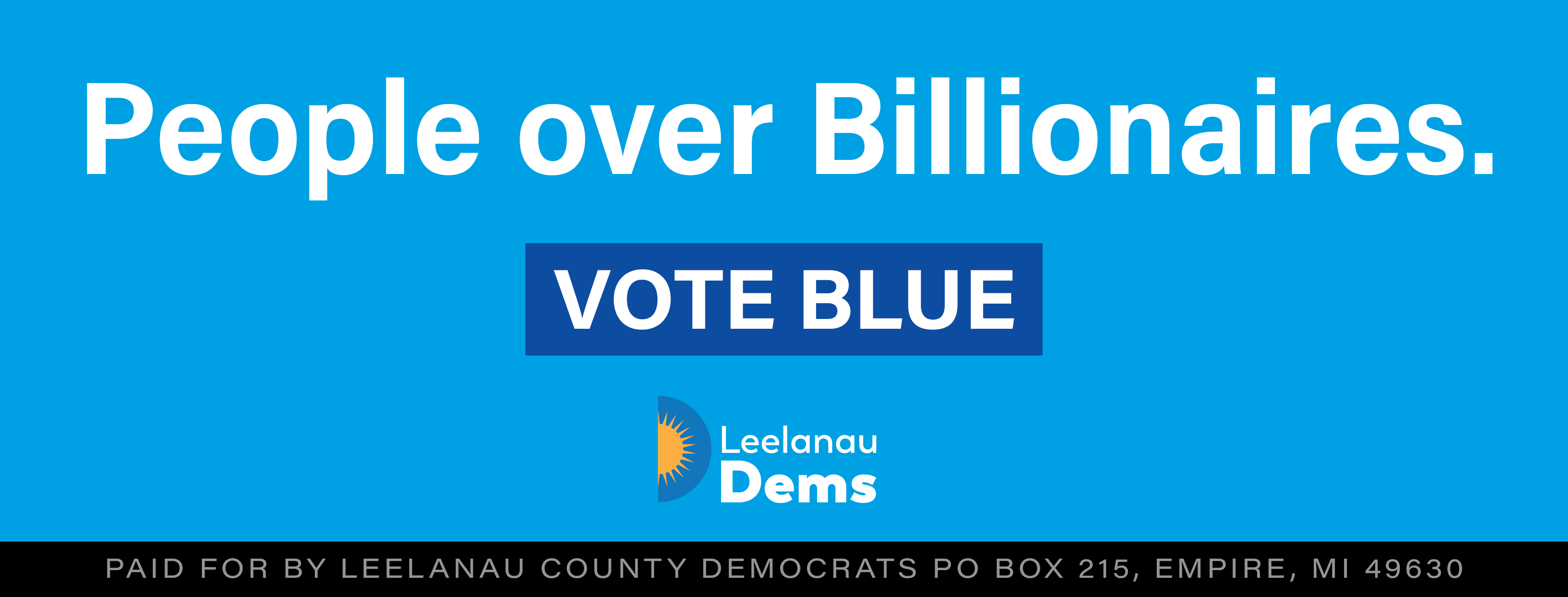
Recently, a billboard went up on a well-traveled county intersection, here in NW Michigan. People Over Billionaires, it said. Vote Blue.
And it started a furious local conversation around just what it meant–always the sign of an effective message. There were letters to the editor claiming that billionaires paid more than their share of taxes (!) and “gave back” to the community. (Spoiler: not true.)
Billionaires were our most productive citizens, the letters said–and we needed to respect them! There were also letters that pointed out, in much calmer and more elegant language than I’m using, that this thinking was pure bullshit.
I was kind of stunned by this—who thinks billionaires are rooting for the little people to enjoy better, publicly supported lives? Elon Musk? Jeff Bezos? Larry Ellison? The Waltons? One could go on and on. The word oligarchy might be used.
Last week, there was a widely shared cartoon floating around social media: An elderly gentleman is pushing a grocery cart. He says: ‘Tell me I’m wrong, but a country isn’t doing well if seniors can’t afford groceries, after working their whole lives.’
Seemed like a straightforward critique of steady inflation, to me, without getting into the weeds about tariffs or the national debt. I get groceries, like most Americans, and I know that prices have gone up significantly, and folks of both political persuasions on fixed incomes are hurting, on several fronts. But the comments were weird.
Leaving aside the usual flotilla of “you dumocrat libtards” remarks and obvious bot observations, there were dozens of people who claimed that they hadn’t found prices going up at all. Lots of accusations about greedy seniors wanting “free stuff” and spending younger generations’ money. Imagine having 45 years to save for retirement, then not doing so. Lazy!
Well, gee. Imagine going after the folks who built the middle-class economy, rather than the ones who destroyed it.
There’s been occasional talk, especially from those who study our history, about current parallels with the Gilded Age, c. 1870–1913. Trump frequently idealizes the late 19th century as America’s economic high point, especially embracing control of the economy with tariffs. Nobody in the Trump administration talks about soaring wealth inequality, dangerous corporate influence, or rampant corruption.
What gave people the idea that a plutocracy was a viable, even desirable, way to run the United States?
A couple days ago, Heather Cox Richardson had an excellent daily letter about the manifestations of wealth inequality—lack of accessible health care, loosening of regulations to benefit the very rich, etc. As she often does, she shared an historical publication that illuminates issues we are facing today: In 1883, sociologist William Graham Sumner published ‘What Social Classes Owe to Each Other,’ concluding that the answer was: nothing.
“Sumner called for a “laissez-faire” world in which those who failed should be permitted to sink into poverty and die to keep the U.S. from becoming a place where lazy people wanted a handout. In the end, such people needed to be purged from society for the good of the nation.
At the time, those succeeding in the industrializing economy nodded along with Sumner. The Republican New York Times editor wrote that even though Sumner’s “views are singularly hard and uncompromising, it is difficult to quarrel with their deductions, however one may feel one’s finer instinct hurt by their apparent cruelty.”
Apparent cruelty is what I found reading Project 2025, which has lots of–updated–language like Sumner’s.
But in the end, what will save us as a functional democracy is… people over billionaires. Right?
 Teacher in a strange land