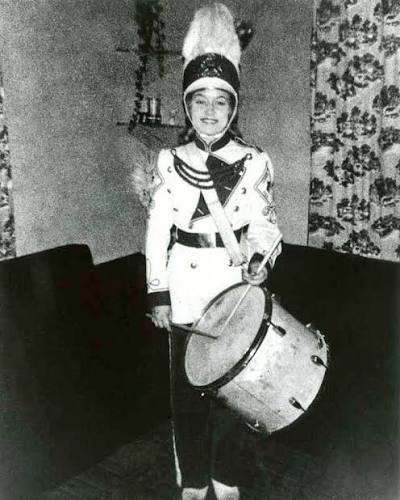
I can’t add anything to the outpouring of love and respect for Dolly Parton. She was phenomenal, in dozens of ways. As a musician, I appreciate her melodic genius and as a writer, I admire her gift for lyrical story-telling and poignancy. But what I’ve loved most, this week, is that black and white of photo of Dolly Parton, class of 1964, in her Sevier HS band uniform.
It reminds me that so very many of the admirable people in our world developed their gifts and talents in a public school classroom. Dolly was the first in her family to graduate from high school; most of her 10 siblings who made it to adulthood dropped out, to work or to marry.
And she was in the band. She also supported underfunded school band programs across the South, for decades. We all know about Dolly’s Imagination Library program (you can donate here) and the hundreds of other ways she gave money and recognition to people who truly needed a boost.
But when we think about the roots of a spectacular career in the arts—they all started somewhere, and Dolly’s did not spring from early identification of extraordinary talent, private lessons or expensive summer camps. They started at home, and were burnished at her garden-variety TN public school.
My personal children played in the band (percussion and trombone)—and both of them expressed impatience with my barely suppressed opinion that band kids were a breed apart. Several of their good-kid friends weren’t in the band—and they could both point, accurately, to some band kids who were not, in school vernacular, good citizens.
However. I built my professional career, and my life before and after that career, on what I learned as a school-aged musician—in band, and choir and youth symphony. School music programs literally sent me to college, the first in my family.
They gave me the skills to offer my services on Saturdays at a community center, as a teenager, giving private flute lessons and earning pocket money. My music teachers—in an ordinary blue-collar public school district—steered me toward scholarships at several levels, membership in the local professional wind ensemble, and opportunities to perform in public (which is one of the big benefits of playing in a school band, BTW—dealing with performance nerves and understanding the necessity of rehearsal).
When Clinton was elected, I hung a poster of him, playing the tenor saxophone, on the band room wall. The point was not political—it was that band kids grew up to do amazing things, from comedy (Tina Fey, flute) to professional sports (Walter Payton, percussion) to walking on the moon (Neil Armstrong, euphonium).
Band kids sometimes face derision from their peers, especially in schools where instrumental music is low on the coolness totem pole. It takes some maturity to get past the name-calling, and that maturity develops on a continuum, assisted by parents and other adults in a student’s life.
Doing things for pleasure, building a community of friends, developing your own opinions—these are adulting skills. The band room can become a home for kids, the place at school where you can hang for hours (and dump your belongings and snack wrappers everywhere, driving your band teacher crazy). Simultaneously, these kids are being challenged to learn complex musical literature and skills, express powerful emotions, entertain their peers and work as a team, with every member’s contribution being important.
And it’s not easy! A couple of years ago, I was contacted by one of my former school administrators. As a retiree, he had decided to learn to play the guitar. He bought a guitar and started taking lessons. And it was frustratingly difficult.
He said that he always assumed learning to play a musical instrument was easy. After all, sixth graders in his building started band in September (in classes of 60 students) and put on a concert in December. How hard could it be?
As satisfying as that was to hear, what matters even more is the number of middle school band kids who push through the difficulty and experience the reward of performing together. That’s the real lesson.
Just ask Dolly.