Just Who is Trashing Public Education?

Get ready for a big dump–a deliberately chosen word–of anti-public education blah-blah over the next five months. It’s about all the right wing’s got, for one thing–and it’s one of those issues that everybody has an opinion on, whether they went to public school. have children in public schools, or neither.

Public education is so big and so variable that there’s always something to get upset about. There’s always one teacher who made your child miserable, one assigned book that raises hackles, one policy that feels flat-out wrongheaded. There’s also someone, somewhere, who admires that teacher, feels that book is a classic and stoutly defends whatever it is—Getting rid of recess? The faux science of phonics? Sex education that promotes abstinence? —that someone else finds ridiculous or reprehensible.

Not to mention—teaching is the largest profession in the country. So many teachers, so many public schools, so much opportunity to find fault.

In other words, public education is the low-hanging fruit of political calculation. Always has been, in fact.

A few years back, when folks were going gaga over Hillbilly Elegy, seeing it as the true story of how one could rise above one’s station (speaking of blahblah)—the main thing that irritated me about ol’ J.D. Vance was his nastiness about public education. Vance has since parlayed a best-seller that appealed to those who think a degree from Yale equates to arriving at the top, into a political career—and putting the screws to affirmative action, in case anyone of color tries to enjoy the same leg-up he did.

J.D. Vance’s education—K-12, the military, Ohio State—was entirely in public institutions until he got into Yale Law School. He doesn’t have anything good to say about public ed, but it was free and available to him, a kid from the wrong side of the tracks. When I read Rick Hess’s nauseating interview with Corey DeAngelis in Education Week, I had a flashback to ol’ J.D., intimating that he achieved success entirely on his own, without help from that first grade teacher who taught him how to read and play nice with others.

DeAngelis says:

I went to government schools my entire K–12 education in San Antonio, Texas. However, I attended a magnet high school, which was a great opportunity. Other families should have education options as well, and those options shouldn’t be limited to schools run by the government. Education funding should follow students to the public, private, charter, or home school that best meets their needs. I later researched the effects of school choice initiatives during my Ph.D. in education policy at the University of Arkansas’ Department of Education Reform.

So—just to clarify—Corey DeAngelis went to public schools K-12, for his BA and MA degrees (University of Texas), as well as a stint in a PUBLICLY FUNDED program at the notoriously right-focused University of Arkansas. That’s approximately 22 years, give or take, of public education, the nation-building institution DeAngelis now openly seeks to destroy.

I’m not going to provide quotes from the EdWeek piece, because anyone reading this already knows the hyperbolic, insulting gist—lazy, dumb, unions, low bar, failing, yada yada. He takes particular aim at the unions—although it absolutely wasn’t the unions—shutting down schools during a global pandemic. He paints schools’ turn-on-a-dime efforts to hold classes on Zoom as an opportunity for clueless parents to see, first-hand, evidence of how bad instruction is. He never mentions, of course, the teachers, students and school staff who died from COVID exposure.

Enough of duplicitous public school critics. My point is this:

The people who trash public education—not a particular school, classroom or curricular issue, but the general idea of government-sponsored opportunity to learn how to be a good, productive American citizen—have a very specific, disruptive ax to grind:

I got what I needed. I don’t really care about anybody else.

This goes for your local Militant Moms 4 Whatever on a Mission, out there complaining about books and school plays and songs and health class. It’s not about parents’ “rights.” It’s about control. And never about the other families and kids, who may have very different values and needs.

It’s about taking the ‘public’ out of public education. And it’s 100% politically driven.

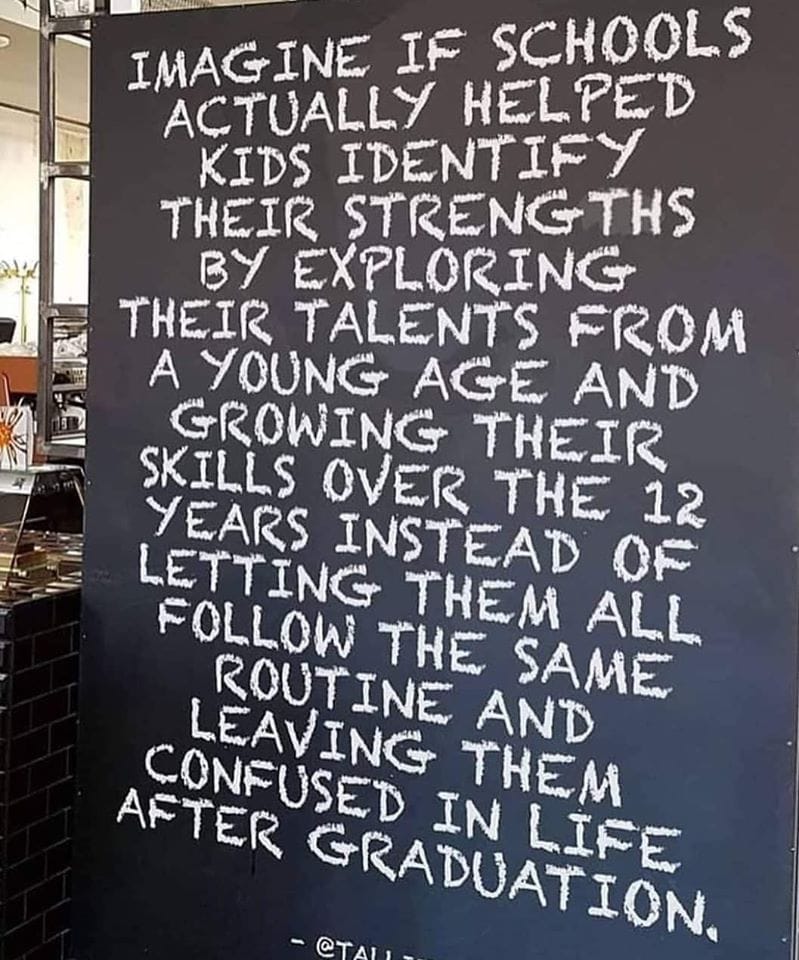
Occasionally, you’ll see someone put forth a visionary principle for public education, like the meme that wonders why schools don’t focus on their students’ strengths. Wouldn’t that be lovely?

Small classes, focused on individual talents and gifts, kind of like Corey DeAngelis’s magnet school. A warm and welcoming community of learners. Ample resources. Ask yourself WHY we don’t have that in every public school (worth noting: some schools get pretty close).

It’s not because educators—or schools, if you will– don’t want to meet student needs. They do.

Just who is trashing public education—and what are THEIR ultimate goals?
What about Homeschooling?

Families who choose to homeschool their children have never been on my negative/activist radar, as a veteran public school educator. I have had both positive and not-so-positive experiences with students who were homeschooled–from a pair of shy, well-behaved sisters who fit seamlessly into the middle school music program due to years of independent music lessons, to a sweet boy who had never really learned to read in the 7th grade and tended to wander aimlessly around the music room, once his mother finally decided to send him to school at age 12.

My ambivalence about homeschooling is likely because I became a teacher in a time when homeschoolers were often young hippie parents who worried that schools would suppress their children’s natural gifts in favor of compliance and standardization.

This was the era of Paulo Freire and Summerhill, and—perhaps my favorite book about education— “Teaching as a Subversive Activity,” by Neil Postman and Charles Weingartner. The subtitle is worth mentioning:  A No-Holds-Barred Assault on Outdated Teaching Methods-with Dramatic and Practical Proposals on How Education Can Be Made Relevant to Today’s World. (1971)

Today, homeschoolers are often escaping what they see as Godless classroom chaos, or a curriculum that acknowledges certain truths about our diversity and honest national history. The pandemic and its aftermath pushed parents on both sides of the masking question into involuntary home academics, and left people frustrated.

So much for drama and relevance, letting children direct their own learning, at their pace and honoring their interests. Instead, as David Labaree and Deborah Malizia note:

Schooling moved from a shared learning and cultural experience that generated a sense of community and common purpose to an individual competition for the grades, credits, extra-curricular achievements and degrees that determine students’ future life chances.

Once college enrollments surged in the mid-20th century, the struggle became a contest to gain admission into the most selective college possible. Rising levels of income inequality have only intensified the competition. One result is the devastating increase in student stress and social disconnection, in a setting where every student becomes a potential adversary in the race for extrinsic achievement, and the relentless pressure hurts students at all levels. 

This is not how schools were supposed to evolve—they were supposed to be sites for building citizenship, democratic equality and opportunity. But here we are.

Still. If Mama wants to educate her little ones at home, I’m OK with that, as long as my tax dollars are not paying for skiing lessons or $500 LEGO sets, part of a misguided voucher scheme.

We are likely to see those kiddos at some point, in the public system, perhaps middle school or high school when the home-school teacher’s curricular expertise across the board founders. Or when one of the kids wants to play in the band, join the chess club or the public school basketball team.

Just as public schools have tried to adapt to their surroundings and unplanned events, like a global pandemic, families have tried to custom-tailor their children’s education. I’m not saying that I think all of those pull-your-kids-out choices were good ones –thinking here about that 12-yr old non-reader, or kids whose parents reject the idea of getting along with people who are very different from you, in a pluralistic society.

But–a strong public school system, built on quality teaching and rich curriculum, still can serve multiple perspectives in a healthy  community, including the desire to educate one’s children at home.

Where I get off the homeschooling train is when homeschoolers refuse to follow community-driven policies. Vaccinations, for example. If you want a free, high-quality public education, or the opportunity to use public schools, at any point, as a springboard for your children’s ultimate goals, you may have to follow a few rules.

The Michigan Legislature is currently considering a registry of all school-age children. Homeschoolers would have to, by law, notify the state that they were homeschooling their children. Beyond that—things like curriculum and testing, which are largely controlled by legislation, for example—there is a great deal of freedom for homeschoolers.

This feels like common sense to me, much like a census or licensing vehicles. Where are the kids being homeschooled—are there are large number in a particular district? Why? Can we expect to see them return to the public school and prepare for that? Where are the kids who are not being schooled at all, home or otherwise—and are they safe? Why do homeschoolers find a simple registry threatening?

It’s interesting how many homeschoolers see this as government interference. Given the increases in homeschooling, this seems like critical data to have: Michigan is home to roughly 1.7 million school-age children, and 1.36 million are in public schools, while 182,000 are in private schools, according to 2022 Census data. That would leave about 150,000 students who are either homeschooled or have dropped out.

That’s a lot of kids. I’d be willing to bet that not all of them are being lovingly homeschooled by teachers with the skills to help them move forward academically.

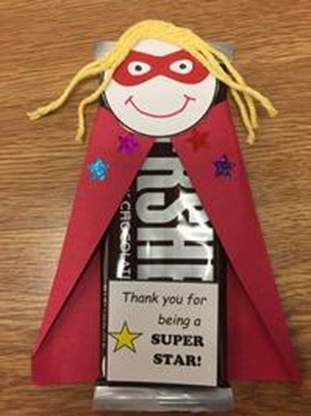
The Grinch Who Stole Teacher Appreciation Week

I’ve always been of the opinion that teachers get so few routine perks in their professional lives they deserve every random treat or award that meanders their way–from sticky little misspelled mash notes to free use of a leased SUV.

After all, there aren’t many workplaces where professionals end up providing their own materials, cleaning services and professional development. There aren’t many college-educated specialists who gladly share their expertise for free–or attend a weekend conference on their own dime, then arrive at work on Monday morning, without a thought for “comp time.” Because if they didn’t show up, someone would have to pay. And it shouldn’t be the teacher next door, or their students.

For these reasons, and a hundred more, nobody begrudges teachers the tokens of appreciation that come their way this week, from the handmade construction-paper cards to the potluck lunch from the PTA. I love it when teachers invite their former students to check in on Facebook–or when they post their stats (years of experience, states/countries/schools, degrees, subjects and so on). It’s good to see colleagues reclaim their honor or share a few points of pride.

But it’s time we asked ourselves just who gets ‘appreciated’ once a year–and whose work is considered vital, essential, and fully professional year-round, with no need for annual symbolic gestures. There’s something about Teacher Appreciation Week that smacks of a pat on the head for being willing to go the distance without adequate compensation or support. We’re supposed to persist and excel ‘for the kids’–a phrase that teachers rightfully perceive as specious and manipulative.

It doesn’t help that National Charter Schools Week is scheduled right after Teacher Appreciation Week (not an accident, folks). The Center for Education Reform, an organization that promotes charter schools, posted the following about Teacher Appreciation week:

‘Rather than evolve and adapt to changes in the 180-year-old factory model system of education, rather than create a new path for teachers that supports their growth over mandating uniformity and lock step acceptance of rules, [teacher associations] have dug in their heels and decided character assassination and anti-charter propaganda is best.’

So much for boosting the spirits and self-respect of teachers during their special week, eh?

Actually, I don’t know a single teacher who isn’t interested in growth–or doing a little rule-breaking, evolving and adapting. In fact, the current walk-outs, anti-voucher campaigns and eloquent education blogs are evidence that teachers are no longer satisfied with flowery sentiments or coffee mugs.

Teachers are telling their communities and state leaders that they’re sick of being underpaid do-gooders and want not only adequate salaries but control over their professional work. They want the resources necessary to succeed—but also a measure of autonomy, acknowledgment of their acquired expertise.

Perhaps teachers are tired of waiting for policymakers to speak to the fact that their working conditions and public respect–measured by classroom authority, as well as wages and benefits–are diminishing every year. Maybe teachers are ready to demand what they need and deserve, rather than hang around hoping to be ‘appreciated’ every May.

Is this a lasting change? Will exasperated teachers not rest until they’ve transformed public education?

Here’s a few crucial but often forgotten facts: In number, teachers are the largest profession in the United States. And collectively, they have the power to demand and win changes to funding and salaries. It’s a stark reminder in our post-Pandemic revival of labor influence.

Policymakers have long relied on teachers’ hearts growing three sizes through the magic of watching children light up with the joy of learning, yada yada. But as the Grinch himself might say–magic doesn’t pay the rent.

The Return of the Tradteacher

Been reading about the tradwife lately? Although explicit definitions vary, the general gist is returning to a post-war conception of a stay-at-home wife, most likely with children (or planning for children), in relationships where men make all the family decisions, and control the finances. Reinforcing patriarchal norms and glorifying the satisfying and ‘natural’ role of housewife.

If you’re hearing a touch of cynicism there, well—I lived through a time when the tradwife, even if she was working, could not get a credit card or substantial business loan. While I certainly defend any woman’s right to stay home and support her children and spouse in places other than an outside workplace, the whole “tradwife” schtick (especially combined with the rollback of Roe) makes me itchy.

It also strikes me that tradwives are just another glitzy, social media-driven facet of a larger wave of backlash against a whole lot of un-trad trends in American society: Full-blown reproductive freedom. The continued shrinkage of mainline religions. Honoring personal sex/gender choices. Women running for office and corner offices–and winning. And so on.

I also see lots of pushback against untraditional teaching, curriculum and school organization models. The whole “Science of Reading” battle rings very familiar to those of us who started teaching in the 1970s, when teachers were pushing back against the “Why Johnny Can’t Read” –because teachers theoretically weren’t teaching phonics–crusade in the late 50s.

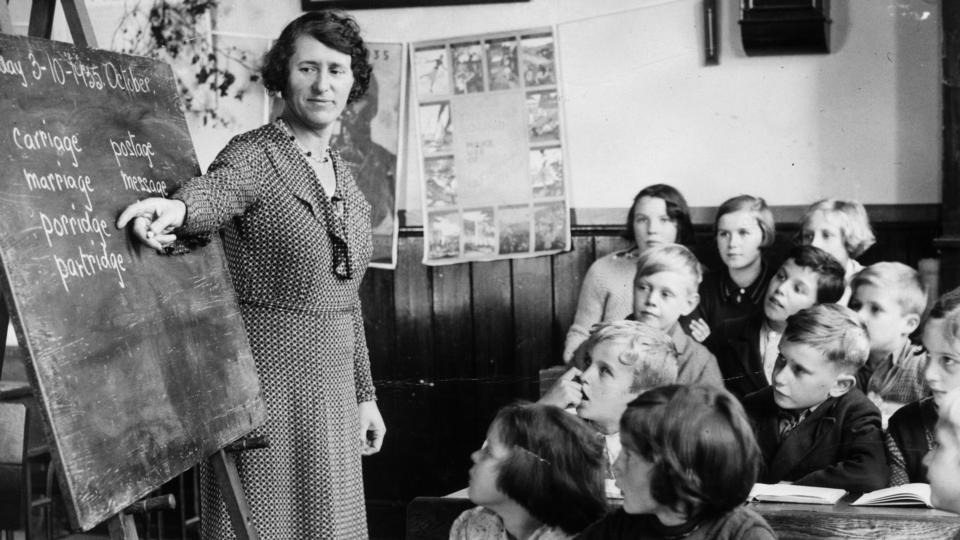
Nearly all of the folks who taught me were tradteachers, using trad methods, and when I entered the classroom, many of my teaching colleagues were 100% traditional-minded as well: Straight rows, direct instruction, textbook-based, daily homework, and off to the principal should you disobey orders. And some of those folks were effective teachers.

But lots of the opinion writing I see from Moms4Liberty, NYT columnists, conservative politicians and ed-bloggers focuses on how different education looks and feels from the classrooms they remember, decades ago—classrooms that may have been racially and economically monolithic, and headed by a series of teachers who did things in the same way.

Peter Greene recently had a good piece about Gloria Jean Merriex, a Florida teacher who broke out of her traditional mold and had some great success. A couple of lines jumped out at me:

Once she had her degree, she chose to teach at Duval Elementary, where for about twenty-five years she was a middle-of-the-road, competent-but-not-exceptional teacher.

Then came No Child Left Behind, and with it, high stakes testing. In Florida, that meant the FCAT, used to give each school a grade, with rewards for A schools and punitive “interventions” for F schools. In 2002, Duval was rated F.

Merriex was troubled. She concluded that if the school was going to be transformed, she would have to transform herself. She dumped the state pacing guides and teaching materials. When she got caught, she begged Duval principal Lee McNealy for a chance to give her methods a try, and McNealy had the guts and trust to give it to her.  Merriex developed materials and approaches of her own, and for the early 2000s, her choices were unconventional. She wrote raps and dances to do with her students for learning math vocabulary and basic processes. She used call and response, movement and arts in the math and reading classroom. If some of her techniques seem less radical twenty years later, that is in part because of her influence.

For many, perhaps most, teachers, their first years in the classroom might look very much like the way those newbies themselves were taught. It was certainly that way for me, wanting to be the World’s Greatest Band Director and following the exact procedures and ideas I had experienced in bands and at music camp in high school. For many years, I too was a competent-but-not-exceptional teacher, like Ms. Merriex.

I also broke out of the traditional mold, and while not all of the things I tried were big successes, I was able to redefine what I wanted students to take away, for the rest of their lives, from being in my classroom. I accomplished many of those goals. I read social media for music teachers now, and I see great changes in thinking about the Big Ideas—from competition to creativity—in music ed.

Traditional teaching—and like tradwives, the definitions are murky—is not always or even often the best bet. Especially if that teacher’s goal is to move every student under her watch forward.

Stanford Professor Jo Boaler is something of an iconoclast in non-traditional math education, and recently–no surprise–there’s been yet another dustup over Boaler’s ideas.

She advocates for ending tracking by ability in math classes, getting rid of timed tests and starting with conceptual understanding before introducing procedures. Most importantly, she wants to elevate the work that students tackle in math classes with more interesting questions that spark genuine curiosity and encourage students to think and wonder. Her goal is to expose students to the beauty of mathematical thinking.

Right there in the first sentence, there are three uber-traditional practices—tracking, timed tests, and doing a series of problems to iron in an algorithm, to get the right answers rather than seeking to understand the concepts underlying the calculation. And who’s out to get Boaler? Well, men who have been the beneficiaries of understanding and excelling at traditional mathematics.

It’s an enormously complex endeavor, teaching. Sticking to the habitual, and ignoring students who check out, only works for awhile. BUT—listen to legislators and parents talk about schooling, and a lot of what you’re hearing is somewhere between nostalgia and flat-out misinformation. The book-banning, faux CRT, Tik-tok blaming, skeptical-of-teachers crowd hasn’t got a clue about what it’s like to teach kids in 2024, beginning with some clarity about the purpose of public education.

As Jess Piper says, in a wonderful column called You Don’t Like It? Move!:

None of us is safe so long as there are folks living in states that are unsafe. They will roll over us first, and you next. The billionaires are using my state AG and other regressive state AGs to file suit to dismantle public schools. They sue to ban abortion and the medicine for self-managed abortions. They sue to stop college loan forgiveness. They sue to overturn civil rights and anti-discrimination policies.

As Piper says—hey, we can’t all move, or teach in a private school where we can craft our own processes, research and convictions. But returning to traditional methods isn’t the policy answer. You have to move forward. It’s the way of the world.  

The 18th of April…

 Does “the 18th of April” ring any bells for you?

Years ago, in a graduate seminar in education leadership (full of would-be superintendents working on PhDs at my well-respected university), our professor entered the room, struck a dramatic pose and said…

“On the 18th of April” (long pause, class attentive)

“In seventy-five” (long pause, dead silence)

“What?” (gray-haired Prof scans the room)

In a small voice, I say,

“Hardly a man is now alive
who remembers that famous day and year.”

(another pause, Professor smiling, nodding)
I clear my throat and say…

“It’s the one that begins ‘Listen my children…’”

(blank faces)

“and you shall hear…”

(still nada)

“of the midnight ride…”

(a couple of people are getting it now)

“of…?”

(muttered) “umm, Paul Revere?”

Prof points to me and says “Don’t answer!” Then he asks: “Who’s the poet?”

When nobody–not one of the 20-odd people in the room– could answer, or would even try, he lets me tell the class. Longfellow.

“When did you learn that?” he asks.
Fifth grade. And I only know an abridged version. But still.

I learned “O Captain, My Captain” (speaking of anniversaries) in 8th grade.

And the prologue to “Romeo and Juliet” in high school. Still with me, along with memorized King James scripture, lots of Cummings, Dickinson and Frost and an embarrassingly large cache of song lyrics.

Why aren’t we using poetry to teach history?

Well, two roads diverged in a yellow wood…

And we chose easily measured standardized test questions.

DIS-Information in Schools

You may have heard the story, a couple days back, about a Republican legislator in Michigan posting a photo of buses at the Detroit Metropolitan Airport, claiming the buses were transporting “illegal invaders.”  News stories politely suggested that he was erroneously referring to undocumented immigrants—after all, Representative Matt Maddock is still in the Michigan House—before confirming that the buses were, in reality, transporting four men’s basketball teams competing in this weekend’s Sweet 16 and Elite Eight games in Detroit.

Was Maddock (whose wife, Meshawn, was recently Co-Chair of the beleaguered Michigan Republican party) simply misinformed? Doubtful that he was hanging around a major metropolitan airport (which is not, by the way, in his district), watching planes and buses come and go, and simply, you know, got the wrong impression about a few dozen young men—tall ones– getting on buses.

Nor has he apologized for what might have been a dangerous trigger, inviting local yahoos to saddle up and head for the airport. In fact, he’s continued to post:

“We know this is happening. 100,000’s of illegals are pouring into our country. We know it’s happening in Michigan. Our own governor is offering money to take them in! Since we can’t trust the #FakeNews to investigate, citizens will. The process of investigating these issues takes time. The whole nation knows about the Democrat illegal invasion human trafficking criminal enterprise. Why does the media only work to cover it up?”

Welcome to Detroit, college athletes.

Back in the day, as part of what used to be called a ‘unit,’ my 7th grade English teacher, Alison Olding, taught us the difference between misinformation (when you think you know something, but it’s wrong) and disinformation (when you deliberately plant known falsehoods). There were plenty of examples to share with a group of 7th graders, back then, and now. Spreading misinformation in middle school (a daily occurrence) is always wrong, but making stuff up to harm someone else is a special kind of reprehensible.

And yet, here we are, hip-deep in AI deepfakes and college professors hosting far-right websites protecting “the American way of life”  and government interventions to suppress social media and—God help us—Russian disinformation about their insatiable, immoral war in Ukraine:

 “The strategy that matters most for the Kremlin is not the military strategy, but rather the spread of disinformation that causes the West to back away and allow Russia to win. That disinformation operation echoes the Russian practice of getting a population to believe in a false reality so that voters will cast their ballots for the party of oligarchs. In this case, in addition to seeding the idea that Ukraine cannot win and that the Russian invasion was justified, the Kremlin is exploiting divisions already roiling U.S. politics.” 

Kinda makes you wonder: Didn’t any of the Republican congressmen on the pro-Putin side learn about misinformation and disinformation in school? How to sort out fact from fiction? How to research questions around information that may or may not be true—and how to accurately evaluate sources that may be biased, or flat-out lying?

It’s a serious and critical education question. There are, indeed, public schools where media literacy is a formal part of the curriculum. There are outstanding digital literacy resources for students, supported by high-quality research. What’s missing is the will and the urgency of the need to educate kids about distinguishing between truth and whatever it is they’re getting on TikTok.

Or, unfortunately, at their kitchen tables or their church or on the bus. Misinformation—can you remember Things You Used to Believe?—has always been a factor in growing up and becoming educated. Disinformation is a darker thing altogether. Especially when it comes from people who should, theoretically, represent integrity. Legislators, for example.

Discussing this with one of my favorite cyber-colleagues, Barth Keck, he said: I teach these very strategies in my Media Literacy class. Sadly, I fear most adults nowadays – including the people on this platform – lack the patience or interest in employing them. I just discussed this point with a colleague who teaches Speech & Debate. He’s seeing kids parrot talking points rather than thinking deeply about issues. Whom are they parroting? Many adults are a lost cause; it’s the kids who need to learn to think critically.

A short piece in the Michigan Advance made this point simply: Disinformation makes our communities less safe. We are not powerless in this plight. Disinformation pulls apart our communities, and community itself is key to fighting back.

Even when it’s uncomfortable or not neighborly or involves a guy you may have enthusiastically voted for, once. When someone is spreading disinformation—even if it’s disinformation that faintly echoes your beliefs about the southern border, federal lawmakers or who deserves a handout—it’s wrong, and they need to be called out. For the sake of your school and community.

Disinformation IN schools is often disinformation ABOUT schools. All of those laws nominally designed to “protect” students from things that make folks uncomfortable—like classroom discussions about lynchings or honest talk in health class about sexual preferences—only open the door for students to absorb misinformation and disinformation when they don’t get the truth in school.

Here’s a heartbreaking and lethal example. My school used to offer, as part of community education, a hunter safety class. You had to be a certain age, produce appropriate licensing, learn about (and be tested on) the safe use of firearms, including keeping them secured when not in use.

Michigan is a hunting state. Opening Day in deer season is often a school holiday. We weren’t thinking about guns as evidence of masculinity or patriotism—or revenge. Our parents weren’t giving us handguns as an early Christmas present.  Our legislators weren’t posing with the whole family carrying assault weapons.  That’s the disinformation part.

From a piece on the 2022 school shooting in Oxford, MI:

What’s particularly hypocritical here is that the most strident defenders of this [gun] culture skew conservative and talk a lot about what isn’t appropriate for children and teenagers. What they think is inappropriate often includes educating kids about sex, about the fact that some people are gay or transsexual and about racism. It’s a perverse state of affairs: Exposing children to simple facts is dangerous but exposing them to machines designed to kill is not. You can’t get your driver’s license until you’re a teenager, or buy cigarettes and alcohol until you’re 21, but much earlier than that, kids can, with adult supervision, legally learn how to end someone’s life.

In Michigan, the shooter’s parents are going to prison for providing their son with disinformation; families and a school district are forever torn.

Once more: communities are the key to fighting disinformation. Start now.

Dissecting Republican Messaging, 101

There it was, in my local newspaper, the Traverse City Record-Eagle. Headline: Michigan kids are in crisis and the governor’s new budget only makes it worse.

You can practically hear the exclamation points, can’t you? Don’t bother trying to read it—it’s paywalled, and not worth 99 cents. In fact, it’s Republican sludge, a perfect example of how to use meaningless scary-talk, unsubstantiated by anything resembling reason or fact.

The author, Beth DeShone, is Executive Director of the Great Lakes Education Project.  Don’t bother going to their website, either—because up top, the organization is described by a boldfaced lie: a bi-partisan, non-profit advocacy organization supporting quality choices in public education for all Michigan students.

That’s some expert wordsmithing right there, as if an organization founded and funded by Betsy DeVos —a fact you will find nowhere on GLEP’s website–could ever be “bi-partisan.”  I haven’t been to GLEP’s website in some time, but there’s not much there anymore.

No staff listed (beyond DeShone), no Board to guide their editorial choices—just a bunch of right-wing blah-blah about Our Public Schools are Failing. Plus a side helping of Thanks Republicans for Trying to Retain Rigorous Standards! (By which they mean the rigorous standard of flunking third graders who aren’t reading at grade level.)

There’s a Twitter account (don’t bother) and a Facebook page where the big news is that GLEP is apparently being spanked for using copyrighted images. GLEP, which once put out a lot of negative editorial content about public education, now seems to be a Potemkin Edu-Village, trying to keep up anti-public school appearances online, while the rest of us are, you know, teaching and learning and actually trying to improve the education system that built Michigan.

So it was a surprise to see GLEP pop up in my local daily. Here is DeShone’s first sentence:

A devastating new report from researchers at Harvard and Stanford universities showed Michigan’s kids have lost nearly half a grade level in reading and math education since state officials and public school bureaucrats ignored medical science and locked them out of the classroom in 2020 and 2021.

Test scores from kids around the world have dropped after experiencing a global pandemic. That’s no surprise. What’s less often reported is that American kids, relatively speaking, did better than many other first-world counterparts:

American students improved their standing among their international peers in all three areas during the pandemic, the data says. Some countries did better than the United States, and the American results do show some areas of concern. But U.S. school policies do not seem to have pushed American kids into their own academic black hole. In fact, Americans did better in relation to their peers in the aftermath of school closures than they did before the pandemic.

So much for ‘ignoring medical science’ and ruining kids. Besides—here in northwest Michigan, several schools remained open, because families did not have access to the internet. The Traverse City public schools arranged for a day off and health department priority in getting their teachers vaccinated. Local schools were paying attention, listening to parents, doing their best under crisis circumstances. Did everyone agree with every decision? Of course not. It was a “damned if you do/damned if you don’t” situation.

DeShone then pivots to some spurious data: How is it that 86% of Black fourth graders in Michigan aren’t proficient in reading? How could our kids be so far behind?

Well. Perhaps it’s because, under a Republican governor, and after adjusting for inflation, Michigan’s education funding in 2015 was only 82 percent of what it was in 1995 — worse than any other state.We’ve been playing financial catch-up for the past six years, and having a pandemic interrupt school as normal didn’t help. And that’s not even factoring in the Republican plan to take over ‘failing’ districts, then proceeding to fail them even further. Or the fact that “proficient” doesn’t mean what most people think it does.

Here are a few more bon mots from Ms. DeShone:

The Governor’s budget spends public school dollars to pay for the lunch for the children of millionaires.

Our students have fallen faster and farther behind in reading and math than ever imagined.

Governor Whitmer’s brand-new budget request for the coming year is only going to do more damage. A lot of it. It’s time to empower parents.

Here’s the thing: Governor Whitmer has been a positive force for public school funding. It’s been a relief to have an education-friendly governor in Lansing. Education budgets have been stable, and her initiatives focused on non-punitive policy, like getting rid of mandated retention for third graders who are behind in reading. The budget has provided funding for all kids to have breakfast and lunch at school, if their district chooses. Per-pupil expenditures have been creeping upwards.

The Repubs have pushed back against Whitmer’s plan to fully fund universal Pre-K, and they really hate her idea of free community college, an attempt to raise education levels in a state where working on the line at GM used to provide a family wage and maybe a cottage up north.

If you really want to dissect the proposed education budget and its priorities, and not just call names and throw out baseless (and, frankly, weird) accusations, try this link.  

There are probably worse states to be in, right now. We aren’t worried about our next Superintendent executing Democrats, for example. But I am still infuriated by DeShone’s editorial. There’s a whole paragraph about the alarming increases in “schools in crisis” that fails to define what a school in crisis is or looks like. There are punches to parents’ guts mentioned; also–parents who “care deeply.”

And that’s the thing that bothered me most—the cozying-up to parents and suggesting it’s time to “empower” them. It’s a column—theoretically—about the upcoming Education budget. The people who are making decisions about what to spend on education are in the State Legislature. The way to get influence over those decisions is to call your legislator or run for office. We’re not empowering parents to craft an education budget.

Maybe it’s because I just read Rachel Bitecofer’s Hit ‘em Where it Hurts, but I immediately recognized that “empower parents!” message, the centerpiece of Republican education politics in 2024. It’s a short, emotion-driven sound bite.  It can mean whatever you want it to mean.

Kind of like that editorial in my newspaper.

Political Messaging, Schools and Republicans

I just finished Rachel Bitecofer’s feisty, punchy book on political messaging, “Hit ‘Em Where it Hurts: How to Save Democracy by Beating Republicans at Their Own Game.”

Recommended—although not, as the subtitle suggests, to beat Republicans at their own despicable, even shocking, game. Recommended because we’re in crisis, and being smarter and nicer is no longer cutting it.

In December of 2020, I wrote a blog entitled Republicans. Up until that point, in my political perspective, there were country-club Republicans who were conservative, in the traditional sense of keeping things that preserved beneficial aspects of their lives in place. And there were the rabid right-wing crazies who emerged like locusts after Barack Obama was elected. But the two were merging, and the outlook for keeping two distinct parties that counterbalanced each other’s policy goals, for the good of the nation, was dim. The Republicans were ruining democracy. On purpose.

I took some grief for that blog, from die-hard moderate Republicans (who are thick on the ground where I live and work), and also from some Democrat friends who thought it took me way too long to outright reject and stomp on anyone who voted Republican in the past two decades.

From the standpoint of March 2024, and Rachel Bitecofer’s crisp and direct prescriptions for saving democracy, however, my hardcore Dems friends were right: You don’t get anywhere with a mushy message, a bunch of facts, and reaching across the aisle. And you can’t share those great policy ideas unless you can get elected.

I blame my 32-year career as a public-school teacher for this habit of equivocating and looking for points of agreement. I spent most of my time trying to reduce conflict, banish name-calling, find common ground, and build functioning communities in my middle school classroom.

So many communities. I was partially successful at this, more so toward the end of my career. If kids don’t get along, after all, they can’t make music together. This is the single most important reason I stopped having chairs and challenges, and tried to avoid unnecessary competition. Teachers everywhere want their students to be able to work together despite differences. It’s what we do.

Bitecofer’s take on political messaging is that Republicans have zero interest in working together to solve problems. They just want to retain power. It’s time for Democrats to boldly claim the high moral ground, she says, rather than using data and reason to present their detailed policy plans, no matter how forward-thinking and appealing they may be to Democrats.

We’re getting beat up, she says, by sophistry. Time to call a lie a lie. To fight back. To take back the word freedom, for starters. We are clearly the party that supports freedom, around the globe, and here at home. Why aren’t we claiming that? The losses that we are suffering now—reproductive freedom, the freedom to vote, the freedom to breathe clean air—have not come from Democratic actions.

She points out that education has generally been seen as a Democratic issue, back to the Elementary and Secondary Education Act in the 1960s (along with minority rights, infrastructure and health care), but the 2021 Gubernatorial election in Virginia turned that around—with a big fat passel of lies about what was happening in public schools.

You remember— charges that teachers were making white kids feel guilty via CRT, encouraging transgenderism and putting out kitty litter for the furries. The kinds of things Dems responded to by politely explaining that critical race theory was an advanced concept, first introduced by Kimberle’ Crenshaw, interrogating the socially constructed role of race and institutionalized racism in society, yada yada.

All true. But completely overridden by the Republicans’ simple, dishonest message: Schools are taking away parents’ rights! (Even though parents have always had rights.) Bitecofer, lurking in the background, would say: Don’t bring reality and truth to a Republican messaging war, because Republicans trust feelings, not facts.

Democrats have, for decades, rallied around more resources and equity for public education. They have gone to schools and registered newly minted 18-year-old voters. They have defended the wall between church and state, pushed back hard against vouchers for the wealthy. Time to claim credit.

America is a uniquely apolitical country, Bitecofer says, with little civic culture. This benefits Republicans, who count on people to vote out of old partisan habits, not new information.

Occasionally, someone will claim that more or better Civics classes would improve engagement in electoral politics in the United States. I seriously doubt that, especially since the things that make the study of Civics engaging and sticky are precisely the things that Ron DeSantis is passing laws against. Kids learn to be good citizens by watching adults—a statement worth pondering, in this election year.

Pick up Bitecofer’s book—it’s a short, easy to digest read. Then pull on your metaphorical boxing gloves.

Do Core Democratic Values Belong in Schools? Some Say No.

I try, when thinking about the path this nation is currently on, not to immediately jump to worst case scenarios or inept comparisons. The uptick in the language of fascism shouldn’t be ignored, however—comparing certain people to Hitler or bemoaning the loss of democracy might not be overkill in the political soup of 2024.

It’s been sneaking up on us, like the proverbial frog in hot water. When looking at curricular change over the past five years—immediately preceding the onset of the COVID pandemic—it’s easy to see that there were plenty of precursors to the anti-woke, book-banning, teacher-punishing mess we find ourselves in as we slowly recover from that major shock to the public education system.

The scariest thing to me about the abuse teachers are taking, across the country, is its impact on curriculum. Here’s the thing: you really can’t outsource teacher judgment. You can prescribe and script and attempt to control everything that happens in the classroom, but it doesn’t work that way.

Several years ago, my school district brought in a Big Famous Ed-Presenter to do an August workshop on lesson design. Because she was expensive, surrounding districts were invited to send interested teachers, those who wanted to learn how to craft engaging lessons and units with aligned performance assessments and instructional strategies. All the teachers would be creating their own curriculum using the MI Grade Level Content Expectations—the standards documents issued by the MI Department of Education.

Once we had been seated in rounds by subject area, the presenter asked us to come up with a common, overarching topic to turn into age-appropriate instructional sequences. We at the humanities table quickly settled on ‘Core Democratic Values’ which were part of the MI Social Studies standards. We then went around the room sharing our chosen topics.

The presenter held up a hand when she heard from our table. No—you’ve misunderstood, she said. I meant something like “Westward Expansion” or “Industrial Revolution”—a topic that’s a key concept in your state Social Studies standards. We all believe in core values, of course, but this is about disciplinary content.

All the K-12 teachers in the room hastened to assure her that Core Democratic Values were indeed a key topic in the state standards, pulling up documents and published units to prove it. The presenter conceded, saying that she did this work all over the country and had not yet encountered such a broad concept—open to a range of interpretation and uses in instructional practice—anywhere in the country.

It felt like a point of pride, really, having these core democratic values as an anchor in the Mitten State standards. I’m not even a Social Studies teacher, and I could think of a dozen ways to insert the core values into lessons in the band room.

Here’s the official definition: Core democratic values are the fundamental beliefs and Constitutional principles of American society, which unite all Americans. These values are expressed in the Declaration of Independence, the United States Constitution and other significant documents, speeches and writings of the nation.

And here’s a list of those identified values: Life, liberty, pursuit of happiness, justice, the common good, equality, truth, diversity, popular sovereignty, and patriotism.

Things we all agree on, right?

Not so much, anymore.

Speaking of precursors, when Michigan was updating its Social Studies framework, back in 2018, there was a major kerfuffle over Core Democratic Values (and a bunch of other hot-topic stuff):

References to gay rights, Roe v. Wade, climate change and “core democratic values” have been stripped from Michigan’s new proposed social studies standards, and the historic role of the NAACP downplayed, through the influence of Republican state Sen. Patrick Colbeck and a cadre of conservatives who helped rewrite the standards for public school students in kindergarten through 12th grade. “They had this term in there called ‘core democratic values,'” Colbeck said. “I said, ‘Whatever we come up with has to be politically neutral, and it has to be accurate.’ I said, ‘First of all, core democratic values (is) not politically neutral.’ I’m not proposing core republican values, either.”

This wasn’t only about rhetorical confusion between ‘Democratic’—the party—vs. ‘democratic’ (the time-honored. foundational principle of our government), although that’s the first thing that comes to mind with the protestors. In fact, reading the article would be a great classroom exercise for older students. The assignment might be: Read and discuss the diversity of opinions shared here, in a representative democracy with a free press.  Who should determine what students learn in a public school?

The proposed conservative edits went deep. They were about redefining concepts like equality, diversity, justice, the common good—and truth. ‘Civil rights,’ for example:

A high school standard about the expansion of civil rights and liberties for minority groups cut references to individual groups, including immigrants, people with disabilities and gays and lesbians. The new proposal includes teaching “how the expansion of rights for some groups can be viewed as an infringement of the rights and freedoms of others.” Colbeck told Bridge he added that phrase.

Surely, most public-school social studies teachers aren’t down with suggesting that not everyone deserves equity and civil rights, because granting those rights might infringe on someone else’s beliefs or “freedoms.”

After months of wrestling over these—yes—core values, the State Board adopted new Social Studies Standards in 2019. The changes they made were reasonable—you can compare the old and new. And core democratic principles and values are woven throughout the curriculum. Surprised that this story turned out OK? The battle is far from over.

The original definition and explication of core democratic values Michigan schools adopted were spot-on, nested in that most traditional American ideal: a free, high-quality fully public education for every child. One that would prepare them for active, informed citizenship. To become good neighbors, stewards of our collective environment, smart consumers and engaged voters. Community builders.

Aren’t core democratic values just about the only thing worth fighting for, in 2024?

Quote of the Day

Sometimes, Facebook bubbles up a worthy glimpse of the past. This awesome quote– from 12 years ago– appeared on my page this morning, causing me to reflect on how much we’ve lost in the past decade. Wood is reflecting here on a remarkably different era– where Michelle Rhee was on the cover of TIME magazine, brooming out “ineffective” teachers, and Teach for America was growing, not shrinking and re-branding. His school was building on the reforms of the 1990s, with student-focused programming and the valuing of teacher expertise. If nothing else, it rebuts the tired cliche’ that “factory model” schools have not changed in the past century– schools have changed radically in just a dozen years. George Wood’s school was in Ohio, where “reformers” see their #1 goal as expanding private school vouchers.

“For the past 18 years, I have worked as a HS/MS school principal alongside a dedicated staff and a committed community to improve a school. In that time, we have increased graduation and college-going rates, engaged our students in more internships and college courses, created an advisory system that keeps tabs on all of our students, and developed the highest graduation standards in the state (including a Senior Project and Graduation Portfolio).

But reading the popular press and listening to the chatter from Washington, I have just found out that we are not part of the movement to ‘reform’ schools. You see, we did not do all the stuff that the new ‘reformers’ think is vital to improve our schools. We did not fire the staff, eliminate tenure, or go to pay based on test scores. We did not become a charter school. We did not take away control from a locally elected school board and give it to a mayor. We did not bring in a bunch of two-year short-term teachers.

Nope, we did not do any of these things. Because we knew they would not work.”

George Wood