Who’s Afraid of Anne Frank?


Last week, in Howell, Michigan, the town where I used to live, a local youth theatre group was putting on a production of the play version of The Diary of Anne Frank—probably the same version put on in my high school, back in the 1960s, when that kind of drama-club effort was considered a worthy stretch.

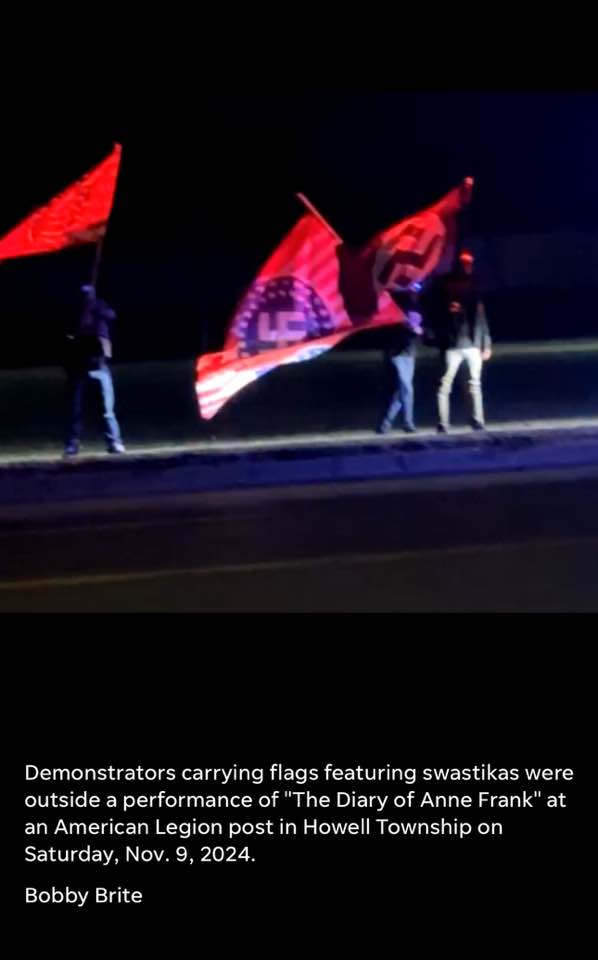
This performance was happening at—of all places—the local American Legion Post. And a few veterans were hanging around outside when some  junior Nazis, masked and waving swastika flags, showed up. They called the cops, who arrived promptly, then escorted the flag wavers across the street.

The “Constitutional” County Sheriff (the same one who hosted Trump in his parking garage on the first day of school in Howell) remarked that because the protestors were ‘peaceful’ there was no need to request their identification. They were just, you know, expressing themselves, which they had the right to do.

There have been other hate marches in the county this year. Not going to link to articles, but the same group of masked dudes with Nazi gear and Trump flags have been showing up on the regular around town, on overpasses and at outdoor events in the summer, mixing a little terror and intimidation into life in a small, generally placid, Midwestern town. Among my local teacher friends, there have been quiet on-line conversations—some colleagues have had these young men in class and recognize them.

We’re in for trouble.

It was predictable, no matter which way the election went. All the disreputable talk and threats and violence have been set loose; the election just gave them a bump. The particular young men who were being babysat by the Sherriff’s men told bystanders that they were protecting “Pureville.”  Doesn’t get more explicit than that.

And public schools, the stage on which society builds their hopes for the future, will suffer.

Nobody reading this, I’m confident, now believes that what’s been set in motion will die down quickly. To wit:

  • There is the ongoing flood of racist texts to Black students, including middle schoolers, across multiple states. These anonymous texts tell them to report to the plantation. Some of the texts address the students by name.  
  • There’s the whole “Your Body/My Choice” assault:
    Over a 24-hour period following Trump’s election, there was a 4,600% increase in the usage of the phrase “your body, my choice” on X. The phrase has made its way offline as well, with young girls and parents across the country using social media to share instances of harassment involving it.

And they are undeniably in the just-getting-started phase.

Most of what I’ve been reading in Ed World over the past two weeks have been pieces on education policy. Will Trump close the Department of Education?  What about Head Start, Title I and IDEA? Will RFK Jr. be crossing the country to destroy vaccine mandates?

In practice, both horrifying and devastating. But I’m more interested in the daily lives of schools, right now. As policies, guardrails and traditional practices fall, it will take time to vacate safety codes and equity-supporting statutes.

But right now, this week, tomorrow, I am thinking about a sea change in school cultures. What Jan Resseger describes as:
 
Fueling the racist, xenophobic, and homophobic attacks on public school curricula, teachers and school librarians, and on Black, Hispanic, gay and transgender children who are now portrayed by Trump and his MAGA crowd as dangerous or threatening.

On the first page of the introduction to Project 2025:  America under the ruling and cultural elite … children suffer the toxic normalization of transgenderism with drag queens and pornography invading their school libraries.

These are things that the chronic public school critics and disaffected students can address now: Redefining pornography. Tormenting kids who are trying to understand their own sexuality. Bringing a gun to school or taking one downtown. Terrorizing Black and brown classmates, for fun. Bringing that slut who refuses to go out with you to heel.

None of these involves changing policy or shutting down the Department of Education.

But they’re already happening.

Forget the “Undecided.” Focus on the Timid.

I read the NY Times daily (I know, I know…) and am an avid follower of their political focus groups. Little sketched heads with thumbnail descriptors (“Bill, white, Florida, 73 years old, voted Trump in 2020”) and their responses to some pretty good policy- and character-focused questions.

To which, they give answers which make me wonder just who their 9th grade Civics teachers were. Lately, the spotlight has been on “undecided” voters, nearly all of whom, IMHO, decided long ago whether to vote and which holes they’ll be punching, behind the curtain, but are anxious to be recognized and asked about their views.

I guess there’s some social cachet in being an “undecided” voter—so discriminating!– but for anyone who can name the people running for President and Congress in their state and district, this election feels like there’s been plenty of information and exposure to what the candidates represent:    The New York Times says undecided voters want more “fine print” details. Really? They’re so lightly engaged that they haven’t made up their minds yet, but they want to dive into the intricacies of tax policy? Unlikely.

In addition, the 67 million people who tuned into the debate on Tuesday got an incredibly clear picture of the candidates’ character and policy goals (or lack thereof).

Here are the people who interest me: The timid. The folks who claim to not be interested in politics. The ones who blanch at the critiquing of men too old and confused to lead the most powerful nation on the planet. Who just want to, you know, get along.

Some of these are people whose votes represent old habits, the influence of their social circles. Some of them are fearful.

Whether that’s fear of change (Will the country finally get a woman in the White House? Will a new president mean that I lose privileges I currently enjoy?)–or fear of breaking away from baked-in but no longer relevant beliefs (Republicans are pro-business and therefore better understand economics, right?), it’s hard to say.

I have written about these voters before—the ones who seem to operate from the gut, whether their gut was telling them to be angry, suspicious… or joyful.

Fact-checking engages only the most involved and informed voters. It doesn’t matter how many times you point out who wrote Project 2025, and how deeply they are enmeshed in the Trump campaign, if you got an oversized postcard from Trump (got four this week) saying he’s disavowed it, well—who are you going to trust?

This is how voters get suckered into believing literally ridiculous claims (Pets for dinner! Executing newborns!) and conspiracies.

Since President Biden’s withdrawal in July, I have joined three Facebook groups and re-activated my interest in another, all groups of women who are planning to vote for Kamala Harris. One group goes all the way back to the Womens March in 2017. Collectively, there are over half a million women reading and posting to these particular groups. And there are hundreds more of these pages, around the country.

And what gets posted and discussed—long, long discussion threads—is fascinating.

It started out with middle-aged women in pearls, blue nail polish and Chuck Taylors. The things they’ve made—hand-painted signs, KAMALA quilts, jewelry and So. Much. Blue.  It was fun to skim, and thousands of new women were joining every day, calling out their towns and looking for friends’ names.

People would post stuff like: My husband says no yard signs, so I just made this blue wreath (beautiful photo) for our front door, and a few hundred women would compliment the wreath and a handful might wonder out loud why the wreath-maker doesn’t get a vote, re: yard signs.

The tone is generally upbeat—finding each other, sharing values—but there have been many, many thoughtful threads discussing how to deal with Trump voters among your friends and family. Some of those conversations are heartbreaking; you realize how divided we have become, and why.

There’s chat about issues, including but not limited to abortion. In every thread, there is someone who says Thank God for this group. I have nobody to talk to.

This is a real thing, this political loneliness. (See,for example: The Lonely Anger of Democratic Women in North Carolina.)

It all comes down to circles of influence. Who do we talk to? Who do we believe?

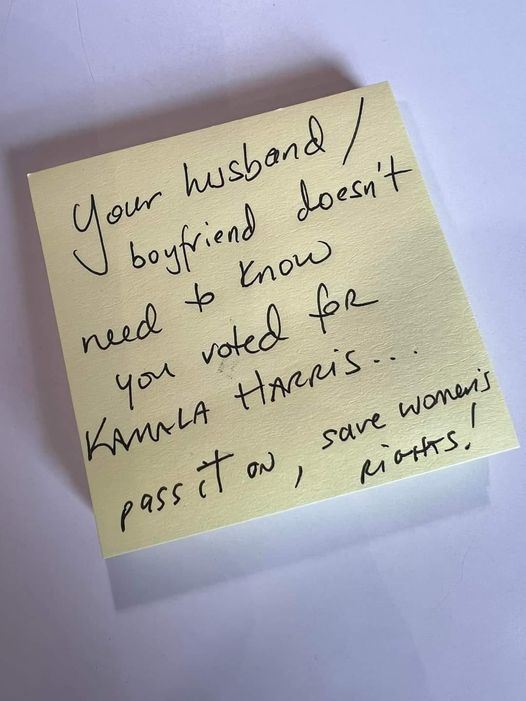
That’s why the post-it note campaign, reminding women that their vote is private, via a little fluorescent square in a public or business restroom, moved me to near-tears.

It’s easy, now, to think that my vote has always been my own, but I’ve lived through eras when women voted as their husbands told them to. My grandmother got to vote, for the first time, in 1924, at the age of 34. I asked her if she remembered who she voted for. She couldn’t, but she did remember asking her younger brother who to vote for.  And she voted for that party for the rest of her life—another 70 years!

This may be the year that women decide to take back our rights.

In the absolute privacy of the voting booth.

 Welcome to the Three-month Campaign! Seriously. Welcome.

More than four years ago, in April 2020, I wrote this ridiculously optimistic piece: A Dozen Good Things that Could (Just Maybe) Happen as a Result of this Pandemic.

Every now and then, I pull it up, shaking my head over the concept that an unprecedented global pandemic could shake loose great ideas and get folks to—tick-tock!—act on them, a kind of “if you only had six months to live…” scenario for the nation.

In my own defense, I had barely been out of the house for weeks and had been fixated on the horrifying numbers and clown-show daily ‘briefings’ from the White House. Doom-scrolling and baking aren’t conducive to embracing political realities.

I still think they were good, actionable options for change, however. Where I was totally wrong: the communal lessons that might be learned from surviving a pandemic, together. In fact, I was most wrong about the “together” part, which never really got a toehold, even as the virus took its terrible toll.

Some of us are uniters. And some are dividers. Lately, the dividers have been winning.

Response to the blog could be summarized as: I wish. People wished that the pandemic would lead to better health care, better air and water quality, renewed friendships. But they didn’t see even a global catastrophe moving the needle here in the land of the brave. The one good thing that came from the pandemic where I live? A third of my county finally got the internet.

In April of 2020, Joe Biden had just been named the presumptive nominee for President. In the previous ten months, we’d been exposed to 11 debates, with so many candidates (20) that they were sometimes split into two groups, debating on different nights. It seemed pretty clear that a full year and a half of campaigning did nobody (except perhaps the 2020 incumbent) any good.

Here’s what I wrote, in April of 2020:

How about a complete re-do of American elections?  For once, the hype is true: this election matters more than any in your lifetime. If the Democrats hang tough (and they should), we might get national mail-in voting with other policies that make registration and voting easier for the November election. Americans overwhelmingly want this.

There could be even more, given a Democratic Congress and Executive branch in the fall. We could jettison or alter the Electoral College.  We could also pass a law limiting the presidential primary, given the headaches, unnecessary spending and ultimate results we got. Canada, our closest and most similar neighbor, elected its last prime minister in eleven weeks.

Thought experiment: Imagine that Congress passed a law limiting primaries to six months, still way longer than other first-world nations, and set a national primary date with top-three, rank-order voting. That would mean campaigning for November 2020 would begin next month! Knowing what we know now about the world—would debates be about more than the horse race and which state votes first and gotcha questions? If we overturned Citizens United, and set spending limits (again, like other nations), we might ultimately get ourselves a reasonable set of qualified candidates and a fair election.

Am I glad Joe Biden eventually prevailed in 2020? Absolutely. And I agree with all the commentary about his successful presidency and heroic decision to stand down.

But I am flat-out amazed at what has happened in the past week, with so little primary-like fuss and fanfare, soundbites, rallies and pounced-on gaffes. And I can’t help wondering why we haven’t shut down the perpetual campaign machine in favor of limiting the time and money spent, given the results we get. Is this about the media and revenue streams?

I wish I had a dollar for every time someone complained about TV ads, mailings, yard signs and repellent messaging. And if I had a dollar for every voter who didn’t pay attention to politics, I’d be in the Forbes 500.

The three-month campaign ahead of us feels positively refreshing. It will be intense—it should be—but it will be over soon. Michigan voters can send in their ballots 40 days before November 5th. The end of September.

There’s been some talk about how risky the Harris candidacy is, floating the possibility of a mini-primary or reasons to re-think promoting the Vice President. But I think Rebecca Traister gets this exactly right in this column: The Case for Being Unburdened by What Has Been. The thrill of taking a huge risk on Kamala Harris.

 Our national political narrative [is] finally accurately mirroring our national reality: Everything is scary, we have never been here before, we don’t know if we can do this, and precisely because these stakes are so high, we are at last going to act like it, by taking unprecedented, untested, under-polled, creative measures to change, grow and fight at a pitch that meets the gravity of the urgent, existentially important task in front of us.

The word I like most here is “urgent.”  Things can go wrong with a long, leisurely primary season where a party eventually settles on just the right candidate. (See: 2016.) They’ve gone wrong in any number of elections, convention or primary, over two centuries plus. Sometimes, making a good-faith choice and jumping off the electoral cliff works out.

In the meantime, listen to Keb Mo. He’s got the right idea.

Political Messaging, Schools and Republicans

I just finished Rachel Bitecofer’s feisty, punchy book on political messaging, “Hit ‘Em Where it Hurts: How to Save Democracy by Beating Republicans at Their Own Game.”

Recommended—although not, as the subtitle suggests, to beat Republicans at their own despicable, even shocking, game. Recommended because we’re in crisis, and being smarter and nicer is no longer cutting it.

In December of 2020, I wrote a blog entitled Republicans. Up until that point, in my political perspective, there were country-club Republicans who were conservative, in the traditional sense of keeping things that preserved beneficial aspects of their lives in place. And there were the rabid right-wing crazies who emerged like locusts after Barack Obama was elected. But the two were merging, and the outlook for keeping two distinct parties that counterbalanced each other’s policy goals, for the good of the nation, was dim. The Republicans were ruining democracy. On purpose.

I took some grief for that blog, from die-hard moderate Republicans (who are thick on the ground where I live and work), and also from some Democrat friends who thought it took me way too long to outright reject and stomp on anyone who voted Republican in the past two decades.

From the standpoint of March 2024, and Rachel Bitecofer’s crisp and direct prescriptions for saving democracy, however, my hardcore Dems friends were right: You don’t get anywhere with a mushy message, a bunch of facts, and reaching across the aisle. And you can’t share those great policy ideas unless you can get elected.

I blame my 32-year career as a public-school teacher for this habit of equivocating and looking for points of agreement. I spent most of my time trying to reduce conflict, banish name-calling, find common ground, and build functioning communities in my middle school classroom.

So many communities. I was partially successful at this, more so toward the end of my career. If kids don’t get along, after all, they can’t make music together. This is the single most important reason I stopped having chairs and challenges, and tried to avoid unnecessary competition. Teachers everywhere want their students to be able to work together despite differences. It’s what we do.

Bitecofer’s take on political messaging is that Republicans have zero interest in working together to solve problems. They just want to retain power. It’s time for Democrats to boldly claim the high moral ground, she says, rather than using data and reason to present their detailed policy plans, no matter how forward-thinking and appealing they may be to Democrats.

We’re getting beat up, she says, by sophistry. Time to call a lie a lie. To fight back. To take back the word freedom, for starters. We are clearly the party that supports freedom, around the globe, and here at home. Why aren’t we claiming that? The losses that we are suffering now—reproductive freedom, the freedom to vote, the freedom to breathe clean air—have not come from Democratic actions.

She points out that education has generally been seen as a Democratic issue, back to the Elementary and Secondary Education Act in the 1960s (along with minority rights, infrastructure and health care), but the 2021 Gubernatorial election in Virginia turned that around—with a big fat passel of lies about what was happening in public schools.

You remember— charges that teachers were making white kids feel guilty via CRT, encouraging transgenderism and putting out kitty litter for the furries. The kinds of things Dems responded to by politely explaining that critical race theory was an advanced concept, first introduced by Kimberle’ Crenshaw, interrogating the socially constructed role of race and institutionalized racism in society, yada yada.

All true. But completely overridden by the Republicans’ simple, dishonest message: Schools are taking away parents’ rights! (Even though parents have always had rights.) Bitecofer, lurking in the background, would say: Don’t bring reality and truth to a Republican messaging war, because Republicans trust feelings, not facts.

Democrats have, for decades, rallied around more resources and equity for public education. They have gone to schools and registered newly minted 18-year-old voters. They have defended the wall between church and state, pushed back hard against vouchers for the wealthy. Time to claim credit.

America is a uniquely apolitical country, Bitecofer says, with little civic culture. This benefits Republicans, who count on people to vote out of old partisan habits, not new information.

Occasionally, someone will claim that more or better Civics classes would improve engagement in electoral politics in the United States. I seriously doubt that, especially since the things that make the study of Civics engaging and sticky are precisely the things that Ron DeSantis is passing laws against. Kids learn to be good citizens by watching adults—a statement worth pondering, in this election year.

Pick up Bitecofer’s book—it’s a short, easy to digest read. Then pull on your metaphorical boxing gloves.